
The Intrepid Battlefield Exoskeleton has progressed from laboratory testing to a simulated mass-casualty field evaluation as a possible mobility aid for service members with lower-leg fractures. The passive device is designed to stabilise and offload an injured limb while allowing the wearer to move independently, but researchers concluded that the latest prototype is not yet ready for field deployment.
At a glance
- Device
- Intrepid Battlefield Exoskeleton, or IBEX
- Type
- Passive fracture-stabilising and load-redirecting lower-limb exoskeleton
- Laboratory test
- 20 participants completed medic and casualty conditions
- Field test
- 12 participants used the Mark II during a simulated mass-casualty event
- Mark II mass
- 2.95 kilograms, with a packed volume of 22.5 litres
IBEX targets the gap between a splint and a mobility exoskeleton
A conventional splint can stabilise a lower-leg fracture, but it generally leaves the casualty unable to walk. Existing mobility exoskeletons can support standing or locomotion, but they are not designed to stabilise an acute tibia or fibula fracture and may be unsuitable for use in mud, sand, snow or combat conditions.
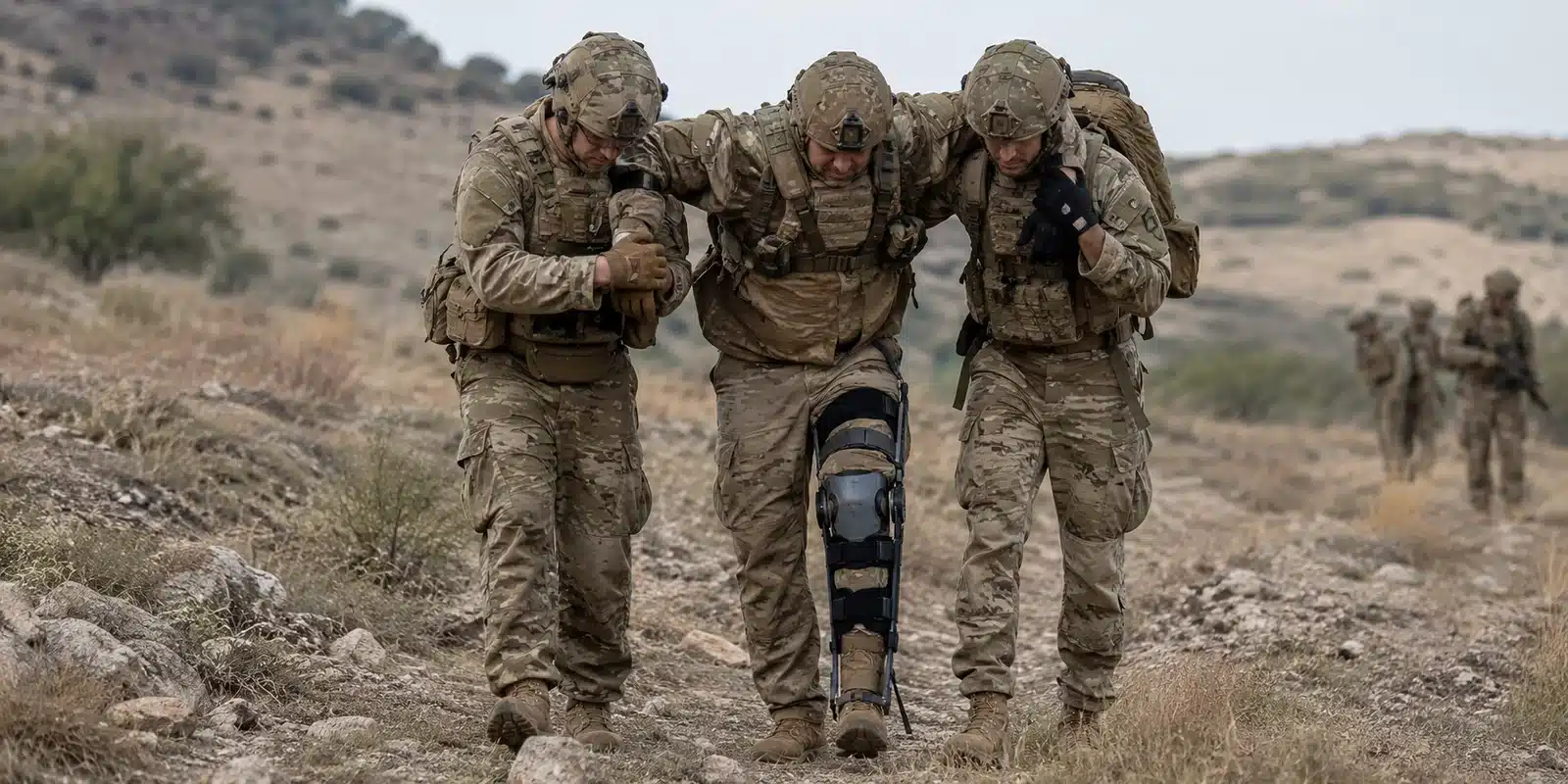
IBEX was developed to combine both functions. The passive system uses an external frame and an offloading structure to redirect ground-reaction forces around the injured leg. A splinting component stabilises the fracture while the frame carries body weight.
According to the research paper, the system is intended to fit approximately 90% of the U.S. Army population, can be configured for either leg and weighs roughly three kilograms. The proposed use case is prolonged field care, where evacuation is delayed and a wounded service member would otherwise need to be carried.
The operational impact could extend beyond the casualty. The study notes that litter evacuation can divert four to six personnel to carry the patient and up to five more for security. Restoring even limited independent mobility could therefore reduce the number of people exposed during an evacuation and preserve more of the unit’s capacity.
Testing exposed problems that were less visible in the laboratory
The research programme evaluated two successive prototypes. Twenty able-bodied participants tested the Mark I in a laboratory, each taking the role of both medic and casualty. They completed functional and military-specific tasks while wearing standard equipment and provided usability and satisfaction feedback.
That feedback led to a Mark II with added padding, a more secure pelvic suspension system, a custom titanium knee, left-or-right configuration and a lighter carbon-fibre terminal device. The revised knee allowed the frame to fold more completely for transport.
Twelve participants then used the Mark II during a simulated mass-casualty event. The field setting included longer distances, uneven terrain, distracting sounds and pressure to complete tasks quickly. Those conditions produced lower usability and satisfaction scores than the controlled laboratory test, despite the mechanical improvements.
Weight was the clearest area where the Mark II scored better. Other changes were not consistently reflected in the ratings. Participants and medics continued to identify fitting, strap adjustment, comfort, security and ease of use as areas needing improvement.
Why it matters
IBEX is not a strength-augmentation suit. It is closer to a deployable trauma-management device that uses exoskeleton principles. That makes it an important example of how wearable robotics can move beyond performance enhancement into emergency mobility and prolonged care.
The study is also valuable because it reports a negative development lesson clearly: a prototype that appears good or excellent in the laboratory may fall to moderate usability in a realistic field scenario. The difference came from terrain, time pressure, complexity and the needs of both the medic applying the device and the casualty wearing it.
The current prototype is not ready for operational deployment
The researchers concluded that the Mark II still needs refinement, particularly in adjustability and ease of fitting. Applying a device to an injured person in a high-stress environment is very different from fitting a healthy participant in a laboratory. Straps and telescoping elements must remain understandable when users are working quickly, wearing gloves or dealing with mud and poor visibility.
The published testing used able-bodied participants and simulated injuries. The system therefore has not yet demonstrated safe independent mobility in people with acute open fractures, severe pain, blood loss or associated injuries. Future comparisons with the current standard of care will be necessary before the device’s clinical or operational value can be established.
What remains uncertain
IBEX has reached a meaningful usability-testing stage, but it is not a deployed military capability. Future work must address fitting speed, fracture stability, safety in actual casualties, mobility across terrain, durability, integration with medical protocols and whether self-mobility improves outcomes compared with splinting and litter evacuation.
Sources
- Ciera A. Price and colleagues, Battlefield exoskeleton usability for lower-limb trauma in prolonged field care: A mixed-methods approach, Wearable Technologies, 2026. DOI: 10.1017/wtc.2025.10036
- Cambridge University Press, full open-access research article. Read the study
- Military Times, Army develops exoskeleton for lower-limb injuries on the battlefield, May 29, 2026. Read the reporting