
Researchers at Northwestern University and Shirley Ryan AbilityLab have tested a rehabilitation system that physically links a therapist and a stroke survivor through two lower-limb exoskeletons. In an early within-subject study involving eight people with chronic stroke, the therapist-exoskeleton-patient interaction system produced greater joint range of motion and longer, higher steps than conventional therapist-guided treadmill mobilisation.
At a glance
- System
- Therapist-exoskeleton-patient interaction, or TEPI
- Published
- Science Robotics, June 17, 2026
- Participants
- Eight people with chronic stroke
- Study design
- Within-subject comparison with conventional therapist-guided treadmill mobilisation
- Main result
- Greater joint range of motion, step length and step height, with similar muscle activation
A therapist and patient move through a virtual mechanical connection
Conventional gait rehabilitation depends heavily on the skill of physical therapists. A therapist can support a patient, resist a movement, correct timing and adjust guidance continuously. The difficulty is that manual assistance is physically demanding and a therapist can only control a limited number of joints at the same time.
Robotic exoskeletons can provide repeated multijoint assistance and collect objective movement data, but many systems rely on predefined trajectories or automated control strategies that reduce the therapist’s direct involvement. The TEPI approach attempts to keep the therapist inside the control loop.
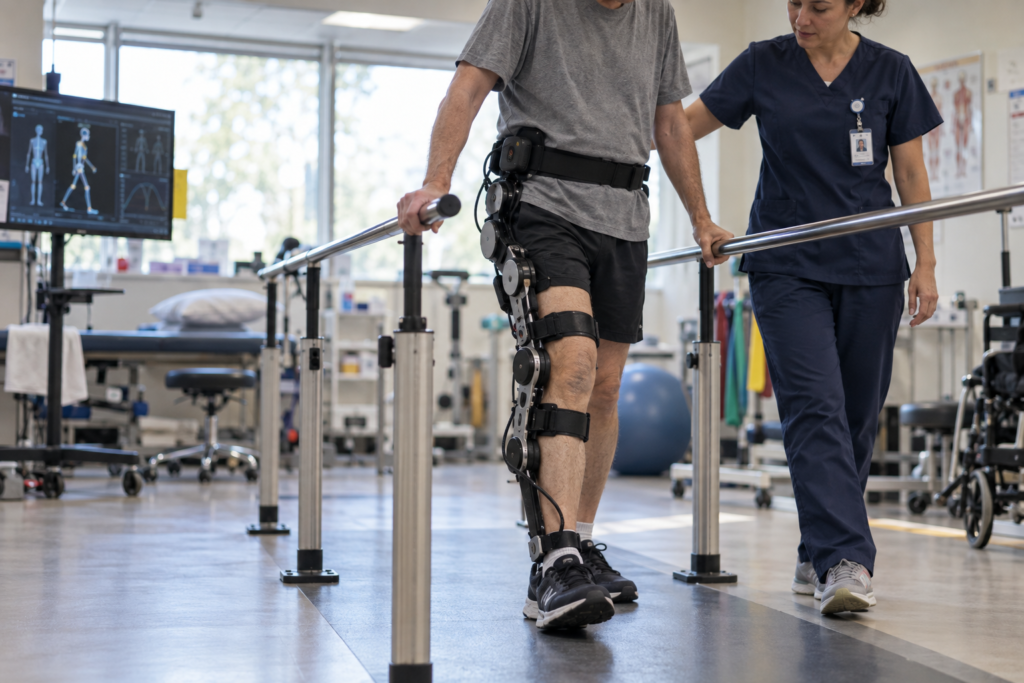
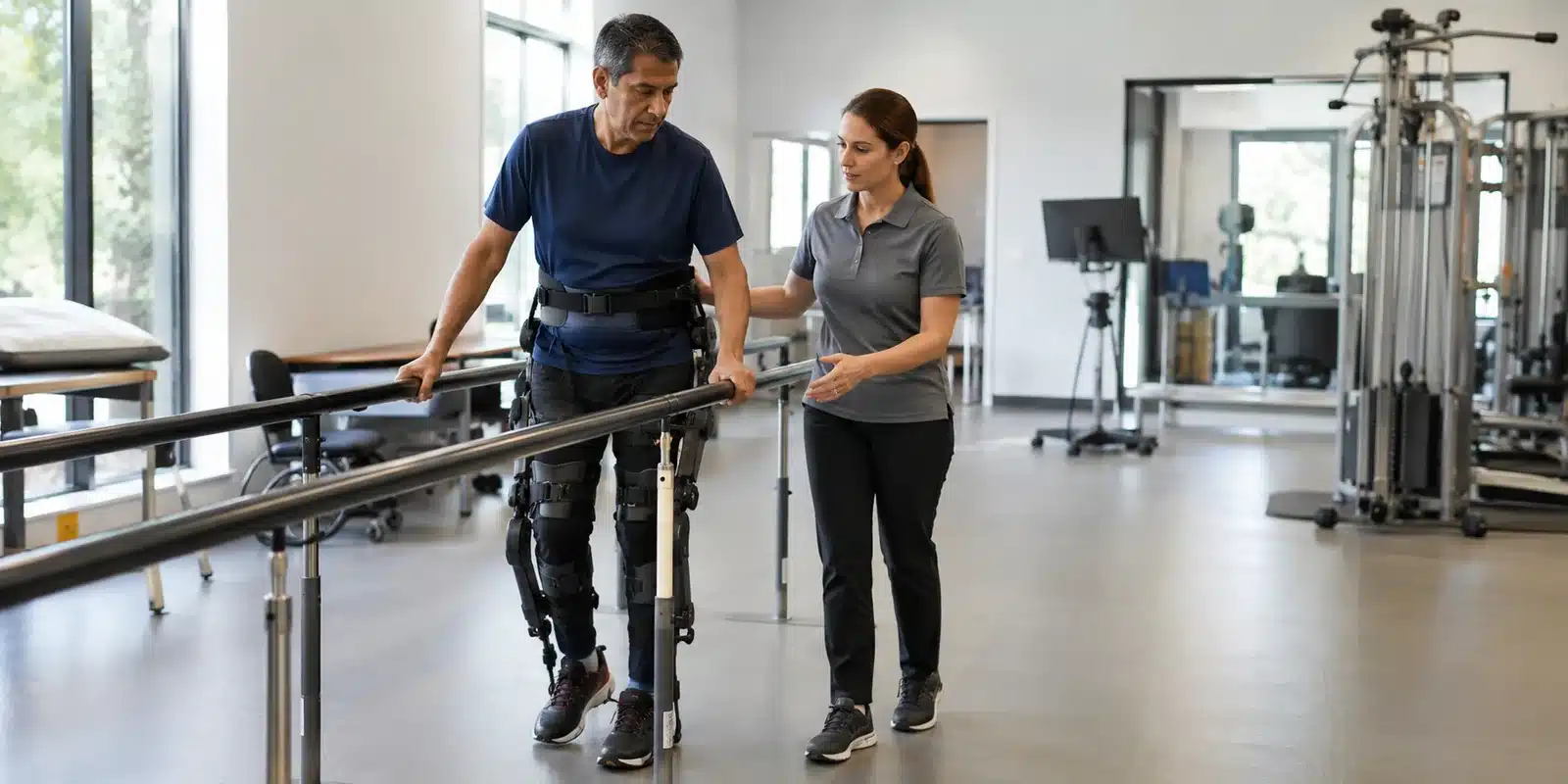
During TEPI training, the therapist and patient each wear a lower-limb exoskeleton. Their hip and knee joints are virtually connected using software-defined spring and damper elements. When the therapist moves, forces are transmitted through the robotic connection to guide the patient. The therapist also receives real-time haptic feedback from the patient’s movement.
The connection is therefore bidirectional. It is not simply a therapist pressing a button to select a robot programme. The therapist uses their own legs to demonstrate, assist or resist movement while feeling how the patient responds.
The study found improvements in several immediate gait measures
The researchers evaluated TEPI in eight participants with chronic stroke using a within-subject design. Each participant completed treadmill training with TEPI and with conventional therapist-guided mobilisation, allowing the investigators to compare the two approaches within the same individuals.
Compared with conventional training, TEPI produced greater movement at the lower-limb joints and increased step length and step height. Muscle activation remained broadly similar, suggesting that the larger movements were not achieved simply by making the robotic system perform the task for the patient. Participants also reported high motivation and enjoyment.
The results are relevant because gait after stroke is not only a question of moving the leg forward. Weakness and loss of independent joint control can affect the hip, knee and ankle at the same time. A system that allows a therapist to coordinate guidance across several joints could support more comprehensive training than hands-on assistance focused on one part of the gait cycle.
Why it matters
TEPI represents a different direction for rehabilitation robotics. Instead of trying to replace the therapist with an autonomous controller, it uses robotics to extend the therapist’s physical reach. That could preserve clinical judgement while reducing the physical burden of repeatedly supporting a patient’s body.
The same architecture could eventually be applied to stair climbing, sit-to-stand movements, overground walking or remote rehabilitation. It may also generate valuable data on how experienced therapists adapt their assistance from one step to the next, which could later inform more responsive control systems.
The research does not yet show a lasting rehabilitation benefit
This was an early evaluation with only eight participants. The reported outcomes describe performance during the tested training conditions. They do not establish that TEPI produces better long-term walking recovery, reduces disability or outperforms established therapy over a full rehabilitation programme.
The setup is also technically demanding because it requires two lower-limb exoskeletons and a reliable real-time connection between them. Before the approach could become routine clinical practice, researchers would need to evaluate setup time, therapist training, safety, patient selection, cost and whether the benefit justifies the additional equipment.
What comes next
The research team plans to test the framework during overground walking, stair climbing and sit-to-stand transitions, and across multiple sessions. Work is also planned on more accessible systems that could extend therapist-guided rehabilitation into the home or support remote care. Those studies will be important because the current evidence is promising but preliminary.
Sources
- Emek Barış Küçüktabak and colleagues, Therapist-exoskeleton-patient interaction for gait therapy, Science Robotics, 2026. DOI: 10.1126/scirobotics.adz9628
- Northwestern University, Robotic exoskeleton could redefine how stroke survivors relearn to walk, June 17, 2026. Read the institutional release
- Shirley Ryan AbilityLab, First-of-Its-Kind Exoskeleton Therapy Could Redefine How Stroke Survivors Relearn to Walk, June 16, 2026. Read the clinical research summary