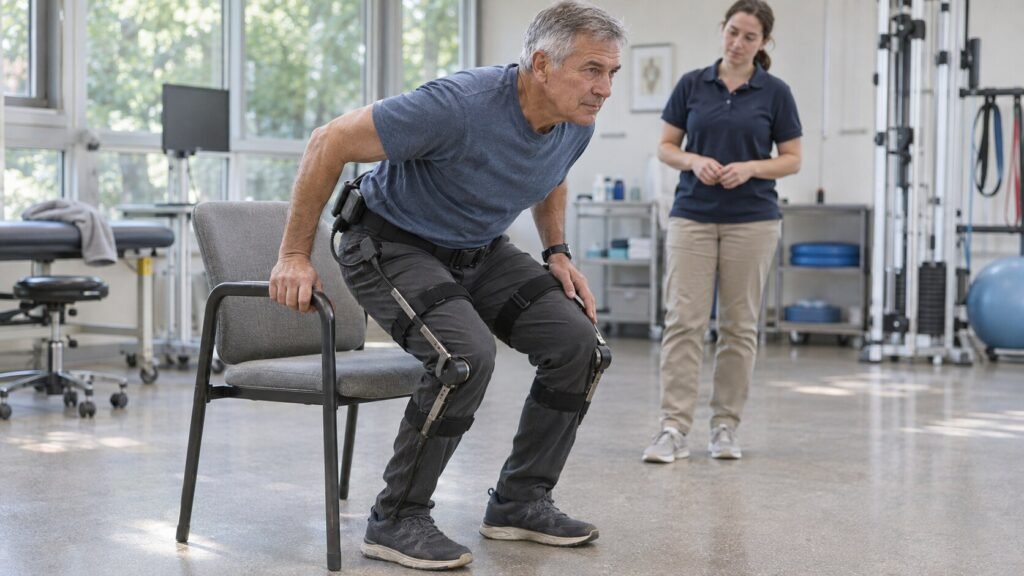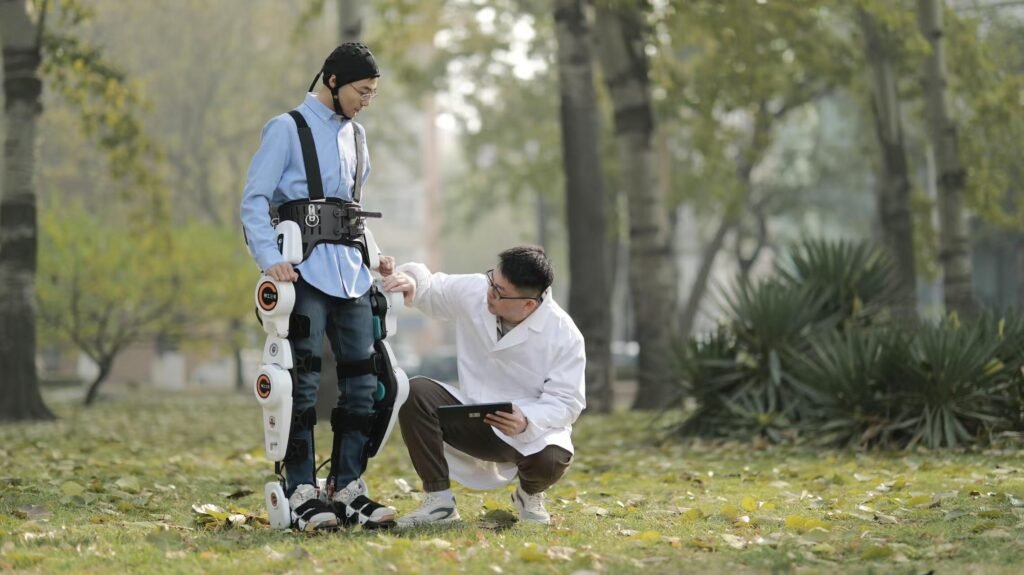

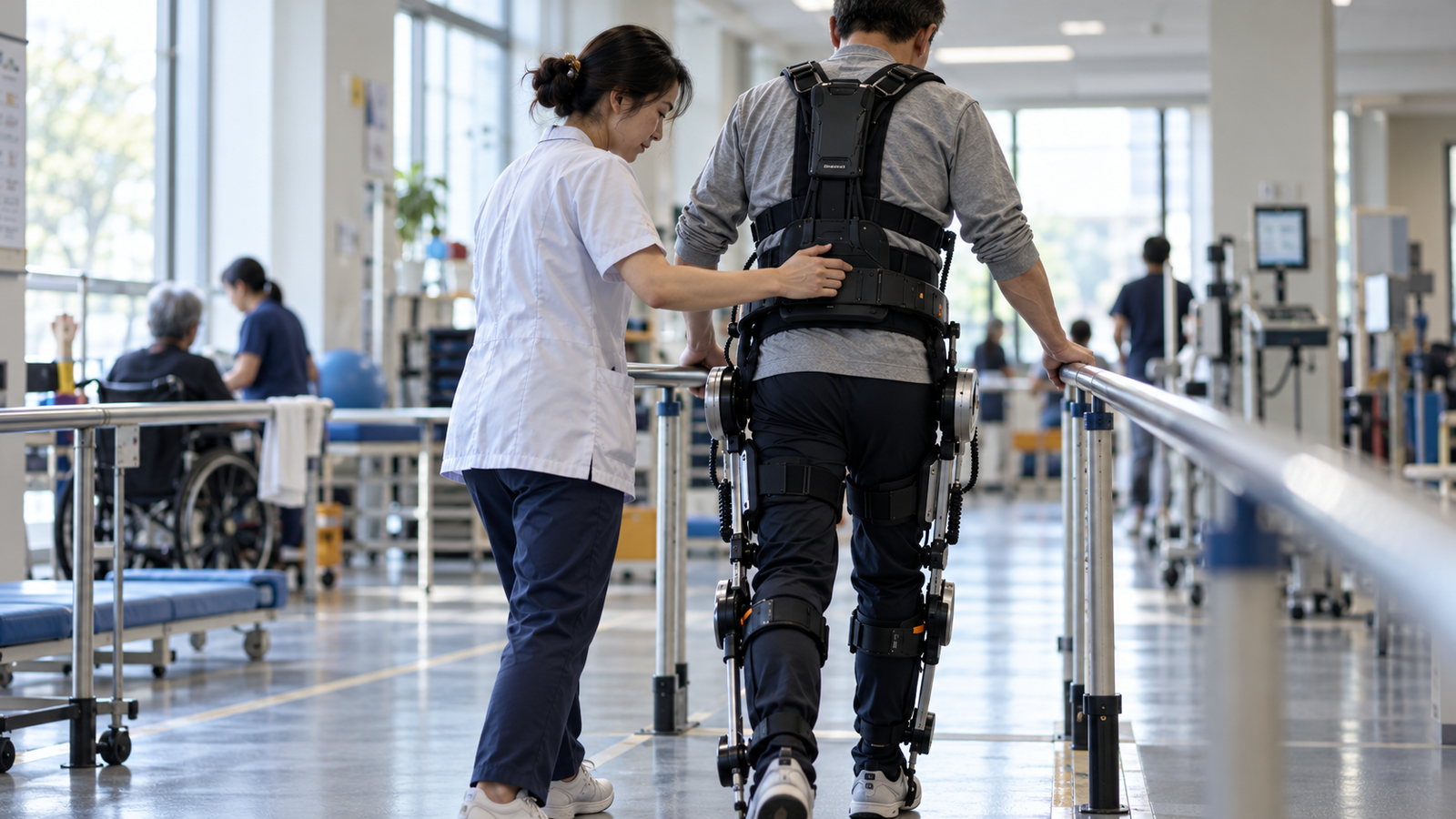
What 14 randomized trials actually found
The researchers searched five databases, including the China National Knowledge Infrastructure, through 26 February 2026. Their final analysis included studies conducted across several countries and multiple exoskeleton or robot-assisted training configurations.
Compared with control rehabilitation, pooled outcomes favored the exoskeleton-assisted groups on the Functional Ambulation Category (walking independence), Berg Balance Scale and Fugl–Meyer Assessment of the Lower Extremity. The authors rated the certainty of evidence for these three outcomes as moderate.
The total sample covers the review as a whole. Each outcome analysis included only the trials that reported that measure.
The pooled between-group estimates were +0.39 points for walking independence on the FAC, +1.66 points for balance on the BBS and +2.40 points on the lower-limb Fugl–Meyer scale. These are differences in specific clinical scores, not percentage improvements or proof that all individuals benefited.
Why the everyday-life results matter
The review found a favorable pooled six-minute walking-distance difference of 19.83 meters, but the authors rated certainty as low and the prediction interval included the possibility of no benefit in a new setting. The result is therefore encouraging, rather than a guaranteed expectation for a clinic selecting a device.
For walking speed on the 10-Meter Walk Test, Timed Up and Go, the Rivermead Mobility Index and modified Barthel activities-of-daily-living scores, the review did not find statistically significant pooled between-group differences. That is not evidence that the devices are ineffective. It means this particular evidence synthesis could not establish an advantage on those outcomes.
A favorable pooled difference on the Functional Ambulation Category, which captures assistance requirements.
Positive pooled estimates for the Berg Balance Scale and lower-limb Fugl–Meyer Assessment.
Evidence remained uncertain for speed, complex mobility and activities of daily living; the studies differed in important ways.
These are not interchangeable devices or protocols
The included studies differed in exoskeleton architecture, overground versus treadmill or platform-based training, level of external support, assistance strategy, therapy dose and comparison intervention. Many individual trials were small, and participant and therapist blinding was often not feasible.
The authors used a conservative random-effects approach and examined prediction intervals where possible. Those intervals crossed the null for many outcomes, indicating that effects in a different patient group or clinical setting may not match the pooled average.
Exoskeleton Index analysis
The most useful finding is the pattern, not one impressive score. The evidence is becoming more consistent for selected measures of walking independence, balance and lower-limb motor function. It is less settled when the question moves to walking speed, complex tasks or independence in everyday activities.
For hospitals and manufacturers, that makes outcome selection critical. A study built around a particular impairment score cannot automatically substantiate a broader claim about independent community mobility or reduced care requirements.
This analysis also does not identify a winning exoskeleton or training protocol. The technology, dose, patient population and comparator all remain relevant to clinical interpretation. EI has previously covered an individual randomized stroke pilot; the new review helps place such single-study results in a wider, more cautious evidence base.
What better trials need to answer
Longer follow-up, clearer reporting of training dose, baseline walking ability and device architecture would help explain who responds, under what conditions and for how long. Future trials also need to measure outcomes that matter outside a gait laboratory, including meaningful functional mobility and activities of daily living.
Readers evaluating clinical systems can explore EI’s Healthcare & Rehabilitation section, while keeping in mind that this meta-analysis reports category-level evidence rather than device-specific efficacy.
What this review does not establish
It does not demonstrate that every stroke survivor will benefit, that one named product outperforms another, or that favorable clinical scores necessarily translate into independent daily living. The absence of statistically significant pooled differences on some measures is not proof of equivalence or lack of effect.
Sources and reporting notes
Primary peer-reviewed source, 16 October 2026. Zhang Z. et al., “Effects of wearable lower-limb robotic exoskeleton–assisted gait training on balance, walking, and activities of daily living after stroke”, Frontiers in Neurology. DOI: 10.3389/fneur.2026.1818981.
Methods note. Fourteen RCTs were pooled; trial populations, training environments and comparator rehabilitation varied. The reported 565 participants are the total across included trials, not the sample for every outcome.
Editorial note. Reported mean differences are in their original clinical-scale units. Findings are not interpreted as proof of superiority for an individual commercial exoskeleton.