
A research team in China has demonstrated a lightweight hip exosuit that replaces conventional motors and pneumatic hardware with bundles of dielectric-elastomer artificial muscle. In treadmill testing with six healthy participants, the active suit reduced the metabolic energy required for walking by an average of 13.9% compared with walking without assistance. The result is technically significant, but the prototype remains an early laboratory system and the phrase “motor-free” should not be confused with “unpowered.”
At a glance
- Study
- Motor-free hip exosuit via high-output fibrous dielectric elastomer actuators
- Published
- Science Advances, July 10, 2026
- Participants
- Six healthy volunteers in treadmill testing
- Main result
- 13.9% average reduction in walking energy use during active assistance
- Important limitation
- The artificial muscles still require electrical power and operating voltages above 1,000 volts
Artificial muscles replaced the conventional motor
Most powered walking exosuits use electric motors, gearboxes, cables or pneumatic actuators to generate assistance. Those components can add mass, noise and rigid structures that work against the purpose of a soft wearable system. The new prototype, developed by researchers led by Wei Yu at Hebei University of Technology, uses dielectric elastomer actuators instead.
Dielectric elastomers are flexible polymer materials that change shape when an electric field is applied. The research team developed a highly polar rubber-like material and rolled thin films into long fibres. According to the published reporting, individual fibres could be made as thin as roughly 850 micrometres and as long as 250 millimetres. A fibre measuring 1.95 millimetres across lifted more than 400 grams, more than 1,300 times its own mass.
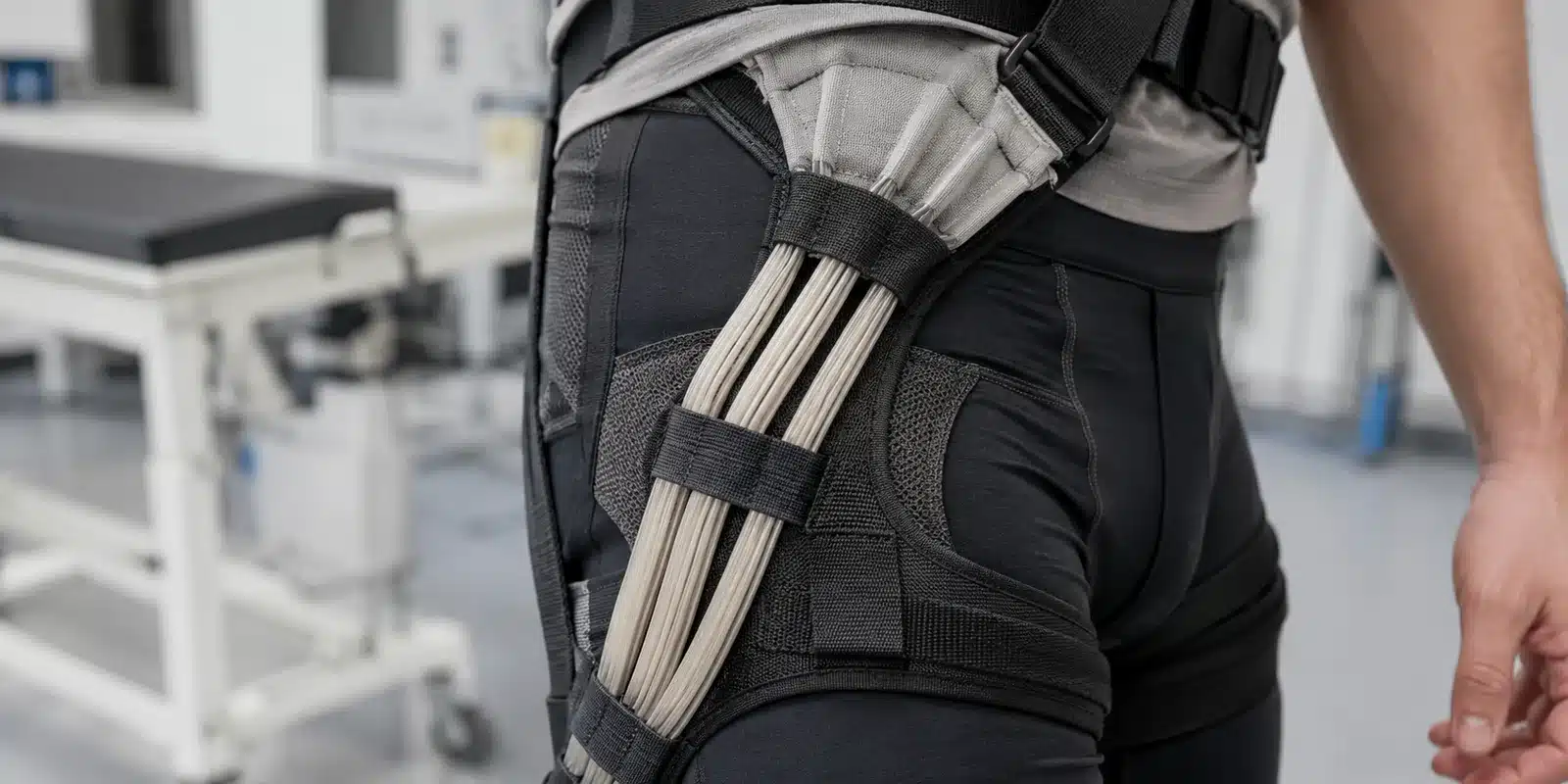
The researchers then assembled the fibres into modular bundles. Two ten-fibre bundles, together weighing about six grams, were incorporated into a hip-assistive exosuit. During walking, the electrically activated fibres lengthen and store elastic energy as the leg extends. That energy is then released to assist the next phase of the step.
The early metabolic result is stronger than the device’s size suggests
The system was tested on six healthy volunteers walking on a treadmill at four kilometres per hour. The study compared active assistance, a passive condition with the suit worn but not electrically assisting, and walking without the suit. Oxygen consumption and muscle activity were monitored to estimate how hard the participants were working.
With the artificial muscles active, average metabolic expenditure was 13.9% lower than during unassisted walking. That places the result among the stronger early demonstrations reported for hip-assistive soft exosuits, particularly given the very low mass of the actuator bundles.
The number should still be interpreted carefully. It comes from six healthy participants in a controlled treadmill experiment, not from older adults, patients with mobility impairment or workers completing a full shift. A reduction measured at one speed does not establish performance on stairs, slopes, uneven terrain or during changes in pace.
Why it matters
The main advance is not simply the 13.9% figure. It is the possibility of producing useful wearable assistance without the usual motor and transmission assembly. If dielectric-elastomer bundles can be made durable, controllable and safe enough for repeated use, designers could build softer and lighter systems that conform more closely to the body.
This could be relevant to personal mobility, rehabilitation and occupational assistance, where users often reject devices because of bulk, noise or movement restriction. The work also illustrates a broader shift in wearable robotics from rigid machines worn on the body toward textile systems whose actuators behave more like biological muscle.
“Motor-free” does not mean passive or electricity-free
The most important editorial clarification is that this is still an actively powered exosuit. The system avoids conventional rotating motors, but its artificial muscles require an electrical field and a battery-powered control system. Dielectric elastomer actuators commonly operate above 1,000 volts. The electrical current can be low, but voltage, insulation, durability and fault protection remain major engineering considerations for a body-worn device.
The research team also identified practical limitations. Battery life restricts the duration of assistance, the current controller does not yet adapt to different walking speeds or terrain, and long-term stability needs to be tested under sweat, repeated loading and temperature variation. These are not minor implementation details. They will determine whether the material can move from an impressive actuator demonstration to a reliable wearable product.
What remains uncertain
The study establishes proof of concept, not clinical or commercial readiness. Larger trials are needed, including users with impaired mobility. Future work must also report durability over many cycles, electrical safety, battery duration, control across changing gait conditions and the total mass of the complete wearable system rather than only the actuator bundles.
Sources
- Ziqi Zhang and colleagues, Motor-free hip exosuit via high-output fibrous dielectric elastomer actuators, Science Advances, 2026. DOI: 10.1126/sciadv.aec6917
- IEEE Spectrum, Exosuit Aids Walking Without Motors, July 20, 2026. Read the technical report
- Tech Xplore, Soft exosuit shows motor-free path to wearable walking assistance, July 21, 2026. Read the research summary