
Lotte Global Logistics and FRT Robotics have agreed to develop and commercialise wearable robots for logistics work, while Lotte Hi-Mart plans testing for appliance delivery and installation. The announcement describes development and validation goals rather than a completed rollout.
At a glance
- Parties: Lotte Global Logistics and Korean wearable-robot company FRT Robotics.
- Status: Development and commercialisation partnership under Lotte’s AX Sprint programme; not a completed fleet deployment.
- Planned work: Collect movement and task data, improve control, and demonstrate systems in logistics operations.
- Related test: Lotte Hi-Mart appliance delivery and installation is identified as a planned validation setting.
- Unknowns: Device model, worker count, duration, sites, commercial terms and outcome measures were not publicly specified.
What Lotte and FRT announced
Lotte Global Logistics and FRT Robotics signed a partnership to jointly develop and commercialise wearable robots for logistics, according to Korean business reporting on 30 July 2026. The project was selected in March through Lotte’s AX Sprint programme, an initiative intended to connect group companies with external technology firms.
The parties said they plan to collect movement and task data in real logistics environments, refine control technology and conduct demonstrations. Lotte Hi-Mart’s appliance delivery and installation work is presented as one proposed test context. That distinction is important: Lotte Global Logistics is the logistics partner, while Lotte Hi-Mart is the consumer-electronics retailer whose delivery operations may provide a demanding validation case.
The announcement is best classified as a development partnership with planned field validation. It is not evidence that wearable robots have completed a pilot, entered routine use or achieved commercial scale across Lotte operations.
Why appliance handling is relevant
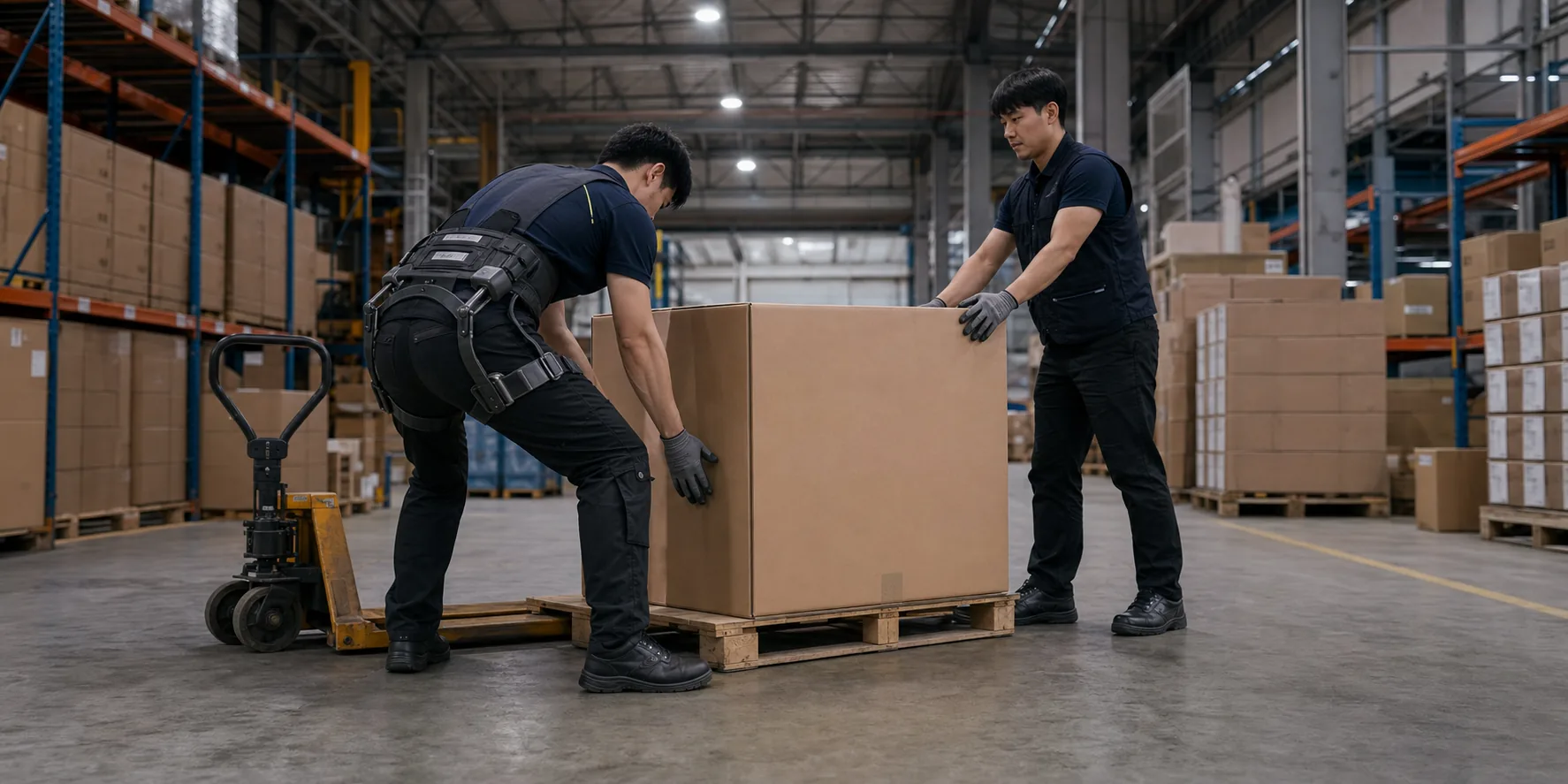
Large appliances create a difficult mix of mass, bulk, constrained grip and residential access. Delivery crews may move between a truck, loading bay, stairs, lifts, corridors and customer homes. Installation can add kneeling, reaching, fine manipulation and work in tight spaces. A back-support device that helps during a controlled warehouse lift may obstruct another phase or be removed before the most difficult access task.
A credible test must therefore map the complete work cycle. It should distinguish the time a device is available, worn, actively assisting, removed and unavailable. It should also record two-person coordination, stair policy, vehicle seating, heat, contact pressure, donning time, cleaning and any interaction with lifting straps or dollies.
What is known about FRT Robotics
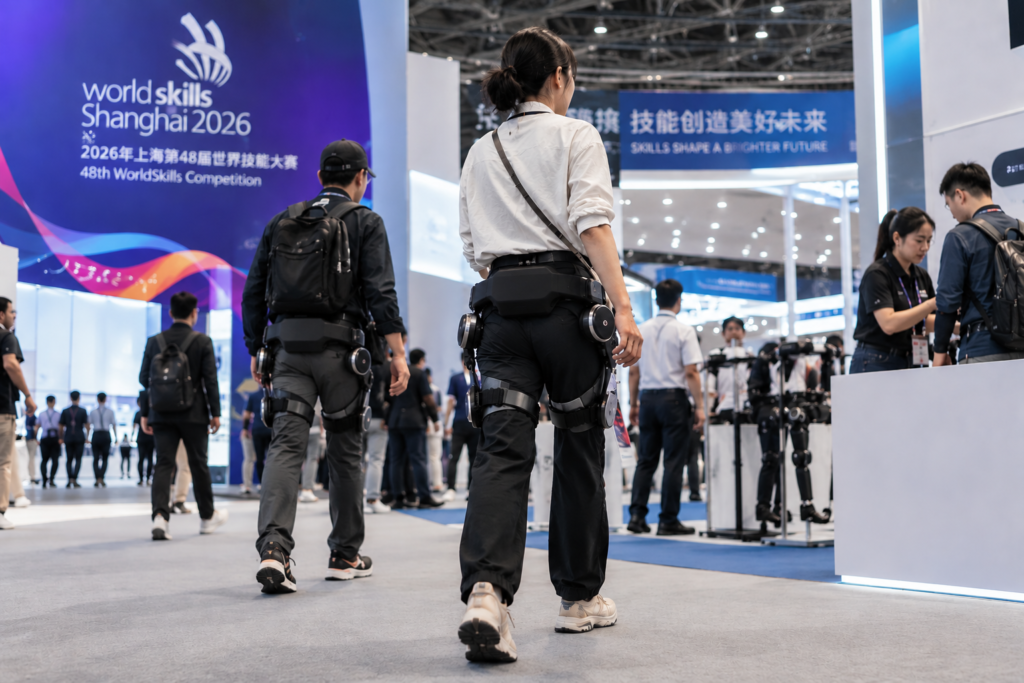
FRT Robotics, also known through its Field Robot Technology name, develops StepUp industrial wearable robots. The company displayed StepUp NEO at Korea MAT 2026. However, the partnership reports reviewed for this article do not identify a specific product configuration for the Lotte work. Assigning StepUp NEO or another model to the test would therefore be speculative.
The public language also uses “AI wearable robot.” That phrase does not reveal the technical method. The planned collection of movement and task data suggests that control adaptation and process analysis are part of the programme, but no public documentation reviewed here defines the model, sensors, training data, validation method or safety boundary. Until those are disclosed, “AI” should be read as a programme label rather than a verified performance characteristic.
Exoskeleton Index analysis
The partnership is commercially relevant because it joins a logistics operator with a domestic wearable-robot developer and names a concrete delivery setting. Its value today is as a signal of structured co-development. It should not be mistaken for proof that a device improves safety, productivity or retention.
The most informative next step would be a preregistered task-level pilot plan. Useful measures include eligible and fitted workers, actual wearing time, non-use reasons, discomfort, device faults, time effects, handling quality, near misses and service burden. Any throughput comparison must control for route, load mix, team composition and learning.
Evidence from logistics field studies
Recent logistics research shows why demonstration and adoption are separate questions. A 24-week randomized trial among 20 order-picking workers retained a measurable reduction in back-muscle activity, but three participants in the intervention group stopped using the device. A 146-worker study of an active back exosuit found positive short-session usability and strong intention-to-use results; it did not establish long-term adherence or injury prevention.
Extended automotive-logistics interviews have also found that compatibility, comfort, heat and adaptation time influence continued use. These findings do not predict the Lotte result, but they identify the implementation data a serious buyer should request. The Exoskeleton Index back-support buyer’s guide and pilot planning playbook provide a framework for that evaluation.
Commercialisation needs more than a successful demo
Moving from co-development to a repeatable service will require a defined product configuration, fit process, training, maintenance, cleaning, data governance and support response. Appliance delivery adds route variability and customer premises, so a system validated in a warehouse cannot simply be assumed to work at the doorstep. Lotte and FRT will also need to state who controls collected worker data and whether algorithms or assistance settings change during the evaluation.
What remains unknown
No public source reviewed here names the exact FRT device, number of workers, test duration, sites, start date, commercial volumes or success criteria. “Develop and commercialise” is an objective, not evidence of a sale or rollout. Planned Lotte Hi-Mart testing should not be described as completed operational deployment.
Sources
- Seoul Economic Daily, Lotte Global Logistics and FRT partnership report, 30 July 2026.
- ChosunBiz, independent partnership report, 30 July 2026.
- FRT Robotics, company and product information.
- Jakobsen et al., 24-week logistics field trial, Applied Ergonomics (2025).
- Hess et al., active back-exosuit warehouse study, Applied Ergonomics (2025).