
Bioservo says 100 U.S. veterans have now been fitted with its Carbonhand grip-assistance glove through the Department of Veterans Affairs healthcare system, with prescribing clinicians across more than 40 VA Medical Centers. The milestone is modest in absolute volume, but it shows how a wearable robotic device can move from individual prescriptions into a repeatable national healthcare access pathway.
- Product
- Carbonhand
- Company
- Bioservo
- Reported milestone
- 100 U.S. veterans fitted through the VA healthcare system
- Clinical reach
- More than 40 VA Medical Centers prescribing the device, according to Bioservo
- Previous milestone
- More than 50 veterans reported by Bioservo in November 2025
- U.S. access route
- Prescription through VA care; Carbonhand has been available through the VA Federal Supply Schedule since October 2024
- Technology
- Motor-driven soft active hand orthosis that senses grip intent and adds grasp force
- Evidence status
- User and site counts are company-reported. The announcement does not provide a comparative clinical outcome dataset.
From the first U.S. veteran prescription to 100 fitted users
Carbonhand reached its first U.S. veteran prescription in February 2024. Later that year, the device was added to the Department of Veterans Affairs Federal Supply Schedule through Bioservo’s partner Affirmative Solutions, giving VA facilities a formal federal procurement route.
By November 2025, Bioservo said more than 50 veterans had received Carbonhand. The company’s latest update now puts that figure at 100 and says clinicians at more than 40 VA Medical Centers are prescribing the system.
The progression is important because it is not simply a distributor signing or a product being listed in a catalogue. It shows repeated prescriptions across multiple facilities inside the largest integrated healthcare system in the United States.
Bioservo says participating VA locations include facilities in California, Texas, Florida, Virginia and Washington, D.C. Its U.S. prescribing page lists a growing number of individual VA sites that have provided one or more Carbonhand systems.
Carbonhand is an assistive device, not a rehabilitation robot
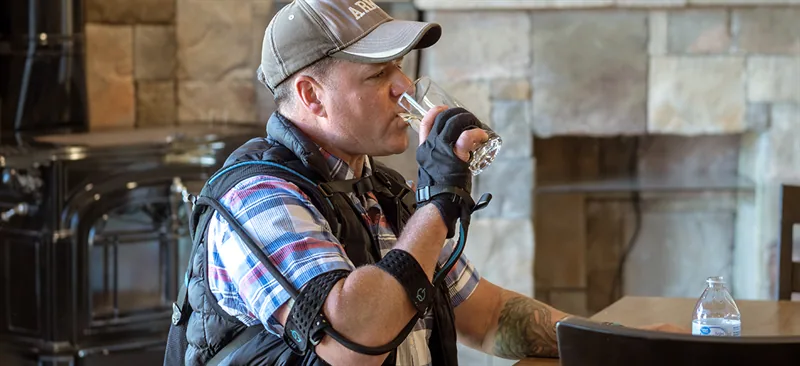
Carbonhand is a soft active hand orthosis intended to add grip strength for people with impaired hand function.
Sensors in the glove detect the user’s grip and feed that information to a control unit. Motors then tension artificial tendons integrated into the glove to supplement grasp force. The system is designed to support activities of daily living rather than to provide repetitive robotic therapy in a clinic.
Bioservo lists potential users with impaired hand function associated with conditions including spinal cord injury, ALS, multiple sclerosis, stroke, brachial plexus injury, nerve injury and other neurological, rheumatic or orthopaedic conditions.
The latest announcement includes an individual veteran example, but Exoskeleton Index is not treating one testimonial as evidence of population-level effectiveness. The more significant signal is the scale and repeatability of the access route.
The VA pathway may matter more than the headline user count
A total of 100 users is small compared with mainstream consumer technology. Medical wearable robotics has a very different adoption curve.
Before a device can scale in healthcare, clinicians need to know who is suitable, how to prescribe it, how the product is fitted, how it is paid for, who supports the user and how replacements or service are handled. Procurement can become as important as the hardware itself.
Carbonhand’s U.S. path illustrates that process.
The first veteran prescription established a clinical use case. Federal Supply Schedule availability then created a recognized procurement channel. Bioservo built clinical education and a growing VA site network around that route. The result is a device now being prescribed at more than 40 medical centers rather than depending on one flagship institution.
The VA operates approximately 170 medical centers and more than 1,000 outpatient sites. That means Carbonhand remains far from universal penetration, but the current network is large enough to show geographic spread rather than a single-center pilot.
Exoskeleton Index analysis
Medical wearable robotics often attracts attention when a regulator clears a device. Carbonhand shows why the more difficult phase begins afterward.
Regulatory status alone does not create adoption. A manufacturer still needs a workable route through clinical assessment, prescription, procurement, funding, training and support.
In Carbonhand’s case, the VA provides an unusually coherent environment for that process. A national health system can create common procurement mechanisms and clinical familiarity across facilities, allowing one device to spread without rebuilding the access pathway from zero in every market.
That makes the 100-user milestone more relevant than the number first appears. The underlying story is that an assistive hand exoskeleton has moved from isolated prescriptions toward repeat use across dozens of U.S. medical centers.
There is also a useful comparison with personal lower-limb exoskeletons. In those systems, Medicare reimbursement and specialist fitting increasingly shape access. Carbonhand demonstrates a different institutional route in which VA benefits and federal procurement can support uptake for eligible veterans.
For buyers trying to understand the difference between manufacturer price, procurement and payer pathways, our Exoskeleton Price Intelligence guide separates those evidence layers.
What the milestone does not prove
Bioservo’s announcement does not disclose the number of active daily users, average duration of use, clinical outcomes across the 100 veterans, procurement spending, replacement rates or how adoption is distributed between the more than 40 VA centers.
The company also estimates that up to 2.5 million Americans, including 250,000 veterans, could benefit from Carbonhand. Those are manufacturer estimates, not measured addressable-user counts from the VA.
The milestone should therefore be read as evidence of distribution and clinical access, not as proof that Carbonhand is effective for every diagnosis or that adoption will continue at the same pace.
What to watch next
The next useful evidence would be less about headline user numbers and more about repeat prescribing and outcomes.
Key signals include whether more VA centers begin prescribing, whether existing sites increase the number of patients fitted, how the device performs across different diagnoses and whether Bioservo publishes larger real-world datasets covering sustained use and function.
For now, Carbonhand provides one of the clearer examples of a soft wearable robotic device moving through a national healthcare procurement and prescription pathway rather than remaining confined to demonstrations or small trials.
Explore the Carbonhand product profile, the Bioservo company profile and Exoskeleton Index’s healthcare and rehabilitation directory.