
When an exoskeleton responds to intended movement
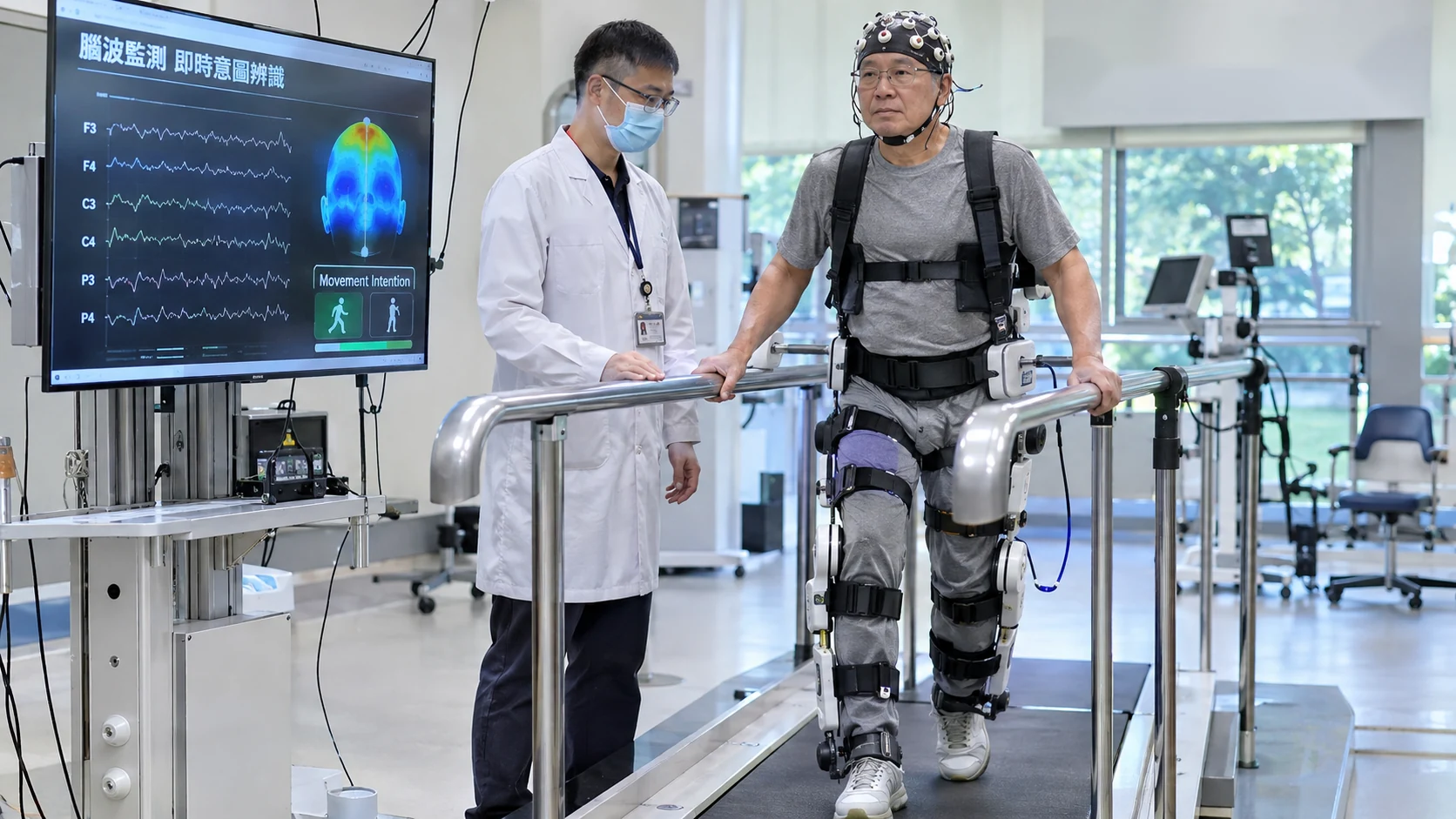
Many rehabilitation exoskeletons guide a person through predefined movement patterns. The more difficult challenge is making the device respond when the person intends to move. Researchers in Taiwan are testing an approach that combines non-invasive brain-signal sensing, artificial intelligence and a lower-limb exoskeleton.
In a 10 November announcement, Taiwan’s Industrial Technology Research Institute (ITRI) reported an average 92.5% motor-intention recognition accuracy during tests with hospitalised stroke patients at Taichung Veterans General Hospital. The figure is notable, but it describes the recognition system rather than the degree of walking recovery achieved by patients.
These are three different technical claims: an intention-classification result, an algorithm-acceleration comparison and a chip-fabrication milestone. None is a measure of clinical rehabilitation effectiveness.
How the EEG-to-exoskeleton system works
The researchers use a dry-electrode electroencephalography cap containing graphene-based sensors to collect brain signals without surgical implantation. An algorithm interprets patterns associated with the wearer’s intended movement and sends a control signal to the exoskeleton for assisted lower-limb rehabilitation.
The brain-signal and control work involves ITRI and National Yang Ming Chiao Tung University. Researchers at National Taiwan University also converted the recognition algorithm into a field-programmable gate array (FPGA) implementation. According to ITRI, the accelerated hardware performed the selected computations 76 times faster than a conventional computer processor in its tests.
That speed result helps explain why chip design matters. A rehabilitation system has to interpret intention quickly enough for assistance to feel responsive. However, the announcement does not publish complete end-to-end latency, test conditions or a side-by-side clinical control comparison. Faster algorithm execution is not automatically faster or safer real-world walking.
Hospital validation is underway, not finished
ITRI says the Taichung team has completed training and testing with stroke inpatients, while a clinical programme at Kaohsiung Medical University Hospital continues to investigate neurological rehabilitation feasibility. The institute is working with Taiwanese companies, including Free Bionics and Rehabotics, on more wearable forms of the system.
The team has also fabricated a preliminary 40-nanometre signal-processing chip. Functional testing, a production plan and applicable Taiwanese medical-device validation steps are still ahead. The release does not give participant numbers, confidence intervals, sensitivity or specificity by movement class, or comparative walking outcomes.
Exoskeleton Index analysis
The development is interesting because it connects three parts of a rehabilitation device that are often reported separately: recognizing an intention, processing it rapidly and delivering physical assistance. The central question is whether that closed loop becomes reliable and useful for patients, not whether its classifier reaches a high percentage in one set of tests.
A recognition score can change with the patient population, EEG setup, movement task and test protocol. Before treating this as a rehabilitation breakthrough, clinicians will need evidence of functional gains, repeatability, time to set up the cap, comfort, safety events and continued performance outside the initial laboratory conditions.
How it differs from the Tianjin brain–spine study
EI recently reported on a Chinese study filing that combines brain signals, spinal stimulation and a lower-limb exoskeleton. That Tianjin project has a different intervention and regulatory milestone. The Taiwanese team is reporting intention-recognition tests and hardware acceleration, without the spinal-stimulation component described in the Tianjin work. These should not be presented as competing clinical-success rates.
The 92.5% value measures recognition of intended movement, not improvement in walking ability.
The release provides no participant count or controlled functional-effect estimate.
A prototype chip and hospital tests do not establish a cleared commercial rehabilitation product.
What would make the next update meaningful?
A peer-reviewed protocol with patient counts, clear intention classes and reproducible accuracy would make the EEG result easier to evaluate. Gait outcomes, functional mobility measures, adverse events and rehabilitation follow-up would answer the more important clinical question: does the closed-loop approach improve rehabilitation compared with established care?
Brain-driven assistance is only one approach
Read our separate report on the Tianjin project to understand how non-invasive brain control is being combined with spinal stimulation in another research programme.
Read the Tianjin research report Research-stage devices are not personal medical advice or established treatment recommendations.Sources and reporting notes
Primary source. ITRI, 10 November 2026 (Traditional Chinese). Institute announcement on the EEG-controlled rehabilitation system, hospital testing and planned product validation.
Secondary cross-check. Taiwan News, 12 November 2026. English-language reporting on ITRI’s announcement.
Reporting boundary. The reported 92.5% is a movement-intention recognition result. The release does not demonstrate improved clinical recovery, medical-device approval or commercial availability.