
An access problem that cannot simply be solved with a ramp
Hikone Castle’s stone stairways are steep, and the site’s special historic designation makes conventional construction solutions difficult. That leaves a practical problem for visitors who cannot safely climb to the main enclosure under their own power.
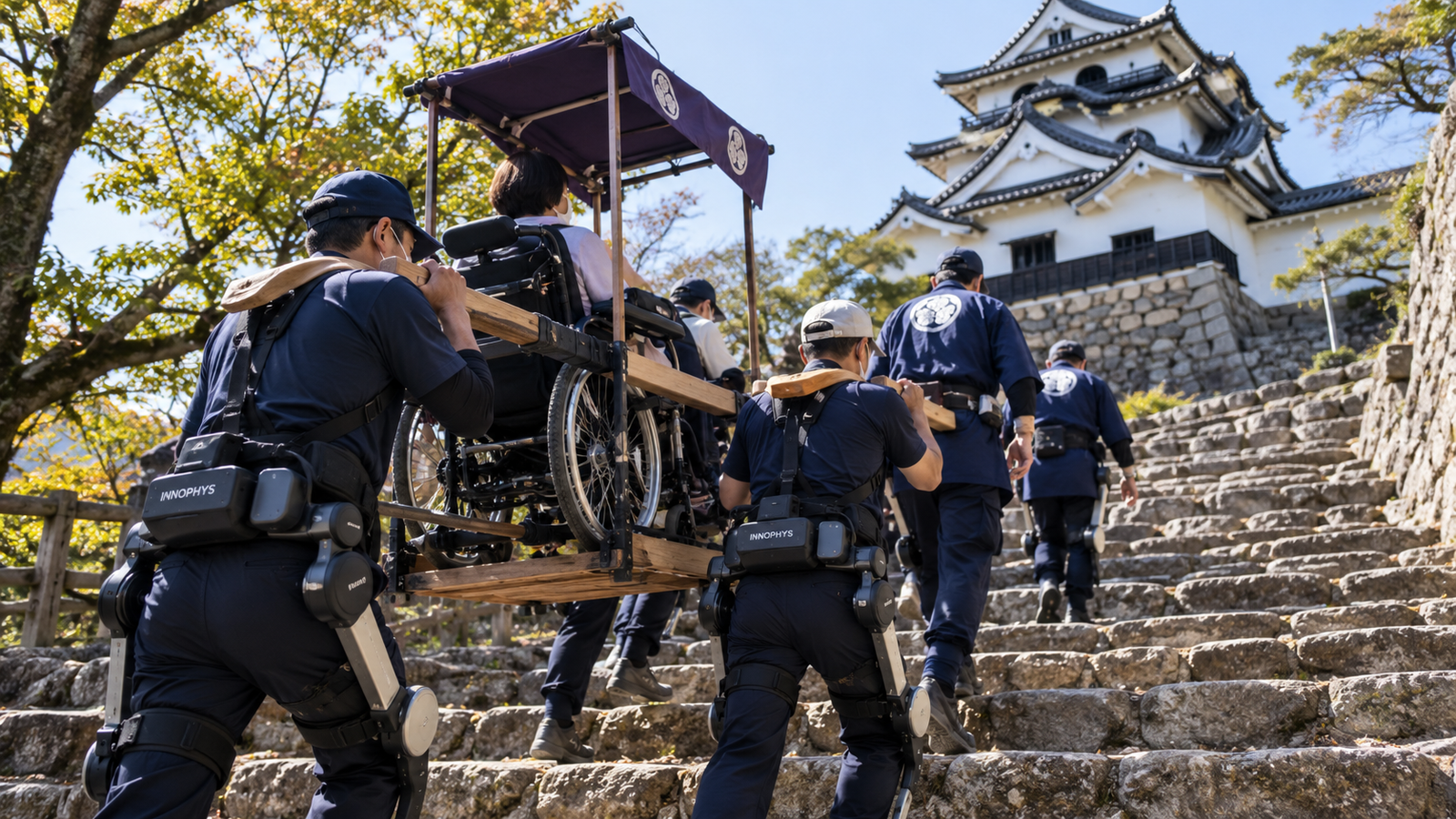
The city invited wheelchair users to try a yamakago, a traditional mountain palanquin, with teams carrying the visitors on a route through the castle grounds. The carriers rotated through three round trips, each with approximately 140 stone steps, around 50 meters of elevation change and an average gradient reported at about 18%.
The supplier reports approximately 285 meters for the round trip and three round trips completed. The six supported carriers used two different types of products.
What the carriers actually wore
According to the October 20 account from Japanese industrial supplier Techno Associe, two carriers wore Muscle Suit Soft-Power EASY-LIFT from Innophys, a lightweight passive lower-back support garment. A further four carriers wore the Mediaid Shikkari Guard Waist EX Hard support product.
That distinction matters. The trial should not be described as six people wearing Innophys exoskeletons, and the two waist-support products should not automatically be treated as equivalent powered robotic systems. The equipment supported the carriers, not the visitors transported in the palanquins.
Participant comments in the supplier’s account described a sense of lower-back reassurance and support during rising and carrying. One carrier said the benefit became particularly apparent on removing the suit. These were subjective impressions from an exploratory demonstration, not a controlled study of muscle activity, injury risk or fatigue.
The palanquin provides a way to move through protected stairs without installing permanent alterations.
The trial considered the physical burden on the people performing the carrying work.
Any repeatable visitor service would need trained carriers, procedures, suitable equipment and workload management.
Why this matters beyond a castle visit
The scenario reverses the usual assistive-exoskeleton narrative. The person with a mobility limitation is not the wearer. Assistance is directed toward the people performing a physically demanding service that makes an inaccessible environment more reachable.
Similar task-level questions can arise in heritage tourism, emergency response, healthcare transportation and other settings where conventional infrastructure modifications are constrained. That analogy does not mean this particular trial demonstrates success in those markets, but it illustrates a different place to look for wearable-support value.
Exoskeleton Index analysis
Hikone Castle is a useful reminder that accessibility and worker ergonomics can be part of the same operational problem. The benefit to the visitor depends on a service delivered by other people, and the feasibility of that service depends partly on what those people are asked to carry and repeat.
For exoskeleton manufacturers, this is a task-specific test of usability: fitting speed, freedom to step, balance while rising, heat, and compatibility with handling posture could matter as much as the advertised support mechanism.
For operators, subjective feedback is only an early signal. A credible wider deployment would need documented carrier workload, safe-handling protocols, staffing requirements and visitor experience over more than a few demonstrations. EI’s 2026 pricing guide tracks the cost positioning of lightweight Japanese support suits, but purchasing a suit alone would not establish a viable access service.
A promising demonstration, not a permanent offering
Techno Associe says Hikone is considering whether historic-palanquin visits could develop into an experience that includes interpretation of the site’s Edo-period history. Before that happens, the city would need to address carrier availability, physical demands and operational safety.
The October trial does not establish a regular booking service, a measured reduction in injury risk or independent proof of improved accessibility outcomes. It does provide an uncommon, documented example of wearable support being tested as part of a broader human-operated accessibility service.
The equipment detail worth keeping straight
Two carriers wore Innophys Soft-Power EASY-LIFT and four wore a different waist-support product. The six-person figure is the total number using support products, not the number using one exoskeleton model. The castle activity was a controlled local trial, not an announced permanent tourist rental or transport service.
Sources and reporting notes
Primary Japanese-language source, 20 October 2026. Techno Associe: assist suits used in Hikone Castle ascent trial. The announcement supplies photographs, participant counts, device breakdown, route information and first-hand comments.
Product records. Muscle Suit Soft-Power EASY-LIFT and Innophys on Exoskeleton Index. Product designations should not be extended to the separate Mediaid support product.
Reporting note. Original Japanese reporting was reviewed in translation. Statements from carriers are self-reported impressions and do not establish quantitative ergonomic effects or long-term safety.