
South Korean wearable-robot company HUROTICS has raised KRW 25 billion, approximately US$18.8 million, in Series A funding. The round brings together investors from technology, healthcare and retail as the company prepares to expand its H-Medi rehabilitation exosuit internationally, develop its H-Care walking-assistance system and build a broader wearable Physical AI platform.
This is more than another robotics funding round
The size of the investment matters, but the composition of the round may be more revealing.
Atinum Investment led the Series A, while existing investors including Stonebridge Ventures, IBK Industrial Bank of Korea, Ajou IB Investment and Wonik Investment Partners participated again.
Mirae Asset Venture Investment joined as a new financial investor.
More unusually, Daewoong, Naver and Lotte entered as strategic investors spanning healthcare, information technology and retail.
HUROTICS says those relationships are expected to support hospital supply and distribution, overseas expansion, and development of its data and software platform.
That does not mean each investor has committed to a specific commercial rollout. No detailed distribution agreement, hospital contract or retail launch tied to the round has been disclosed.
But the investor mix illustrates the broader commercial direction of wearable robotics: the hardware increasingly sits at the intersection of healthcare delivery, consumer access, software and physical data.
US dollar conversion is approximate and based on the KRW/USD exchange rate on October 16, 2026. HUROTICS has not publicly disclosed a valuation for the Series A round.
H-Medi gives the company a commercial starting point
HUROTICS is not raising the capital around a purely conceptual wearable robot.
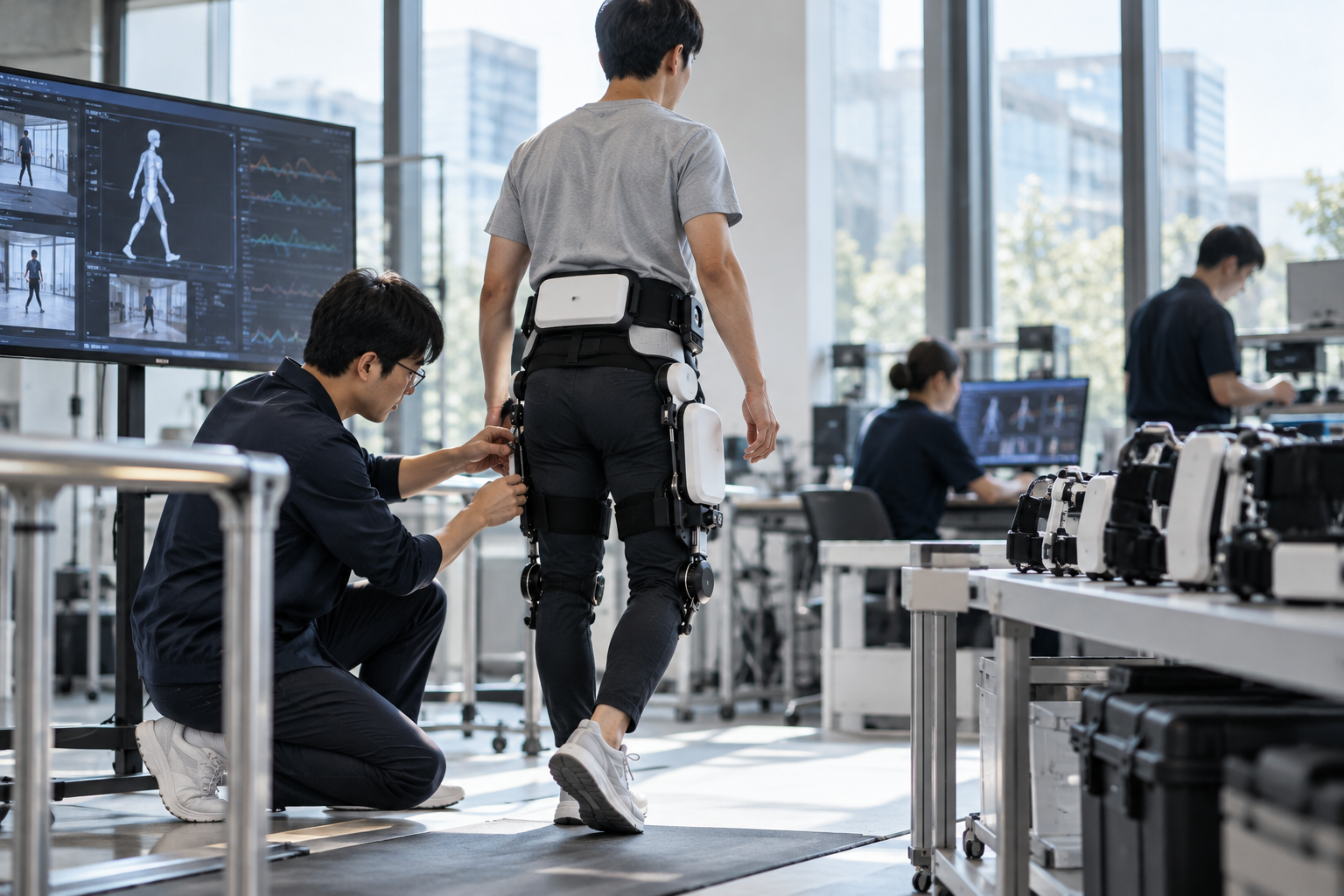
Its current commercial platform is H-Medi, a soft powered gait-rehabilitation exosuit designed to assist movement around the thigh during rehabilitation and gait training.
The company’s official specifications list a complete wearable system weight of 4.5 kg and maximum assistance force of 220 N. Motion sensors analyze the gait cycle and synchronize assistance with the user’s movement.
H-Medi is classified by HUROTICS as a Class II medical device in South Korea and was commercially launched in September 2025.
Korean reporting says the system has since been introduced at medical institutions including Severance Hospital, Chung-Ang University Hospital and Korea University-affiliated hospitals.
The company has also expanded the product into research use outside Korea. H-Medi was exported to the University of Illinois Chicago in 2026 for stroke-rehabilitation research and physical-therapist education, according to company-supplied reporting.
For readers evaluating rehabilitation products more broadly, Exoskeleton Index tracks H-Medi alongside other systems in the Healthcare & Rehabilitation category.
The next move is from rehabilitation into everyday mobility
The funding plan becomes more interesting when H-Care is added to the picture.
HUROTICS says part of the Series A will fund the development and mass production of H-Care, an everyday walking-assistance wearable robot.
That would move the company beyond a supervised clinical rehabilitation product and toward a larger mobility market built around daily movement.
The distinction is important.
A rehabilitation exosuit is normally purchased or deployed through hospitals, clinics, research centers and other professional settings. An everyday walking-assistance device requires a different commercial infrastructure: broader distribution, easier fitting, lower support burden, simpler operation and a value proposition that remains useful outside therapy sessions.
HUROTICS has not yet disclosed enough public product information for Exoskeleton Index to treat H-Care as a fully characterized commercial system, so it is not being linked here to a product profile.
The Series A nevertheless gives the company more capital to move that programme toward commercialization.
Why Naver, Lotte and Daewoong matter
A strategic healthcare investor potentially relevant to clinical channels, medical commercialization and healthcare market access.
A major Korean technology group joining as HUROTICS expands its software, data and Physical AI ambitions.
A consumer and distribution group whose participation is notable as HUROTICS looks beyond hospitals toward everyday mobility.
These sector labels explain why the investor combination is strategically interesting. They should not be interpreted as confirmation that specific Daewoong, Naver or Lotte business units will distribute H-Medi or H-Care.
What HUROTICS has said publicly is narrower: it intends to work with the strategic investors on areas including hospital supply, distribution, overseas expansion and data and software development.
That is still meaningful.
Wearable robotics companies often have strong engineering but limited access to the commercial infrastructure needed to scale hardware: healthcare channels, consumer distribution, software expertise, service networks and international market access.
Strategic capital can be valuable precisely when it contributes those capabilities in addition to cash.
HUROTICS is also positioning itself as a Physical AI company
The company’s longer-term plan extends beyond selling individual exosuits.
HUROTICS says it intends to develop personalized walking algorithms based on gait data, along with software intended to assess risks such as sarcopenia and falls.
It describes this strategy as a wearable Physical AI data platform.
The concept reflects a broader shift occurring across robotics.
A wearable device can generate continuous information about how a person walks, accelerates, compensates and responds to assistance. If that data is collected and interpreted reliably, the hardware can become one part of a larger feedback system rather than the entire product.
HUROTICS already describes its technology stack around real-time motion analysis, personalized assistance, deep-learning analysis and digital-twin-based diagnostics.
The commercial question is whether those capabilities can become scalable software or recurring services around the wearable hardware.
Exoskeleton Index analysis
This round matters because it shows three parts of the wearable-robotics market beginning to converge: medical rehabilitation, everyday mobility and data-driven assistance.
HUROTICS already has a commercial medical product. The new capital is intended to help it move outward from that clinical base rather than simply fund another prototype.
That path is increasingly attractive across the exoskeleton industry.
Clinical rehabilitation offers defined users, professional supervision and established procurement channels. Everyday mobility can potentially address a much larger population, but it demands lighter products, simpler operation, broader distribution and stronger evidence that users will continue wearing the technology outside controlled settings.
The arrival of strategic investors from healthcare, technology and retail is therefore notable even before any specific commercial partnership is announced.
It also fits a wider pattern documented in our 2026 exoskeleton market analysis: larger investors and industrial groups are increasingly treating wearable robotics as a category with multiple routes to scale rather than a single specialized medical or industrial niche.
The next test for HUROTICS will not be whether it can raise capital. It will be whether that capital converts into international regulatory progress, repeatable distribution and a successful transition from hospital rehabilitation into everyday mobility.
The funding arrives as Korean wearable robotics attracts more capital
HUROTICS is not developing in isolation.
South Korea has become one of the more active wearable-robotics ecosystems, spanning medical rehabilitation, industrial support and personal mobility.
Domestic manufacturers benefit from a broader national robotics base, major electronics and industrial groups, university research programmes and a relatively active venture-investment environment.
The new HUROTICS round adds another substantial funding event to a year in which wearable-robot companies have been attracting larger checks and increasingly strategic capital.
That does not mean funding itself validates a product’s clinical effectiveness or guarantees commercial success.
It does indicate that investors are willing to finance the transition from research and early commercialization toward manufacturing, regulatory expansion and distribution.
What the funding announcement does not establish
HUROTICS has not disclosed its Series A valuation, sales revenue, H-Medi unit shipments or binding commercial commitments from Naver, Lotte or Daewoong.
The announcement also does not provide a commercial launch date, final specifications or pricing for H-Care.
References to a wearable Physical AI platform describe the company’s development strategy rather than an independently validated commercial platform already operating at scale.
What to watch next
The first milestone is H-Medi’s international expansion.
HUROTICS says the new capital will support overseas regulatory approvals and distribution, making progress outside South Korea one of the clearest indicators of whether the current product can scale.
The second is H-Care.
A detailed product announcement covering specifications, intended user group, regulatory positioning, pricing and commercial timing would provide the first real indication of how HUROTICS intends to compete in everyday walking assistance.
The third is the software layer.
If gait data, personalized assistance and risk-prediction tools become recurring products rather than supporting features, HUROTICS could evolve from a wearable-hardware manufacturer into a broader mobility-data business.
That is the bigger strategic promise behind this round.
From wearable robot to mobility platform
For now, the clearest fact is straightforward: HUROTICS has secured substantially more capital to expand a commercially launched rehabilitation exosuit and push into a broader category of wearable mobility.
The participation of Naver, Lotte and Daewoong gives the round an importance beyond its approximately US$18.8 million headline value.
It connects wearable robotics with three capabilities the sector increasingly needs to scale: technology infrastructure, healthcare access and distribution.
Whether those relationships become meaningful commercial channels remains to be seen.
But if HUROTICS can successfully connect H-Medi, H-Care and its data strategy, the company will be attempting something increasingly important across the exoskeleton market: turning a specialized wearable robot into a broader mobility platform.
Sources and reporting notes
Seoul Economic Daily, October 15, 2026. Wearable Robot Maker Hurotics Raises 25 Billion Won in Series A.
ZDNet Korea, October 15, 2026. HUROTICS raises KRW 25 billion Series A, reporting Atinum as lead investor and Daewoong, Naver and Lotte as strategic participants.
Smart Today, October 15, 2026. Funding, product expansion and Physical AI strategy.
HUROTICS. Official H-Medi product information and company history.
Currency note: KRW 25 billion is approximately US$18.8 million using the KRW/USD exchange rate on October 16, 2026. The US dollar value is approximate and may vary with exchange-rate movements.