
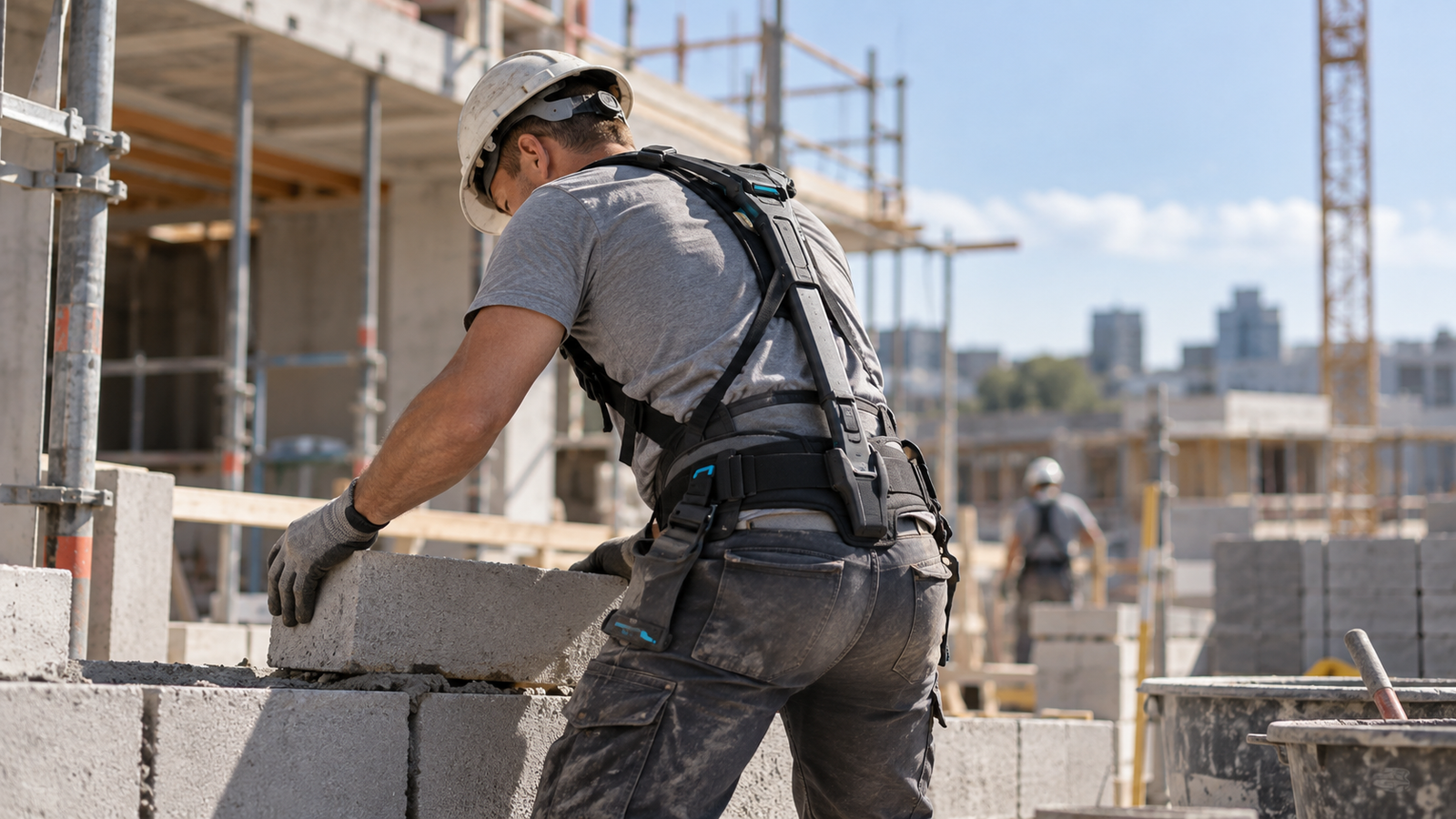
A field study involving 15 masons across five active construction sites found that passive back-support exoskeletons reduced reported fatigue by 42.11% and perceived exertion by 26.74%. The physical benefit was substantial. But after using the systems in real masonry work, willingness to continue wearing them fell by 57.41%, putting comfort and freedom of movement at the center of the adoption question.
The physical benefit was difficult to ignore
The study was designed to test something occupational exoskeleton research still lacks: what happens when devices leave a controlled laboratory and are used during actual construction work.
Researchers followed 15 masons across five construction sites and compared baseline conditions with work performed using two commercially available passive back-support exoskeleton designs.
The results were strongly positive on measures of physical demand.
Results reported by Al-Khiami and Lindhard for the tested construction tasks and study population. They should not be interpreted as universal effects across all exoskeletons, workers or construction activities.
Mean fatigue scores fell from 3.80 to 2.20 on the study’s five-point fatigue scale. According to the researchers, 93.3% of participants reported lower fatigue while using the exoskeletons, while none showed an increase on that measure.
Perceived exertion also fell substantially, from a mean Borg RPE score of 15.33 without an exoskeleton to 11.23 with assistance.
The researchers additionally reported a 46% reduction in physical effort and a 41.33% improvement in their endurance measure.
For the occupational exoskeleton industry, that part of the result matters. These were not simply mechanical bench tests. The systems were being evaluated by professional masons in real construction environments.
Then the usability problem appeared
The study becomes more interesting when the researchers move from physical assistance to worker acceptance.
Despite the reductions in fatigue and exertion, willingness to continue using the back-support exoskeletons declined by 57.41% after real-world exposure.
Around 93% of participants reported some degree of movement restriction, while every participant reported discomfort associated with straps and buckles.
That distinction is critical. An exoskeleton can successfully reduce part of a worker’s physical demand and still create enough interference elsewhere in the task to weaken the case for everyday use.
Masonry is particularly demanding in this respect. Workers do not simply bend and lift in a repeatable straight line. They walk, rotate, reach, align materials, work at different heights and move through changing site conditions.
A back-support system therefore has to do more than generate assistance during trunk flexion. It has to remain tolerable through the rest of the job.
Comfort may be more important than maximizing assistance
The researchers found strong relationships between practical usability and willingness to continue using the systems.
Movement restriction was strongly associated with willingness to continue use, with a reported correlation of r = 0.79. Ease of adjustment showed a similarly strong relationship at r = 0.76.
Those correlations come from a small sample and should not be generalized into universal adoption rules. But the direction is commercially important.
For manufacturers, more assistance is not necessarily the only path toward a better product. Lower weight, easier adjustment, softer contact points, freedom of movement and compatibility with complete work cycles may determine whether physical assistance translates into repeated use.
The two exoskeleton designs did not perform equally
The field programme included two substantially different passive systems: the rigid HAPO back-support design and the softer textile-based BISKO.
A related 2026 paper from the same researchers examined the two designs separately in the same 15-mason, five-site field setting.
The differences were significant.
BISKO was associated with a 50.53% reduction in perceived fatigue and a 32.57% reduction in perceived exertion. For HAPO, the corresponding reductions were 27.39% and 14.76%.
The softer BISKO system also scored better for comfort and adjustability and produced less reported movement hindrance.
This is important because it prevents the adoption finding from being interpreted too broadly. The evidence does not suggest that construction workers simply reject exoskeletons after trying them.
Instead, it suggests that architecture, weight, attachment design and movement compatibility can materially change the user experience even when two products target the same body region.
Exoskeleton Index analysis
This is a positive signal for occupational exoskeletons, even if the adoption result initially looks uncomfortable.
The study provides evidence that wearable back assistance can meaningfully reduce perceived physical demand during real construction work.
The remaining challenge is increasingly an integration problem rather than a simple proof-of-concept problem.
Early occupational exoskeleton development had to demonstrate that a wearable system could reduce load or physical effort at all. The next generation has a harder target: create that assistance while interfering as little as possible with everything else the worker needs to do.
That means comfort, adjustability, heat, range of motion, compatibility with tools and protective equipment, and transitions between assisted and unassisted tasks are becoming competitive product features rather than secondary ergonomic details.
The commercial winner may not be the exoskeleton that produces the largest isolated biomechanical effect. It may be the system workers are willing to keep wearing after the demonstration is over.
This fits a wider shift in construction exoskeleton research
The findings add an important second layer to another recent construction study covered by Exoskeleton Index.
In that earlier field experiment, a passive lower-back exoskeleton was associated with 37% lower fatigue and 29% better hazard-recognition performance during three-hour construction work sessions.
Taken together, the studies point in an encouraging direction. Occupational exoskeleton research is moving beyond the narrow question of whether a device can reduce muscle activity under controlled conditions.
Researchers are increasingly examining what assistance does to the complete work system: fatigue, attention, productivity, comfort, movement, user acceptance and the decision to continue wearing the device.
That broader evaluation is necessary if exoskeletons are to move from demonstrations and short pilots into repeatable occupational deployment.
Why selective use may be more realistic than all-day wear
The results also challenge the assumption that successful adoption means every worker wearing the same exoskeleton continuously for an entire shift.
For physically demanding jobs with varied tasks, a more practical model may be selective use during the activities where assistance creates the clearest benefit.
A mason may benefit from back assistance during repeated material handling while preferring unrestricted movement during alignment, walking, kneeling or precision work.
That does not necessarily represent failed adoption. It may represent better task matching.
Exoskeleton Index has argued previously that workplace deployments should separate four questions: physical benefit, operational compatibility, human adoption and economic viability. A positive result in only one layer is not enough to justify scale. See our deeper analysis of why workplace exoskeleton pilots succeed or fail.
The new construction evidence reinforces that approach.
What this study does not prove
The results should not be interpreted as evidence that back-support exoskeletons prevent workplace injuries. The study measured perceived exertion, fatigue, physical effort, endurance, comfort and acceptance rather than long-term injury incidence.
The sample was also small at 15 masons. Although the overall field programme ran for four months, baseline and post-exoskeleton data were collected over three days per participant rather than over months of continuous individual use.
The findings therefore provide useful field evidence about the tested devices and tasks, but they cannot establish how every construction trade, worker population or back-support exoskeleton would perform.
What manufacturers need to solve next
The next stage of occupational exoskeleton development is likely to be defined by how effectively manufacturers preserve assistance while reducing everything the wearer notices about the device.
For construction in particular, the priorities are becoming clearer: lower mass, less restrictive structures, better attachment systems, faster fitting and adjustment, less pressure at contact points, and designs that tolerate complex multi-directional movement.
Longer field trials should also track whether comfort changes with familiarization, whether workers become more selective about when they use assistance, and whether early fatigue benefits remain meaningful after repeated full-shift exposure.
Productivity, task quality, heat, cleaning, durability and compatibility with personal protective equipment will also matter for employers evaluating deployment beyond a small pilot.
For buyers and safety teams, the takeaway is equally straightforward. The question is no longer simply whether a construction exoskeleton reduces physical demand.
It is whether the benefit remains large enough once the worker has to perform the entire job.
The bigger signal for occupational exoskeletons
A 42% reduction in fatigue in real construction work is not a trivial result.
Neither is a 57% deterioration in willingness to continue using the technology.
The value of this study is that both outcomes can be true at the same time.
For a maturing exoskeleton industry, that is useful evidence. It shifts development away from proving that assistance is mechanically possible and toward building products that workers can realistically integrate into demanding jobs.
The physical benefit is becoming easier to demonstrate. The next competitive frontier is making that benefit comfortable enough to keep.
Explore the wider Construction & Field Operations category to see current exoskeleton products, suppliers and research relevant to construction work.
Sources and reporting notes
Al-Khiami, M. I. & Lindhard, S. M. (2026). “On-Site Evaluation of Back-Support Exoskeleton Effectiveness in Construction: A Multiple Case Study of Physical Performance, Ergonomic Comfort, and User Acceptance among Masonry Workers.” Journal of Construction Engineering and Management, 152(10), article 04026167. DOI: 10.1061/JCEMD4.COENG-17207.
Related field comparison. “Field comparison of rigid and soft passive back-support exoskeletons: physical exertion, comfort, and adoption among masonry workers.” Safety Science, 2026, 197:107138. DOI: 10.1016/j.ssci.2026.107138.
Exoskeleton Index. Construction Exoskeleton Field Study Links Lower Fatigue to Better Hazard Recognition, September 23, 2026.
Reporting note: The 42.11% fatigue reduction and 57.41% decline in willingness to continue use refer to the aggregate field-study results. Device-specific findings from the related HAPO/BISKO comparison are identified separately and should not be treated as an independent second cohort.