
A field study involving 16 construction workers found that using a passive lower-back exoskeleton was associated with 37% lower fatigue and a 29% improvement in hazard-recognition performance. The result is important because it moves workplace exoskeleton evaluation beyond biomechanics: reducing physical demand may also influence how effectively workers notice hazards in a changing work environment.
- Study
- Improving Situational Awareness through Fatigue Reduction with Exoskeletons
- Publication
- ASCE OPEN: Multidisciplinary Journal of Civil Engineering
- Published online
- 16 July 2026
- Participants
- 16 construction workers
- Setting
- Field experiment during normal construction work
- Exposure
- Three-hour work sessions with and without the exoskeleton
- Device
- Prototype passive lower-back exoskeleton
- Device weight
- Approximately 0.91 kg
- Reported fatigue result
- 37% reduction in fatigue with exoskeleton use
- Hazard recognition
- 29% improvement in hazard-recognition performance
- Fatigue / hazard-recognition relationship
- r = −0.71, P = 0.002
- Other situational-awareness measures
- No significant changes in safety risk perception or SART scores
- Commercial status
- Research prototype, not a commercially deployed product
The important result is not simply lower fatigue
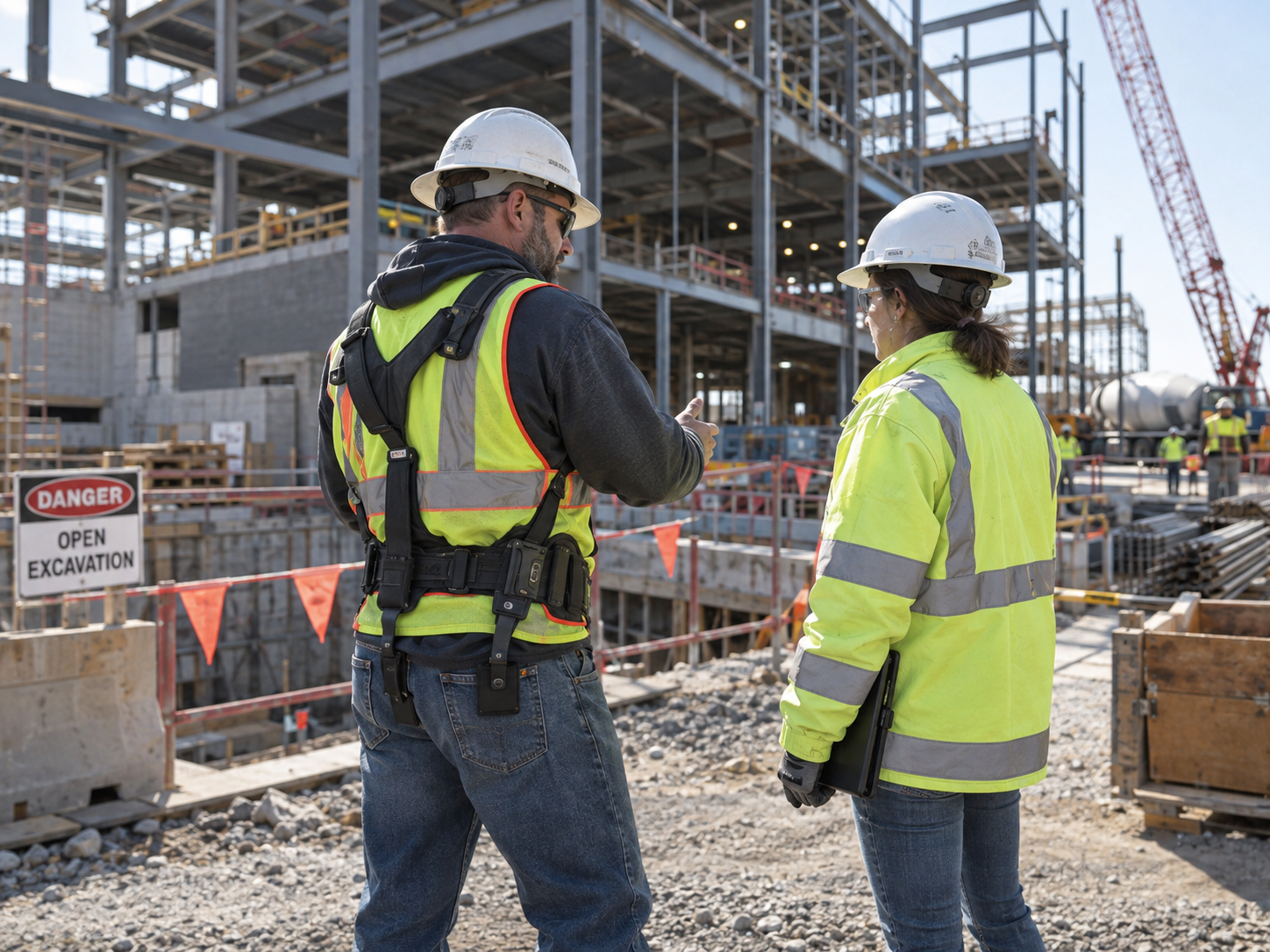
Most workplace exoskeleton research starts with a physical question. Does the device reduce muscle activity, perceived exertion, joint loading or strain during demanding work? Those outcomes remain important, but this study examined something less frequently measured: whether reducing physical fatigue could also affect a worker’s ability to recognize hazards. Researchers tested 16 construction workers while they performed their normal work both with and without a prototype passive lower-back exoskeleton. Workers completed three-hour work sessions under each condition. Fatigue was assessed using a rating-of-fatigue scale, while situational awareness was evaluated through hazard-recognition performance, safety risk perception and the Situational Awareness Rating Technique, or SART. The researchers reported two significant changes. Fatigue was reduced by 37% when workers used the exoskeleton. Hazard-recognition performance improved by 29%. That combination makes this study more relevant to occupational deployment than another isolated biomechanical result.Workers who accumulated less fatigue also tended to recognize more hazards
The researchers also examined the relationship between changes in fatigue and changes in hazard recognition. They found a strong negative correlation: r = −0.71, P = 0.002 In practical terms, workers who experienced smaller increases in fatigue tended to show greater improvements in hazard recognition. The result suggests that physical fatigue and safety-related cognitive performance may be connected during demanding construction work. That does not establish that reducing fatigue automatically causes workers to identify more hazards. The study shows an association, not a proven causal mechanism. That distinction matters, particularly if these findings are eventually used to support procurement or workplace-safety decisions.The field setting makes the study particularly relevant
Construction is difficult territory for occupational exoskeletons. Unlike a highly standardized manufacturing station, construction workers frequently move between subtasks, surfaces, tools, body positions and work areas. A device may need to support lifting or bending while still allowing walking, climbing, crouching, tool access and rapid changes in posture. Texas A&M researchers specifically highlighted this difference when discussing the study. The workers were therefore tested during their regular construction activities rather than being limited to a single repetitive laboratory movement. That gives the result practical relevance. It does not make the study equivalent to a long-term deployment trial, but it begins to answer a more useful question: What happens when an exoskeleton is introduced into the complexity of real work?The exoskeleton itself was a lightweight research prototype
The tested system was a prototype passive lower-back exoskeleton rather than an existing commercial product. It weighed approximately 0.91 kg. The design used a segmented structure following the shape of the spine, with shoulder and lower-body attachment points and elastic thigh straps intended to provide assistance during repetitive bending and lifting. Because the system is passive, assistance is generated mechanically rather than by electric motors or batteries. This distinction is important when interpreting the results. The findings should not automatically be applied to every industrial exoskeleton, powered back-support system or construction wearable. Different assistance mechanisms, weights, fit systems and movement constraints can produce very different physical and cognitive effects.Not every safety-related measure improved
The study did not find improvements across every measure of situational awareness. Hazard-recognition performance improved significantly. However, researchers reported no significant changes in broader safety risk perception or SART scores. That makes the correct interpretation considerably narrower than saying: Exoskeletons make construction workers safer. The evidence supports a more precise conclusion: In this field experiment, workers using a passive lower-back exoskeleton reported lower fatigue and performed better on hazard recognition, while broader situational-awareness measures did not significantly change. The study also did not measure accident rates, injuries or near-miss reduction. Those outcomes would require substantially larger and longer studies.This adds a new dimension to workplace exoskeleton evaluation
The result matters because employers do not deploy exoskeletons into isolated muscles. They deploy them into an entire work system. That system includes physical demand, attention, movement, productivity, PPE, tools, workflow, fatigue and worker acceptance. For years, occupational exoskeleton evaluation has concentrated heavily on the physical side of that equation. The Texas A&M study suggests that cognitive and perceptual outcomes deserve more attention as well. For construction and other dynamic occupations, that could be particularly important. A worker may be physically assisted while still needing to continuously detect moving equipment, unstable surfaces, overhead work, changing access routes, nearby workers and other environmental hazards. If an intervention changes physical fatigue, it is reasonable to ask whether it also changes the worker’s capacity to monitor those conditions.The result should not be generalized to every exoskeleton
There is also evidence pointing in the opposite direction. A separate 2025 study examining an active back-support exoskeleton during a construction-related framing task found reduced visual attention and lower situational-awareness scores for many participants. Researchers reported increased visual cognitive load while participants used the system. That study involved a different device, experimental setup and type of assistance, so the results are not directly comparable. But the contrast is useful. An exoskeleton can potentially reduce one physical burden while introducing another cognitive or coordination demand. That means buyers should not assume that physical assistance automatically improves attention, safety or overall job performance. The effect has to be measured for the actual device and task.Exoskeleton Index analysis
The most important commercial implication of this study is not the 37% fatigue figure. It is the possibility that workplace exoskeleton pilots may be measuring too little. A buyer evaluating a back-support exoskeleton may currently measure discomfort, muscle activity, perceived exertion and perhaps task completion time. Those are useful metrics. But if physical assistance can influence attention or hazard recognition, the evaluation framework becomes broader. For employers in construction, logistics, utilities, maintenance and manufacturing, a serious pilot may need to ask several questions at the same time: Does the device reduce the physical demand it was selected to address? Does it interfere with walking, climbing, reaching, tools or required PPE? Does productivity remain acceptable? Will workers continue wearing it after the novelty period ends? And does the intervention affect attention, workload or awareness of the surrounding environment? This has implications for suppliers as well. The stronger B2B proposition may eventually be less about selling a wearable device and more about helping customers identify the right task, select the appropriate technology, structure the pilot and generate evidence that supports a scale or stop decision. That is also why task-specific selection matters more than broad claims about an exoskeleton making work easier or safer. Our analysis of why workplace exoskeleton pilots fail reaches a similar conclusion: successful deployment depends on the interaction between the device, task, worker and operating environment rather than a specification in isolation.What this means for construction buyers
The study should not be used as evidence that an employer can purchase an exoskeleton and expect a 29% improvement in hazard recognition. It should change what employers consider measuring. A construction pilot could evaluate:- physical fatigue before and after representative work periods;
- task-specific discomfort and perceived exertion;
- mobility across actual work transitions;
- compatibility with helmets, harnesses, belts and other PPE;
- productivity and task completion time;
- worker acceptance after repeated use;
- attention, cognitive workload or hazard recognition where relevant;
- heat, fit and pressure during realistic exposure periods;
- maintenance and donning requirements; and
- whether the device remains useful across the specific task it was selected to support.
Construction may be an unusually important test environment
Construction exposes one of the central challenges facing workplace exoskeletons. A factory workstation can sometimes be redesigned around a highly repeatable movement. A construction site continually changes. Workers move between locations, work heights, materials, tools and physical demands. That makes task-device compatibility harder, but it also makes construction an important environment for understanding whether exoskeletons can progress beyond controlled ergonomic applications. If a wearable system reduces fatigue but restricts movement, creates excessive heat or increases cognitive demand, the physical benefit may not translate into a successful deployment. If it reduces physical demand while preserving mobility, productivity and awareness, the value proposition becomes considerably stronger. The new study provides one encouraging signal. It is not yet enough to establish that broader outcome.What the study does not establish
The field experiment involved only 16 construction workers. That is sufficient to identify an interesting signal, but not to establish a universal effect across construction occupations, worker populations or exoskeleton designs. The exposure period was also limited to three-hour work sessions. The study therefore does not establish whether the same fatigue or hazard-recognition effects persist after full shifts, repeated use or months of deployment. The tested device was a specific 0.91 kg passive research prototype. Results should not be transferred directly to commercial passive systems, powered back exoskeletons or products supporting other body areas. Hazard recognition was measured experimentally. The research did not establish reductions in injuries, accidents or near misses. Finally, the strong relationship between changes in fatigue and hazard recognition is correlational. It supports further investigation into a possible link between physical fatigue and cognitive safety, but it does not prove that fatigue reduction itself caused the improvement in hazard recognition.What to watch next
The next step should be larger and longer field trials. Those studies will need to determine whether the effect persists across different trades, tasks, construction environments and worker populations. Full-shift exposure would be particularly useful. So would comparisons between passive and powered systems, because the additional weight, control architecture and movement interaction of an active exoskeleton may affect cognitive workload differently. Longer pilots should also measure productivity, adoption and worker acceptance alongside fatigue and safety-related outcomes. For buyers, this is the larger signal. The evidence base for occupational exoskeletons is gradually moving from: Does the device reduce physical load? toward: What happens to the entire work system when physical assistance is introduced? That is a much more demanding question. It is also the question that will ultimately determine whether workplace exoskeletons move from promising ergonomic equipment to repeatable industrial deployments. Explore Construction & Field Operations exoskeletons, read our analysis of why workplace exoskeleton pilots fail, or browse the wider Exoskeleton Product Directory.Sources
- ASCE OPEN: Improving Situational Awareness through Fatigue Reduction with Exoskeletons, published online 16 July 2026
- Texas A&M University: Construction exoskeletons may help workers spot hazards by reducing fatigue, 17 September 2026
- International Journal of Industrial Ergonomics: Visual attention and situational awareness during exoskeleton use in construction work, 2025