
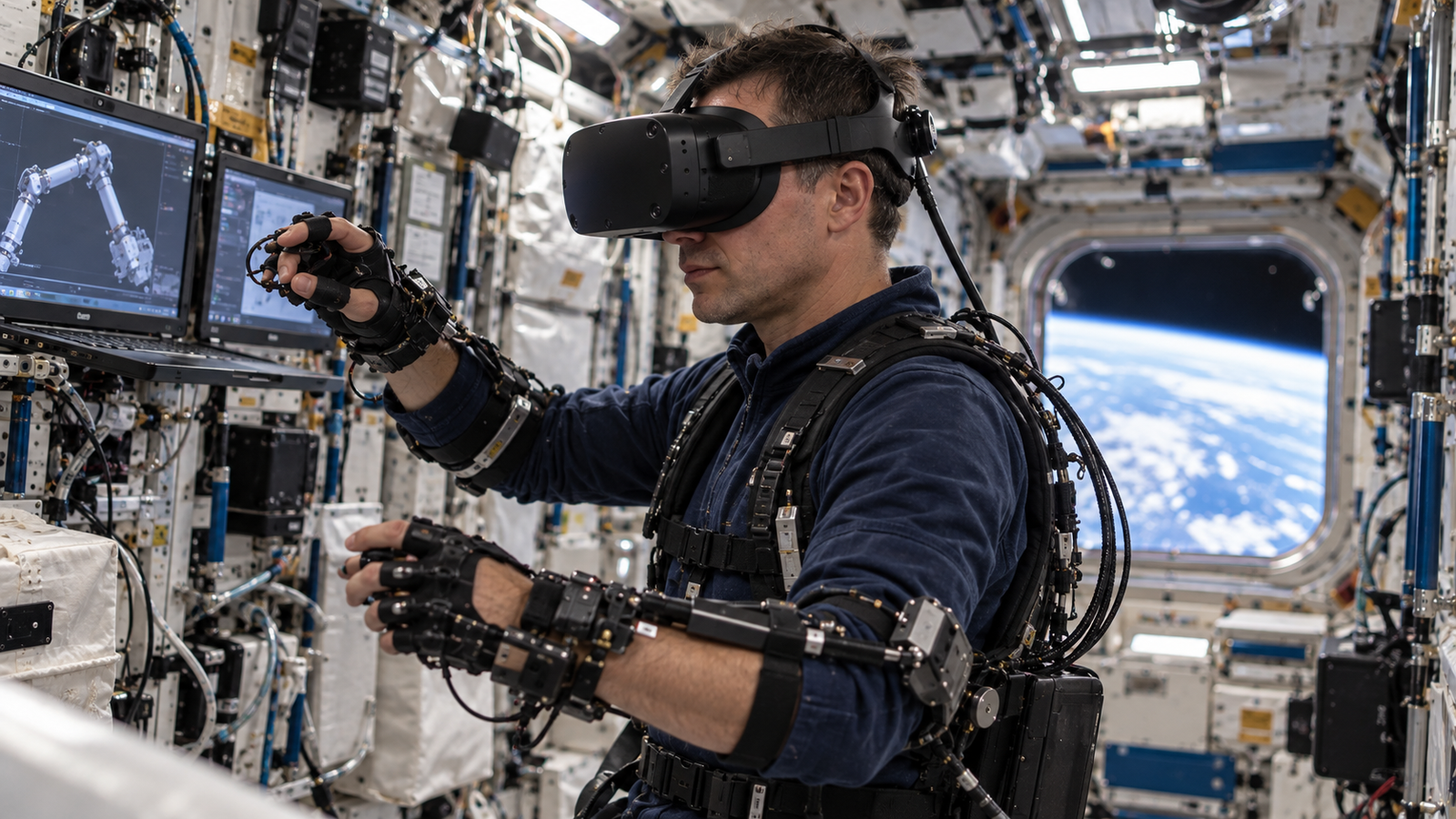
Cosmonauts aboard the International Space Station are testing an exoskeleton suit, virtual reality goggles and hand controls designed to remotely operate robots. The current Teledroid experiment is still in its simulation phase, but the longer-term plan is more ambitious: let an operator move inside the station while a robotic system reproduces those actions during work that could eventually extend to the exterior of the ISS.
An exoskeleton in orbit, but not for lifting
Most exoskeletons covered by Exoskeleton Index are designed to assist the person wearing them.
They reduce physical load, support walking, train movement or augment a particular joint.
The Teledroid system uses the wearable structure for something fundamentally different.
Here, the exoskeleton is an interface.
The operator moves inside the International Space Station while the control system records those movements and translates them into commands for a robotic counterpart.
NASA reported on October 13 that station commander Pyotr Dubrov and flight engineer Anna Kikina tested the system together. One cosmonaut wore the suit and virtual reality goggles while simulating tasks including picking up tools, using them and connecting or disconnecting components.
The second cosmonaut monitored the session on a computer and provided verbal guidance.
NASA reported another Teledroid session on October 14, describing a combination of the specialized suit, VR goggles and hand controls used to manipulate tools in a simulated space environment.
The 40-session figure describes the planned Teledroid programme, not completed orbital robot operations. The physical Teledroid robot is not yet aboard the ISS.
The robot itself has not reached the station yet
That distinction matters.
The hardware currently being tested in orbit is the operator side of the system: the exoskeleton, control equipment and virtual interface.
Russia’s Progress MS-35 cargo spacecraft delivered the equipment to the ISS in September.
The physical Teledroid robot is planned to follow aboard Progress MS-36.
Roscosmos has described Teledroid as an anthropomorphic robotic system intended to support operations associated with extravehicular work.
Russian reporting based on the programme states that the robot can operate in a copying mode, reproducing movements made by the cosmonaut wearing the control exoskeleton, while selected tasks are also intended to use autonomous functions.
The current ISS sessions are therefore not demonstrations of a physical robot already operating outside the station. They are preparation for the later stages of the programme.
Teledroid is planned as a three-stage experiment
The development programme is designed to move progressively from simulation toward increasingly realistic robotic work.
Project chief designer Evgeny Dudorov has said that up to 20 sessions are planned using the copying-type control device with a virtual simulator.
A further 20 sessions are planned around the physical Teledroid robot, including work inside the station and on its exterior.
Planned tasks include handling electrical connectors, attaching carabiners, installing safety lines and manipulating hand tools.
Why control a robot with an exoskeleton?
Traditional robotic teleoperation can rely on joysticks, buttons, screens or purpose-built control stations.
A wearable copying interface attempts something more intuitive: map the human operator’s own movements onto the robot.
If the cosmonaut raises an arm, changes hand position or manipulates an object, the robot can be commanded to reproduce that movement rather than requiring every joint action to be translated manually through conventional controls.
Virtual reality can then give the operator a view of the environment from the robot’s perspective.
The concept effectively turns the robotic system into a remote physical extension of the human operator.
That puts Teledroid within an emerging branch of wearable robotics in which exoskeleton hardware is used not primarily to assist the body, but to capture human motion and transfer it into another machine.
Exoskeletons are becoming interfaces for robots
That idea is increasingly appearing outside spaceflight as well.
Exoskeleton Index recently covered Chestnut Robotics’ Aero UMI, a wearable hand exoskeleton designed to collect human manipulation data and teleoperate a matching robotic hand.
The underlying application is different, but the technological shift is similar.
An exoskeleton does not necessarily have to make its wearer stronger.
It can also measure human movement with enough structure and precision to become an input device for robotics.
As humanoid robotics and Physical AI expand, that role could become increasingly important for teleoperation, human demonstration data and robotic training.
Exoskeleton Index analysis
Teledroid is interesting because it stretches the definition of what an exoskeleton can be used for.
The wearable system aboard the ISS is not primarily augmenting the cosmonaut. It is translating the cosmonaut into a control signal for another robot.
That creates a very different relationship between humans and wearable robotics.
In industrial or rehabilitation systems, the machine normally acts directly on the wearer. In teleoperation, the exoskeleton instead becomes part of a human-machine interface that can project the operator’s movement into an environment the person does not physically occupy.
Space is an unusually strong use case for that architecture because some external tasks expose humans to environments where robotic substitution could potentially be valuable.
But the important word is still potentially.
Teledroid has not yet demonstrated routine external ISS operations, and the current orbital tests should be interpreted as an experimental control programme rather than evidence that robotic avatars are ready to replace human spacewalks.
If the later stages work, however, exoskeleton technology will be doing something far beyond reducing fatigue: allowing human dexterity and decision-making to operate through a machine in another environment.
The ultimate target is work outside the ISS
The planned external phase is what makes Teledroid particularly significant.
The robot is expected to be installed on the exterior of the Russian segment of the station, where it can be evaluated on tasks that resemble elements of spacewalk work.
The programme has cited connectors, tethering hardware and hand tools among the intended objects.
The long-term attraction is straightforward: some work that currently requires a person to enter the vacuum of space could potentially be performed by a robotic system controlled from inside the station.
Russian Cosmonaut Training Center reporting has framed Teledroid partly around reducing risks and costs associated with human extravehicular activity.
That remains an objective rather than a demonstrated operational outcome.
A spacewalk involves far more than manipulating a handful of known objects. Reliability, situational awareness, dexterity, communication delay, fault tolerance and unexpected conditions all become critical.
What has actually been demonstrated so far?
NASA confirms that Dubrov and Kikina are testing the exoskeleton-based Teledroid control system aboard the ISS and using it with VR and hand controls in simulated manipulation tasks.
The physical Teledroid robot itself has not yet performed those orbital tasks. Its delivery is planned for a later Progress mission.
No published performance results currently establish manipulation accuracy, task-completion speed, operator workload, reliability or whether Teledroid can reduce the number or duration of human spacewalks.
What happens next
The next major milestone is the arrival of the Teledroid robot itself.
Once the physical platform reaches the station, the experiment can move beyond virtual manipulation and test whether movements captured through the exoskeleton translate effectively into real robotic actions in microgravity.
If that phase succeeds, external ISS testing would represent the most important step.
The key questions will no longer be whether a cosmonaut can move a simulated robotic arm.
They will be whether the system can manipulate real space hardware accurately, safely and reliably enough to become useful alongside human crews.
A very different future for wearable robotics
Exoskeleton development is usually discussed around one fundamental relationship: a wearable machine helping a human body move.
Teledroid reverses part of that relationship.
The human moves first.
The wearable system captures that intent.
And another machine may eventually perform the physical work somewhere the operator does not need to be.
That makes the experiment more than an unusual space application.
It is another sign that exoskeleton technology is beginning to overlap with teleoperation, humanoid robotics and Physical AI, creating applications where the wearable itself is only one part of a much larger robotic system.
Explore the Exoskeleton Index product directory for current wearable robotics systems across industrial, medical, mobility and research applications.
Sources and reporting notes
NASA, October 13, 2026. International Space Station daily update reporting that Pyotr Dubrov and Anna Kikina tested an exoskeleton suit for remote robot control using virtual reality and simulated tool-manipulation tasks.
NASA, October 14, 2026. ISS update confirming continued Teledroid testing with a specialized suit, virtual reality goggles and hand controls in a simulated space environment.
Roscosmos / Interfax, September 16, 2026. Reporting that the Teledroid exoskeleton control equipment was sent to orbit on Progress MS-35 and that the anthropomorphic Teledroid robot was planned for a subsequent Progress MS-36 flight.
Teledroid programme reporting, September 2026. Project chief designer Evgeny Dudorov described a programme of up to 40 sessions, including virtual simulation, physical robot testing inside the station and later work on the ISS exterior.
Reporting note: Exoskeleton Index distinguishes throughout this article between the control system currently being tested aboard the ISS and the physical Teledroid robot planned for the later phases of the experiment.