
Wandercraft will make its Eve personal exoskeleton commercially available in the United States on 17 September, moving the self-balancing system from FDA clearance into the harder stage of personal-use deployment. The launch is being built around prescription, individual fitting, companion certification, national distribution and reimbursement support rather than a conventional direct-to-consumer sale.
- Product
- Eve
- Company
- Wandercraft
- U.S. commercial availability
- 17 September 2026
- FDA status
- Class II medical device cleared under K260381 for adults with spinal cord injury at any neurological level, subject to individual eligibility and prescription
- Use model
- Personal upright mobility on level indoor surfaces and certain immediately adjacent level outdoor areas
- Companion requirement
- A trained companion must be present and remain within arm’s reach during use
- Training
- Five sessions of about two hours each for the user and companion
- Distribution
- National Seating & Mobility is the exclusive complex rehabilitation technology distribution partner; additional clinical and federal partners are also involved
- Public retail price
- Not disclosed
- Medicare status
- Wandercraft says it anticipates potential eligibility within 60 to 90 days. That is a company expectation, not current confirmed reimbursement for Eve.
The important step now is access, not another engineering milestone
Wandercraft received FDA clearance for Eve in August. The 17 September launch moves the company into a different challenge: getting an advanced personal exoskeleton from regulatory clearance into users’ homes.
Eve is designed for eligible adults with spinal cord injury at any neurological level who can operate its controller and tolerate standing. The company lists additional fitting limits, including a maximum user weight of 100 kg and height up to 1.94 m, alongside joint mobility and body-dimension requirements.
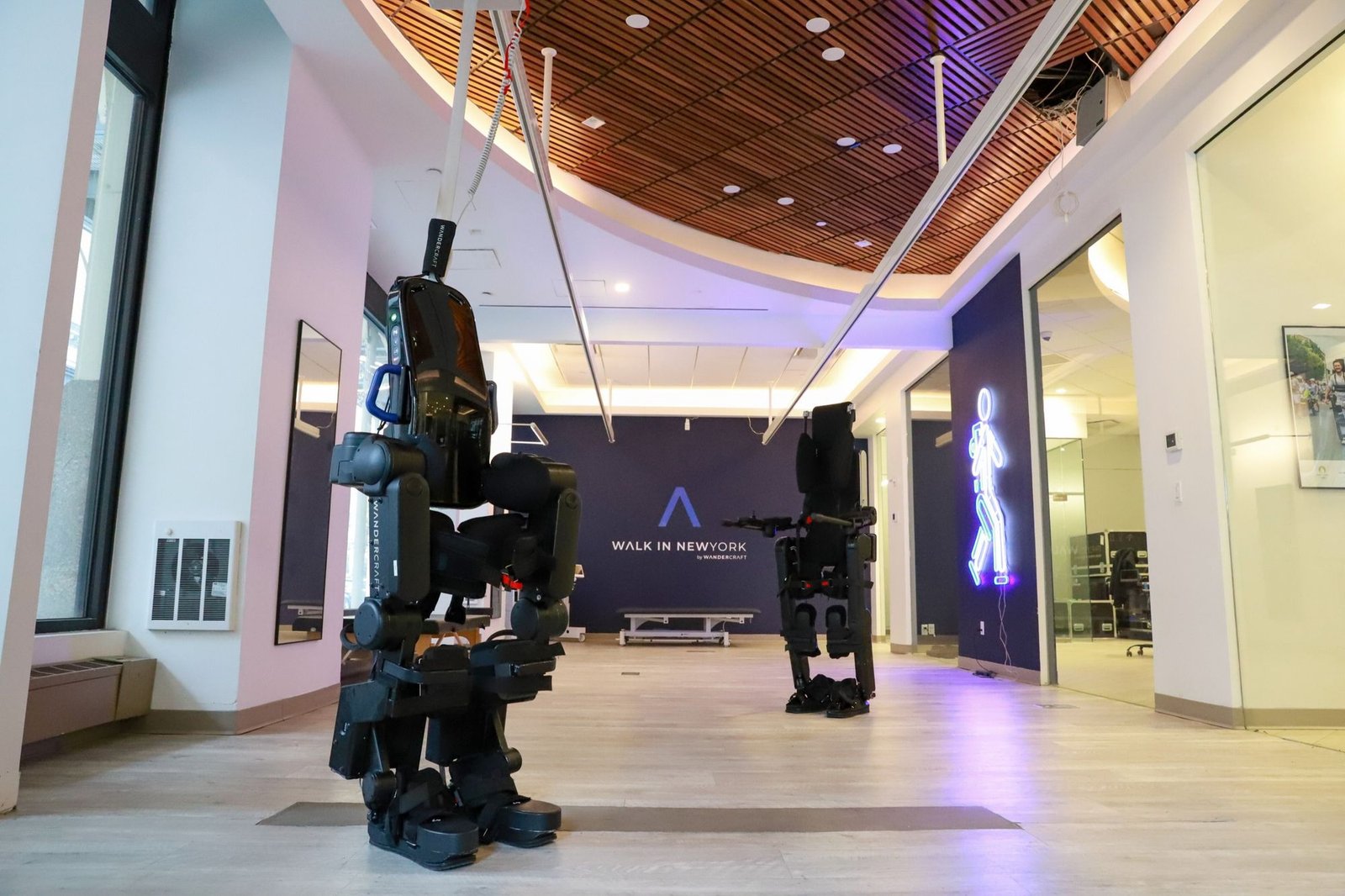
The system is self-balancing and designed to allow hands-free upright movement without crutches or a walker. Wandercraft says Eve has 12 motors and approximately four hours of battery life.
But “self-balancing” does not mean independent unattended use.
Eve must be used in the presence of a trained companion, and Wandercraft says that companion must stay within arm’s reach while the user is walking. Both the user and companion go through assessment and certification.
Training is built into the commercial pathway
Wandercraft’s process begins with pre-screening and clinical evaluation, followed by an individual fitting.
The user and companion then complete five training sessions of about two hours each. The programme covers transfers, operation of the remote controller, walking on level surfaces, activities of daily living and safety procedures. Wandercraft says the programme can be completed in as little as one week or spread across roughly 30 days.
That creates a very different commercial model from consumer walking-assistance products that can be ordered directly online.
Eve is a prescription medical device with a controlled onboarding process. The sale depends on clinical suitability, fitting, training and a support network around the user.
National Seating & Mobility gives Eve a large distribution footprint
One of the more consequential parts of Wandercraft’s U.S. plan is the distribution structure.
National Seating & Mobility will serve as the exclusive complex rehabilitation technology distribution partner for Eve. Wandercraft says the company has more than 180 locations across the United States and Canada and will support evaluation, access, delivery and service.
Other named partners fill different parts of the pathway.
Walk US will support evaluation, training, demonstrations and preparation for personal use. Good Shepherd Rehabilitation will serve as an Eve partner in Pennsylvania’s Lehigh Valley. USVetServ will act as an authorised independent distributor for the Department of Veterans Affairs and other VA facilities.
The result is a distribution model built around specialist rehabilitation and durable medical equipment channels rather than a normal retail storefront.
Medicare remains one of the biggest commercial questions
The U.S. reimbursement environment for personal lower-limb exoskeletons changed materially when Medicare established a payment pathway under HCPCS K1007.
Wandercraft says its access specialists will help users and care teams with claim submissions, coverage requirements, reimbursement questions and financing options.
The company also says it anticipates Eve could become eligible for Medicare reimbursement within 60 to 90 days.
That language needs to be read carefully. At the time of writing, Wandercraft is describing an expected future reimbursement position, not a confirmed current Medicare payment amount for Eve.
There is also no public retail price for Eve in the material reviewed by Exoskeleton Index.
That makes the commercial launch important, but still incomplete from a price-transparency perspective. For medical exoskeletons, the access pathway can matter as much as the sticker price, which is why our Exoskeleton Price Intelligence guide keeps manufacturer pricing, procurement and reimbursement separate.
Exoskeleton Index analysis
Eve’s launch matters because it tests whether self-balancing exoskeleton technology can move from supervised rehabilitation into structured personal use.
Wandercraft already has experience with Atalante X in clinical environments. Eve is a more difficult commercial proposition because the company must support use outside the clinic while maintaining a tightly defined safety and training model.
The distribution architecture suggests Wandercraft understands that the product cannot scale through hardware alone.
Prescription, evaluation, fitting, companion training, reimbursement support, servicing and local partners are all being built into the route to market. That is the infrastructure personal medical exoskeletons need if they are going to move beyond small numbers of highly specialised users.
The companion requirement also illustrates an important distinction between “hands-free” and “independent.” Eve can balance without crutches or a walker, but the current intended-use model still requires another trained person to be present.
Commercial success will therefore depend on more than the engineering performance of the robot. It will depend on whether eligible users can realistically complete the access process, secure funding, train with a companion and integrate Eve into daily routines.
Where Eve can and cannot be used
Wandercraft says Eve is intended for level indoor areas and level surfaces in immediately adjacent open-air spaces that are part of a building, such as a patio, terrace or courtyard.
The company says the system is not intended for stairs, slopes, ramps, wet or icy ground, crowded areas, parking lots, roadways or sport. It should not be used to cross a public street.
Those limitations are important when interpreting “personal mobility.” Eve expands upright mobility into everyday environments, but it is not positioned as an all-terrain replacement for a wheelchair.
Wandercraft itself describes the system as a complement to the wheelchair rather than a replacement.
What to watch after 17 September
The launch event with United Spinal Association will mark the start of commercial availability, but the strongest evidence will come afterward.
The most important signals are a published price or financing structure, confirmation of Medicare eligibility, the number of evaluation and training sites, first completed home deliveries and evidence showing how users integrate the system into daily life.
It will also be important to see whether Wandercraft’s distribution partners can make the structured access pathway work outside a handful of specialist centres.
If that model scales, Eve could become one of the clearest tests yet of whether self-balancing personal exoskeletons can develop a sustainable U.S. market.
Explore the Eve product profile, the Wandercraft company profile and Exoskeleton Index’s healthcare and rehabilitation directory.