
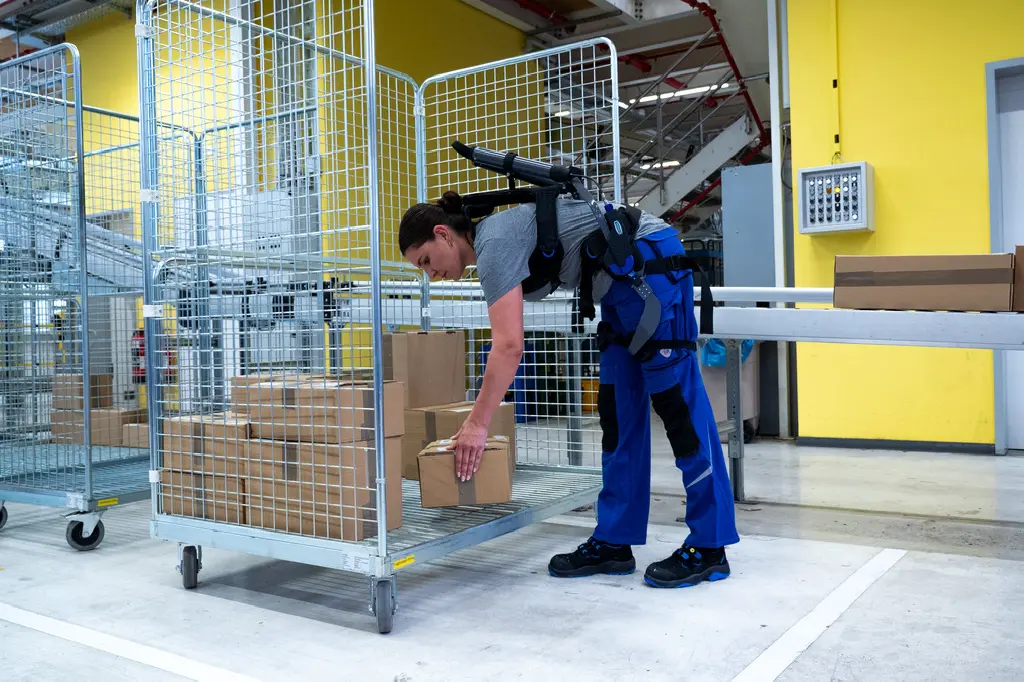
German handling-technology specialist Schmalz has expanded its industrial exoskeleton portfolio with NEXO Pro, a passive lower-back support system weighing about 5 kg and aimed at lifting, order picking, machine loading and other tasks involving repeated or prolonged forward bending.
At a glance
- Company
- J. Schmalz GmbH
- Product
- NEXO Pro
- Type
- Passive forward-bend / lower-back exoskeleton
- Weight
- Approximately 5 kg
- Reported support
- Up to 30% reduction in back strain, according to Schmalz
- Power
- No battery or external energy source
- Sizes
- T3 for users up to 175 cm; T4 from 170 cm upward
- Commercial status
- Listed as a new orderable product in Schmalz’s catalogue; public price not displayed
NEXO Pro targets bending and lifting rather than overhead work
Schmalz announced the NEXO Pro on September 1 as a new addition to its ergonomic manual-handling range.
The official product page positions the passive system around lower-back support during dynamic trunk flexion, such as picking up and setting down goods, as well as tasks where workers remain bent forward for longer periods.
Schmalz lists applications including logistics order picking, paving and tile work, loading and unloading metal- or woodworking machines, and mounting large components that require forward-leaning postures.
The system uses a stable frame, ergonomic vest, adjustable lap belt and padded leg supports. A control unit allows the wearer to activate the assistance and adjust support strength and timing for different tasks.
Unlike powered exoskeletons, NEXO Pro does not use motors, a rechargeable battery or an external energy source.
Schmalz claims up to 30% lower-back relief
Schmalz says NEXO Pro can reduce strain on the back by up to 30% without further compressing the spine.
The device weighs approximately 5 kg and is available in two sizes. T3 is intended for users up to 175 cm tall, while T4 begins at 170 cm; the T4 product specification lists a maximum user height of 200 cm.
Textile components are removable and washable, and the company emphasizes tool-free adjustment so that wearers can adapt the fit without specialist equipment.
The product is already listed in Schmalz’s catalogue under separate T3 and T4 part numbers. Prices are not publicly shown on the product page; Schmalz directs users to log in or contact the company for current pricing and availability.
This is an expansion, not Schmalz’s first move into exoskeletons
NEXO Pro does not mark Schmalz’s entry into wearable ergonomics.
In March 2025, the company announced that it was expanding its manual-handling portfolio with MATE exoskeletons for lower-back and upper-body support. Its current catalogue still includes the passive MATE UTB upper-body system for chest-height and overhead work.
That makes NEXO Pro more interesting as a portfolio development than as a first product.
Schmalz is best known for industrial handling technologies including vacuum automation and lifting systems. The company’s continued addition of body-worn support suggests exoskeletons are being treated as another tool within a broader ergonomics and material-handling offer rather than as a separate robotics category.
Exoskeleton Index analysis
That portfolio context is the most important part of this launch.
The industrial exoskeleton market has historically been shaped by specialist wearable-robotics companies. Schmalz approaches the problem from the opposite direction: it already sells equipment designed to help workers move and handle loads, and exoskeletons sit next to vacuum lifters, cranes and other ergonomic systems.
For buyers, that changes how the technology may enter a workplace.
An exoskeleton is not always a replacement for lifting equipment. In many tasks, fixed or semi-fixed handling devices are preferable because they can take the load away from the worker entirely. Wearable support becomes more relevant when the task remains mobile, variable or difficult to automate and workers still need freedom to move.
NEXO Pro is therefore competing not only with other back-support exoskeletons but with alternative ergonomic interventions.
Its passive architecture removes battery management and charging from the deployment equation. The trade-off is that passive systems cannot actively generate powered assistance in the same way as motorized devices. Whether that balance is useful depends on the specific task, posture, duration and worker.
Schmalz’s catalogue approach is another sign of maturation. Industrial exoskeletons are increasingly being sold by companies that already have established relationships with manufacturing and logistics customers, which could reduce the friction of discovery, demonstrations and after-sales support.
How NEXO Pro fits into the back-support market
Back-support exoskeletons are already one of the most established industrial categories.
For example, SUITX by Ottobock’s IX Back Air is a passive back-support system used for lifting and bending, while Paexo Back represents another established passive approach. Different systems vary significantly in weight, force transfer, range of motion and the tasks they are designed to support.
Schmalz’s own NEXO Pro weighs about 5 kg, so buyers should not evaluate the “30% relief” claim in isolation. Device weight, fit, freedom of movement, heat, task duration and user acceptance all matter in real deployment.
Exoskeleton Index’s practical buyer’s guide recommends comparing exoskeletons against a defined task profile rather than choosing from headline support figures alone.
What remains unknown
The “up to 30%” back-relief figure is a Schmalz-reported product claim. The public launch material does not provide a peer-reviewed study, detailed test protocol, participant count or independent validation supporting that figure.
Schmalz also does not display a public purchase price on the product page, and the announcement does not identify major customer deployments, installed-unit numbers or long-term workplace outcome data.
The company’s press release describes the passive system as requiring no external power, battery or maintenance. In practice, buyers should still account for inspection, fit checks, hygiene and replacement of wearable textile components as part of normal operational use.
Why this launch matters
NEXO Pro is not the most radical exoskeleton announced this week. It is arguably more representative of how the industrial market may scale.
A mature handling-equipment supplier is placing a passive exoskeleton directly into an existing industrial catalogue, with defined sizes, spare textile kits, application examples and product part numbers.
That is less dramatic than a prototype reveal, but commercially it matters.
Recent deployments such as Athens International Airport’s rollout of 15 passive back-support exoskeletons show that buyers are increasingly moving beyond demonstrations when the task fit is clear. Schmalz is positioning NEXO Pro for the same broad class of repetitive bending and lifting problems across logistics and manufacturing.
The next useful evidence will come from customer deployments and independent ergonomic testing rather than additional product claims.