
One of the biggest barriers to making exoskeletons feel natural in the real world may not be motors or batteries. It may be the need for the machine to decide what activity the user is performing before it knows how to help.
A new Perspective published in Nature Machine Intelligence on 24 August argues that lower-limb exoskeleton control should increasingly move away from discrete activity modes and toward end-to-end artificial-intelligence systems capable of estimating the user’s physical state continuously.
The proposed direction is known as task-agnostic exoskeleton control.
The concept is ambitious: instead of switching between separate controllers for walking, running, stairs or other movements, the exoskeleton estimates the biological joint moments the wearer is producing and uses those estimates to determine assistance in real time.
At a glance
- Publication: Nature Machine Intelligence Perspective.
- Published: 24 August 2026.
- Core idea: Replace or reduce discrete task classification with end-to-end AI-driven assistance.
- Physiological signal: Real-time estimates of biological joint moments.
- Potential benefit: One control framework that can adapt across a much broader range of human movements.
- Main challenges: Safety, optimization, robustness and the amount of training data required.
- Evidence context: The Perspective builds on previous experimental research rather than reporting a new commercial product or clinical trial.
Why current exoskeleton “modes” are a problem
Many powered lower-limb exoskeletons use some form of activity recognition.
The system identifies a movement or terrain condition and selects an appropriate control strategy: level walking, stairs, incline, running, standing or another predefined task.
That works well when human movement fits cleanly into predefined boxes.
Real life does not.
A person can slow down, turn, step sideways, lift an object, change gradient, stumble, bend, transition from walking to standing or perform movements that the system’s designers never explicitly programmed.
The new Perspective argues that this creates a fundamental scalability problem. Human movement is continuous and effectively unlimited, while a library of task-specific controllers is necessarily finite.
The alternative: estimate what the body is doing directly
The task-agnostic approach attempts to shift the question.
Instead of asking:
“Is the person walking uphill or climbing a stair?”
the controller tries to estimate:
“What biological joint moment is this person generating right now, and how should the device assist it?”
The authors describe end-to-end AI control systems that use real-time estimates of physiological state, particularly biological joint moments, as a potential foundation for more flexible assistance.
In simple terms, a biological joint moment describes the rotational demand being generated around a joint by the human body.
If the exoskeleton can estimate that demand accurately and quickly, assistance can potentially be based on the user’s movement itself rather than a manually selected activity category.
Exoskeleton Index analysis
This is strategically important because the long-term consumer exoskeleton will probably not win by offering 30 modes instead of 20. The better experience is likely to be a system that needs fewer visible modes because it understands movement continuously in the background. The same principle matters in industrial environments, where workers rarely repeat perfectly identical motions all day.
This is a roadmap, not a new performance trial
The distinction matters.
The 2026 Nature Machine Intelligence paper is a Perspective. It synthesizes recent work and identifies the technical problems that need to be solved for task-agnostic control to become broadly deployable.
It should not be reported as a new trial proving that an AI-controlled exoskeleton is ready for mass-market use.
There is, however, substantial experimental work behind the argument.
A 2024 Nature study demonstrated the underlying approach across 28 activities
Several authors of the new Perspective were involved in a major Nature paper published in 2024 that tested task-agnostic control using biological joint-moment estimation.
The researchers trained a deep neural network to estimate hip and knee moments and deployed the system across 28 activity groups and 66 conditions, ranging from conventional locomotion to less structured movements.
The network achieved an average R² of 0.83 against ground-truth hip and knee moments.
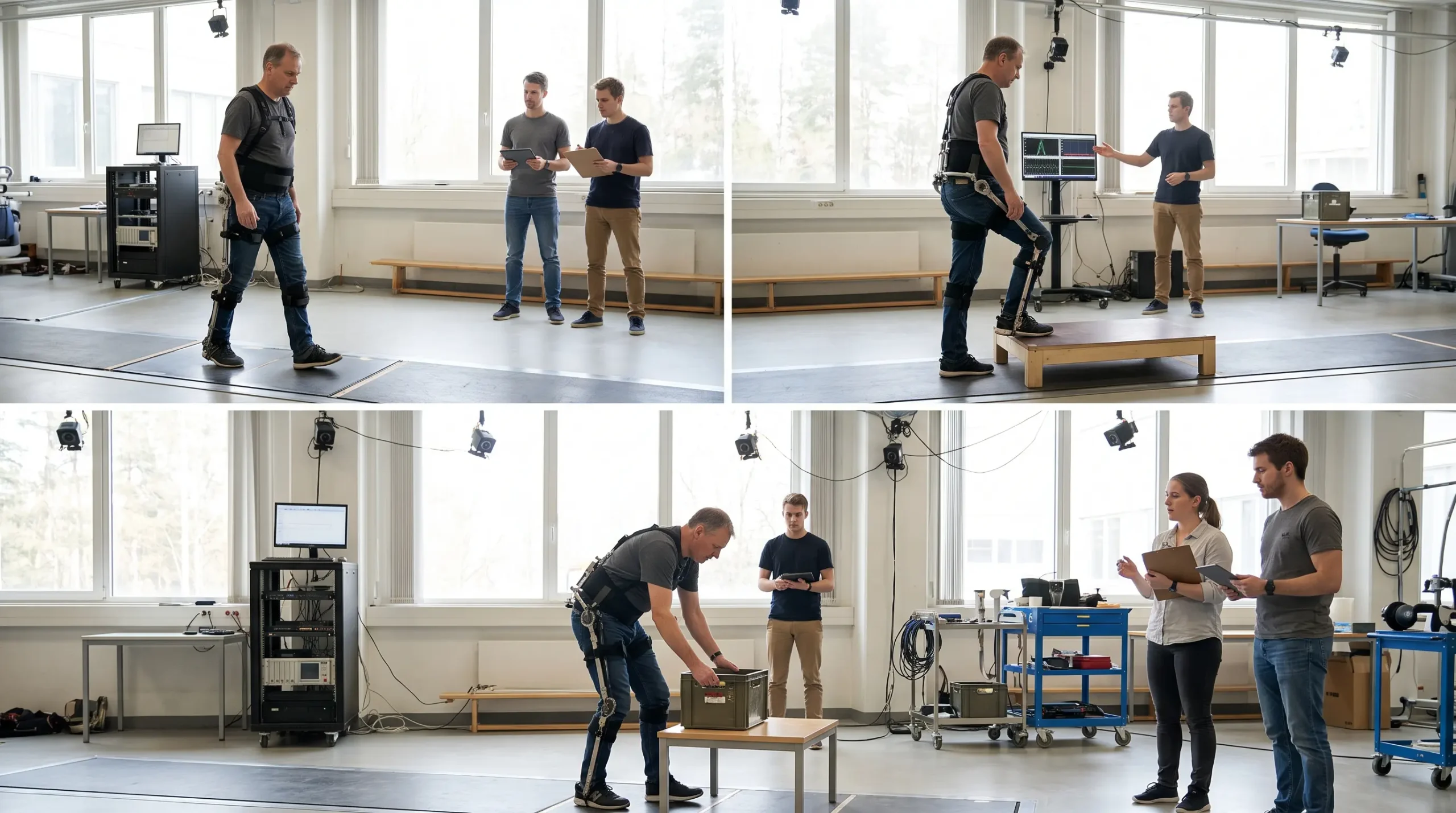
The researchers then evaluated assistance during ten activities including level walking, running, lunging and lifting an approximately 11 kg load.
Depending on the activity, the controller reduced either metabolic cost or lower-limb biological joint work by between 5.3% and 19.7% relative to the zero-torque condition, without manually changing the controller between activities.
Those results do not mean that every task-agnostic controller will deliver a 5–20% benefit. The outcome measure differed depending on the task, and the experiment used a specific research platform and participant group.
What it demonstrated more clearly was that one data-driven control approach could operate across a much wider movement set than the conventional mode-by-mode architecture.
The data burden is enormous
AI systems do not become task-agnostic simply by replacing a rules-based controller with a neural network.
The 2024 study illustrates the scale of the training problem.
The published dataset included 15 users in the training data performing the 66 conditions across the 28 task groups, with a separate ten-user validation dataset. In total, the researchers released more than 22 million ground-truth joint-moment labels across the lower limbs.
Collecting high-quality biomechanical data at that scale is expensive and technically demanding.
The 2026 roadmap therefore identifies reducing the training-data burden as one of the major challenges for the field.
Safety becomes more complicated when the controller is more flexible
A mode-based controller has an important advantage: its expected behaviour can be bounded around a defined activity.
An end-to-end AI controller has to behave safely in movements and environments that may differ from the data on which it was trained.
The new Perspective explicitly identifies safety mechanisms as a key requirement alongside optimization and robustness.
This is particularly important because an exoskeleton is not software acting on a screen. The controller commands motors that apply physical torque directly to a moving human body.
Failure modes therefore need to include more than prediction accuracy.
Developers need to consider uncertainty, unexpected movements, sensor errors, unusual user biomechanics, hardware faults, environmental transitions and what the device should do when confidence is low.
The commercial implication: control software is becoming part of the product moat
Consumer exoskeleton marketing still tends to emphasize visible hardware specifications such as motor output, torque, device weight and battery range.
Those specifications matter.
But two devices with similar actuators can feel radically different if one applies assistance naturally and the other repeatedly fights the user’s movement.
As the hardware supply chain matures, control software may become one of the more defensible differentiators between competing exoskeleton platforms.
This is already visible in the consumer market, where companies increasingly promote adaptive or AI-assisted gait control alongside mechanical specifications.
The broader market analysis is similar. In our 2026 exoskeleton market outlook, we identified control systems, movement data and human-robot interaction expertise as reusable assets that can create value beyond an individual product.
The research has a direct link to commercial wearable robotics
The author group spans Northeastern University, Georgia Institute of Technology and other research institutions, while one author is affiliated with Skip Innovations.
That affiliation is worth noting because Skip is developing consumer-oriented powered mobility technology.
It should not, however, be interpreted as an announcement that Skip has deployed the control architecture described in the Perspective in a commercial product.
The paper is a research roadmap and the authors declare no competing interests.
Why task-agnostic control matters beyond consumer walking
A controller capable of adapting continuously could have implications across several exoskeleton markets.
Consumer mobility
Outdoor users transition constantly between gradients, speeds, steps and irregular terrain. Reducing the need to select modes could make an exoskeleton feel more like normal clothing or equipment and less like a robot that needs continual management.
Industrial work
Real jobs often combine walking, lifting, bending, carrying, squatting and reaching rather than one perfectly repeated motion. More adaptable assistance could expand the range of tasks one wearable system can support.
Ageing and mobility assistance
People with age-related mobility decline may particularly benefit from interfaces that require little technical interaction. A device that adjusts automatically is potentially easier to integrate into daily life than one requiring repeated mode selection.
Research and rehabilitation
Task-agnostic controllers could allow researchers to test assistance across more realistic movement combinations and could eventually support therapeutic systems that adapt to changing patient capabilities.
Each application would require its own safety, evidence and regulatory framework.
What remains unknown
- How well task-agnostic controllers generalize to people whose biomechanics differ substantially from training populations.
- How much training data will ultimately be required.
- Whether one model can transfer reliably between different exoskeleton hardware platforms.
- How uncertainty should be handled when the system encounters unfamiliar movement.
- What safety architecture regulators will expect for AI-driven physical assistance.
- The computational and battery cost of increasingly sophisticated real-time control.
- Whether commercial users perceive a meaningful improvement over well-designed task-specific controllers.
The bigger direction is becoming clearer
The exoskeleton industry has spent years improving actuators, batteries, materials and mechanical design.
Those improvements remain necessary. But the next performance frontier increasingly involves understanding the wearer.
The 2026 Nature Machine Intelligence roadmap argues that genuinely useful real-world exoskeletons may need to move away from thinking in a finite set of predefined tasks and instead continuously estimate the forces the human body is already trying to produce.
If that approach can be made safe, robust and data-efficient, the result could be an important change in how wearable robots are designed.
Instead of users adapting their movements to the machine’s modes, the machine increasingly adapts itself to the user.
Explore the broader wearable robotics market, browse current systems in the product directory, or see how control quality affects real-world consumer use in our hiking exoskeleton analysis.
Sources
- Shepherd et al., “A roadmap for end-to-end task-agnostic exoskeleton control,” Nature Machine Intelligence, published 24 August 2026. DOI: 10.1038/s42256-026-01297-7.
- Molinaro et al., “Task-agnostic exoskeleton control via biological joint moment estimation,” Nature 635, 337–344, 2024. DOI: 10.1038/s41586-024-08157-7.
- Associated open research dataset and model resources released with the 2024 Nature study.
Editorial note: The 2026 publication is a research Perspective rather than a new clinical or commercial product trial. Experimental performance figures in this article refer to the separate 2024 Nature study and should not be generalized to other exoskeletons.