
Dephy has expanded its Sidekick powered-walking system with a second footwear design for standard-to-wide feet, extending available sizing from women’s 4 through men’s 16. The update is not a new motor or control algorithm, but it addresses a less glamorous issue that can decide whether consumer exoskeleton assistance is useful at all: fit.
The shoe is part of the exoskeleton, not an accessory
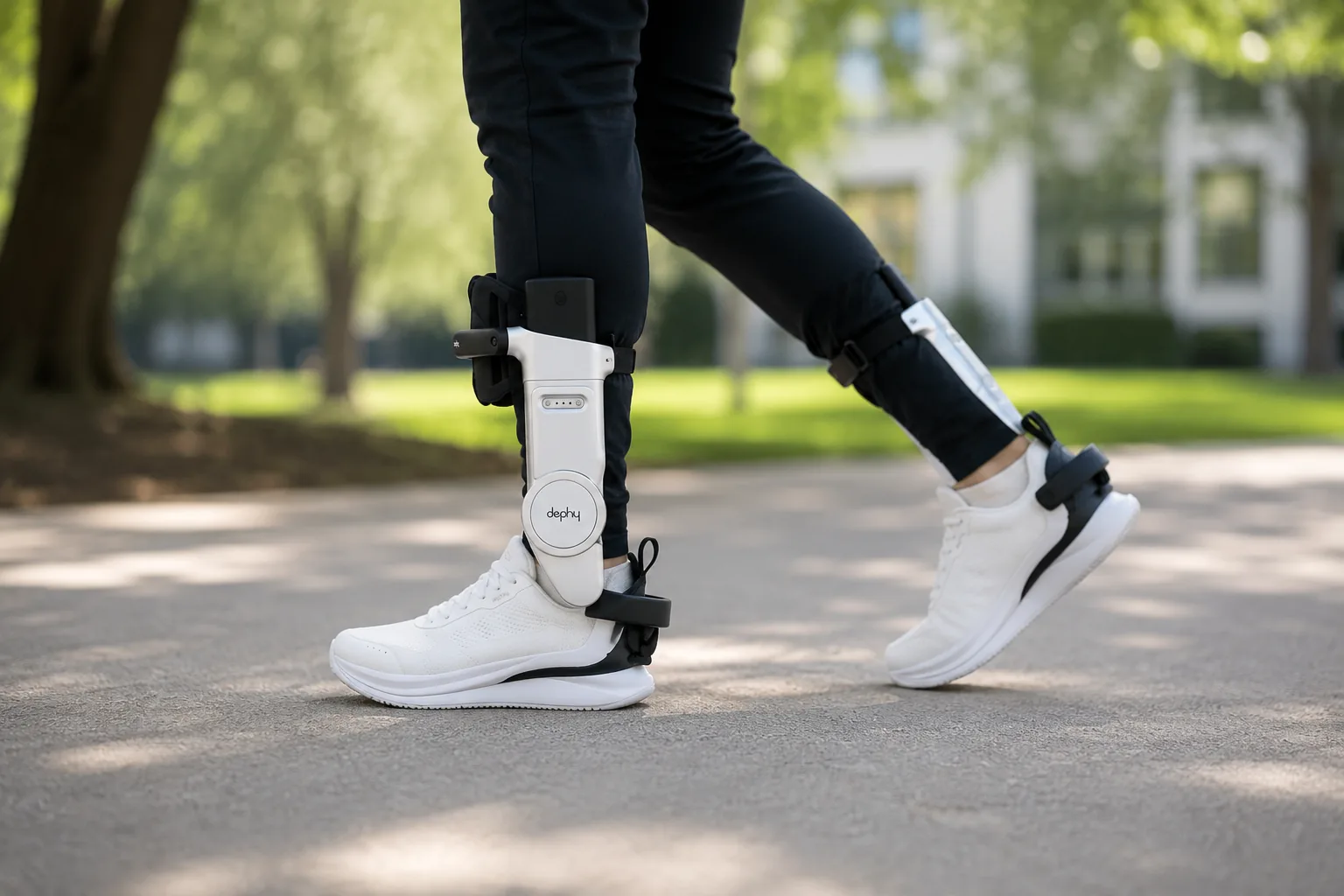
Sidekick provides powered assistance around the ankle during push-off. That means the path from actuator to foot to ground is part of the mechanical system.
Dephy’s two footwear designs are built around a structural ground-reaction plate and attachment interface that transfers powered force from the wearable device through the shoe.
The original shoe was better suited to standard-to-narrow feet. The new version uses a wider last, softer foam, less arch support and a different entry design for users who need more width or a different comfort profile.
For ordinary footwear, poor fit is uncomfortable. For powered footwear, poor fit can also interfere with how assistance feels, how long the product can be worn and whether the user wants to put it on again tomorrow.
What Sidekick is designed to do
Dephy positions Sidekick as a consumer wellness and mobility product for people who can already walk independently and want walking to feel easier. It is not a medical device and is not intended as a rehabilitation system.
The current product uses powered ankle assistance rather than a hip or knee frame. Dephy says the system learns the user’s gait during roughly the first 20 strides, then applies assistance during the push-off phase of walking.
The company lists three power levels and says the device responds to movement 1,000 times per second. Sidekick weighs about 1.4 kg per side including battery, according to Dephy, with a stated real-world range of approximately 3–5 miles per charge depending on power level, pace and terrain.
That architecture is relevant because the ankle contributes substantial positive power during normal walking. Supporting push-off can reduce the muscular work required from the calf and plantarflexor system without placing a full powered structure across the hip and knee.
Why fit becomes a commercialization question
Exoskeleton research often focuses on torque, metabolic cost and muscle activity. Consumer adoption adds another layer: the benefit has to exceed the burden of wearing the device.
That balance is especially important for augmentative systems used by people who can already walk.
A 2023 study in Communications Engineering used a Dephy ExoBoot research platform to measure how participants valued powered ankle assistance during uphill walking. The assistance itself produced a positive perceived economic value, but the added mass and burden of wearing the exoskeleton offset much of that benefit on average. Results also varied substantially between participants.
The study was not a test of the current Sidekick consumer product and should not be used to quantify Sidekick performance.
What it does show is a broader design principle: assistance cannot be evaluated in isolation. Weight, comfort, inertia, fit and user preference all influence whether a wearable robot creates net value for the person wearing it.
That makes a footwear-fit expansion more consequential than it might appear from the announcement alone.
Personalisation is also supported by earlier Dephy research
A separate 2022 Nature study used a portable ankle exoskeleton developed with Dephy hardware to show that assistance could be personalised while people walked in real-world conditions rather than only through lengthy laboratory optimisation.
Again, that research platform is not the same as the commercial Sidekick sold today.
But it supports the technical direction behind adaptive ankle assistance: different users do not necessarily benefit from the same assistance profile, and the controller has to work with the person rather than simply apply a fixed amount of power.
Sidekick’s commercial challenge is to translate that research lineage into something much simpler than a laboratory system: put on the footwear, attach the devices, walk, and receive useful assistance without expert tuning.
Nike gives the ankle-powered category another strategic signal
Dephy is also the robotics partner behind Nike’s Project Amplify, a separate powered-footwear programme announced in 2025.
Nike says more than 400 athletes had accumulated more than 2.4 million steps across over nine hardware versions during Project Amplify development. Nike plans a broader consumer launch in the coming years.
Project Amplify is not Sidekick, and Nike’s testing should not be presented as validation of Dephy’s commercial product.
It is still relevant to the market because it shows that one of the world’s largest footwear companies sees powered assistance at the ankle as a consumer product direction worth developing.
That is a strong strategic signal for a category that, only a few years ago, was primarily discussed inside biomechanics laboratories.
Sidekick is testing a different consumer-exoskeleton architecture
The fast-growing outdoor exoskeleton market is often associated with powered hip systems. Sidekick takes a different approach by concentrating assistance lower in the kinetic chain and integrating the system with purpose-built footwear.
Neither architecture is automatically superior.
Hip systems can deliver assistance around large proximal joints and may be easier to package around a waist belt. Ankle systems target push-off more directly but have to solve mass, footwear integration and force transmission close to the foot.
The market will ultimately decide which designs users prefer for different tasks.
Sources
- Dephy, Sidekick footwear expansion announcement, 6 August 2026.
- Dephy, Sidekick technical overview and specifications.
- Medrano et al., economic value of augmentative exoskeletons, Communications Engineering, 2023.
- Slade et al., personalising exoskeleton assistance in real-world walking, Nature, 2022.
- Nike, Project Amplify development and testing, 2025.
Explore the ecosystem
View the Dephy Sidekick product profile, explore the Dephy company profile, or compare more systems in the Exoskeleton Index product directory.