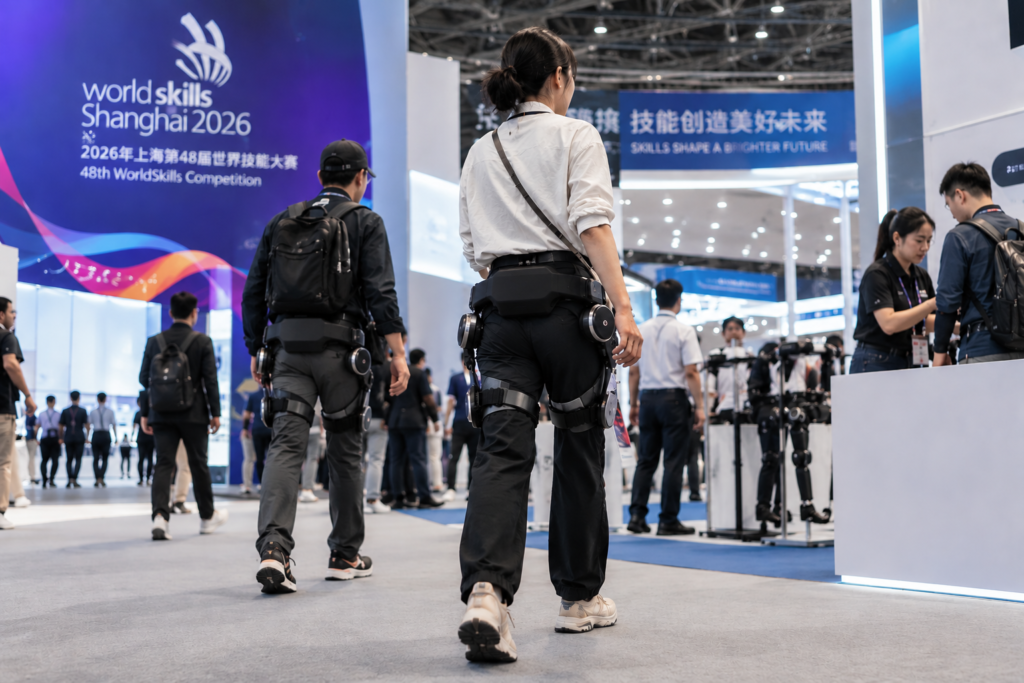


Ascentiz has opened direct commercial sales of its H Pro and H Ultra powered hip exoskeletons, with launch MSRPs of $1,499 and $1,999 respectively. The move matters because it takes the H Series beyond trade-show demonstrations and early testing into a more ordinary consumer-commerce test: published pricing, sizing, fulfilment, returns and direct customer support.
Commercial availability is more important than another launch announcement
Ascentiz introduced the H Series publicly before opening general sales, but the 6 August announcement moves the product into a different phase.
The H Pro and H Ultra can now be purchased through the company’s online store. The H Pro was announced with an MSRP of $1,499 and H Ultra at $1,999. As of 30 August 2026, Ascentiz lists H Pro at a promotional price of $1,299, reduced from $1,499, and H Ultra at $1,699, reduced from $1,999. The store is also advertising limited-time accessory gifts, including attachment mounts and a randomly selected motor-cover set. Pricing and offers may change.
Check current Ascentiz H Pro & H Ultra pricing →
Affiliate link. We may earn a commission at no extra cost to you.
That may sound like a retail detail, but it is an important market signal.
A prototype only needs to demonstrate that the engineering concept works. A consumer product has to survive sizing errors, returns, battery complaints, customer expectations, shipping, support tickets and repeated real-world use.
Consumer exoskeletons are increasingly being tested on those terms.
What the H Series is designed to do
The H Pro and H Ultra provide powered assistance at the hips. Ascentiz positions them for users who can already stand, balance and walk independently and want assistance during walking, hiking, travel and other supported activities.
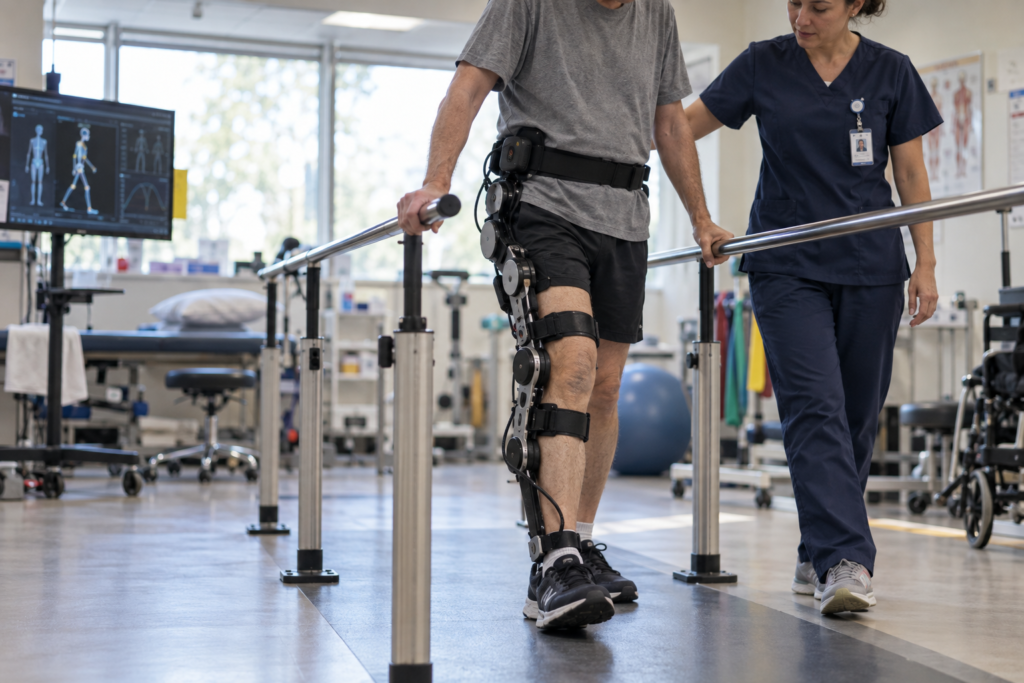
The systems are not medical devices and are not intended to diagnose or treat a condition.
Ascentiz says sensors and its motion-recognition software time assistance to the user’s stride and adapt across different movement types. The company’s current use guide lists everyday walking, stairs, hiking and travel among supported activities and advises users to begin on stable, level surfaces while learning how the device responds.
H Pro is rated by Ascentiz at 1,000 W peak power with dual 22 Nm torque figures, while H Ultra is listed at 1,100 W with dual 24 Nm. The company lists both systems at about 2.5 kg and gives a current fit range of approximately 155 to 200 cm in height, 65 to 145 cm at the waist and 40 to 80 cm around the thigh.
Those are manufacturer specifications. Real-world comfort and assistance will still depend on body geometry, strap adjustment, gait, terrain and selected mode.
The modular platform is the more ambitious part of the strategy
Ascentiz is not presenting the H Series as a fixed single-purpose device.
The company uses a shared Exo-Belt architecture intended to support interchangeable assistance modules. The H module provides hip propulsion, while Ascentiz says a K module for knee support is moving into production. H Ultra also includes expanded developer access through the company’s BodyOS platform and SDK.
If that ecosystem develops as described, modularity could create a different ownership model from buying a completely separate device for each joint or use case.
But the distinction between platform ambition and delivered functionality matters. Buyers evaluating H Pro or H Ultra today should judge the current hip-assist system on what is available now. Future modules and third-party applications should not be priced into the purchase as if the full ecosystem were already established.
Where the “35% less work” claim sits
Ascentiz’s launch material says the H Series can reduce the work of walking by up to 35%. Its product marketing also uses related language around feeling lighter, reducing effort and assisting uphill movement.
Those statements should be treated as company performance claims unless the underlying test protocol and independent results are published.
The broader scientific premise is credible. Powered assistance at the hip can reduce the metabolic cost of walking under controlled conditions. A 2019 Science study of a portable exosuit that assisted hip extension reported a 9.3% reduction in metabolic rate during treadmill walking at 1.5 metres per second.
Other powered hip-exoskeleton research has also reported metabolic reductions, with results depending on device architecture, control strategy, participant population and walking condition.
That literature supports the idea that well-timed hip assistance can make walking physiologically easier. It does not validate Ascentiz’s specific 35% figure, because the device, participants, terrain, assistance metric and testing protocol are different.
Range claims also need real-world context
Ascentiz lists a maximum range of 25 km for H Pro and 50 km for H Ultra using two removable batteries.
The company’s own use guide correctly adds an important caveat: actual distance varies with assistance mode, terrain, speed, temperature, carried load, battery condition and fit.
That qualification should be central to how buyers read consumer exoskeleton range.
Unlike an e-bike travelling along a relatively predictable rolling surface, a wearable robot is responding to a human whose stride, body mass, cadence and route can change continuously. A flat urban walk and a steep trail are different energy problems.
For this category, independent range testing across real terrain will become more valuable than a single maximum-distance number.
A more competitive consumer exoskeleton market
Ascentiz enters a consumer segment that is becoming visibly more competitive. Products from companies including Hypershell, Dephy and other emerging wearable-robotics developers are testing different architectures for walking, hiking and mobility augmentation.
That diversity is positive for the market because it forces the category to compete on practical consumer criteria rather than novelty alone:
- price;
- weight and packability;
- fit range;
- comfort over several hours;
- battery endurance;
- terrain adaptation;
- noise;
- ease of donning and adjustment;
- returns, warranty and after-sales support.
Those are the details that can turn wearable robotics from an impressive demonstration into a product people actually keep using.
View current Ascentiz prices and availability →
Sources
Explore the ecosystem
Compare more powered exoskeleton products, explore the Outdoor, Sports & Consumer Mobility sector, or read our Exoskeleton Market 2026 analysis.