
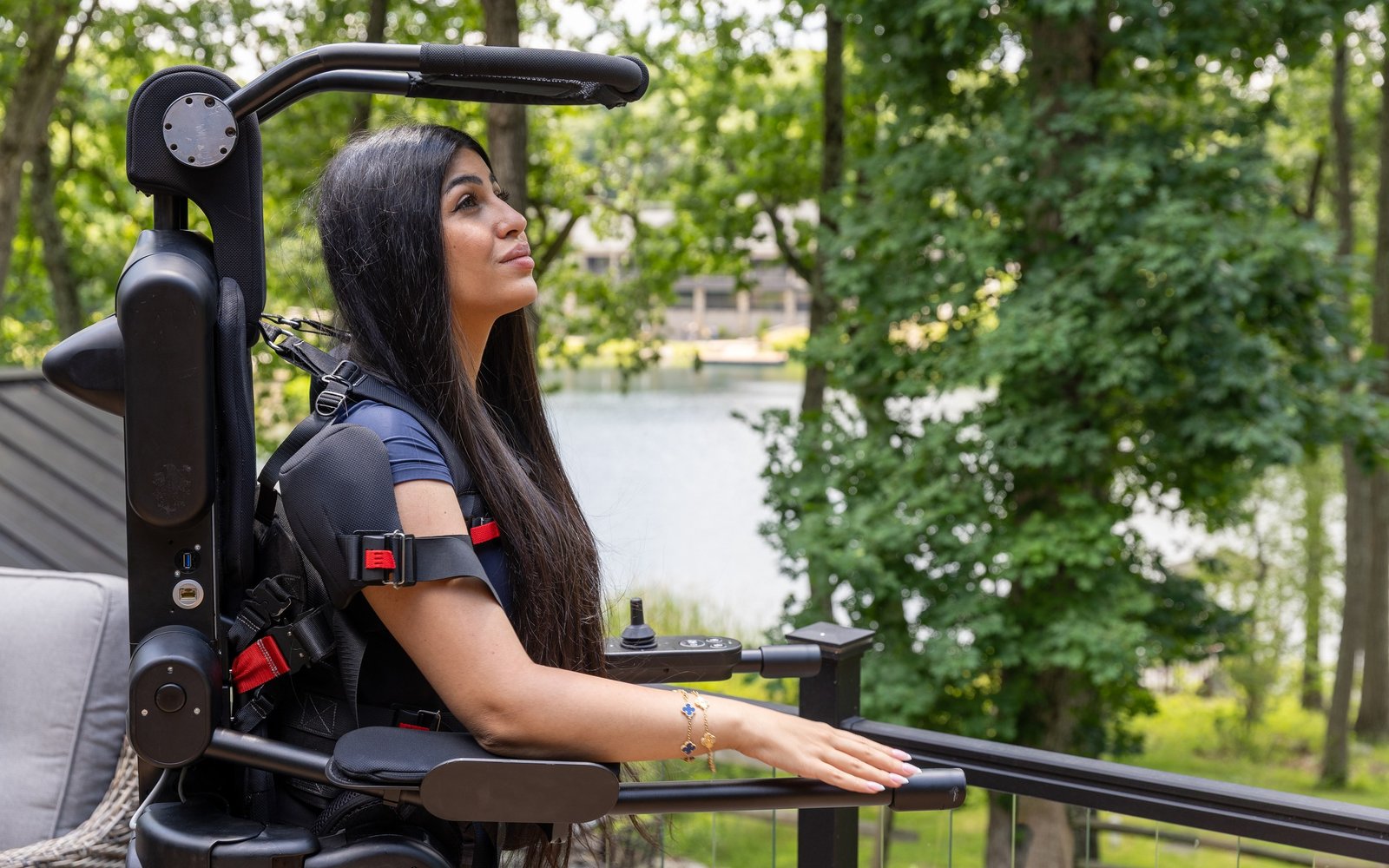
A newly registered French study will compare Wandercraft’s Eve self-balancing exoskeleton directly with a manual wheelchair across four everyday and recreational tasks. Rather than asking only whether Eve can stand or walk, the study will test how the two mobility options compare when users make coffee, brush their teeth, retrieve a parcel and perform archery.
- Study
- Personal Exoskeleton or Manual Wheelchair: a Comparison of Performance and Satisfaction in Activities of Daily Living Among People With Spinal Cord Injuries
- Registry
- NCT07828912
- Product
- Eve
- Company
- Wandercraft
- Comparator
- Manual wheelchair
- Lead sponsor
- Centre Mutualiste de Rééducation et de Réadaptation Fonctionnelles de Kerpape
- Collaborators
- Groupement des Hôpitaux de l’Institut Catholique de Lille and Wandercraft
- Study status
- Not yet recruiting as of 22 September 2026
- Planned enrollment
- 5 participants
- Study design
- Single-case experimental design with repeated within-participant comparisons
- Tasks
- Archery, retrieving a parcel, making coffee and brushing teeth
- Primary outcome
- Participant-rated performance and satisfaction using the Canadian Occupational Performance Measure
- Secondary outcomes
- Clinician-rated performance, task-completion time, Eve usability, psychosocial impact, perceived exertion and device reliability
- Planned study period
- October 2026 to April 2027
The study asks a more useful question than whether Eve can walk
Personal exoskeleton research has historically focused heavily on walking speed, walking distance, standing time and whether a user can successfully complete a mobility protocol.
Those outcomes remain useful, but they do not fully answer the question that matters once an exoskeleton moves into personal use: what does being upright actually allow someone to do?
The new study, known as KER-EXHOME and registered as NCT07828912, is designed around that question.
Participants will use both Eve and their manual wheelchair to perform the same set of tasks.
The comparison therefore goes beyond showing that an activity can be completed while wearing an exoskeleton. It creates a direct within-participant test of how the experience differs depending on the mobility technology being used.
Four tasks are designed to expose different mobility trade-offs
The protocol divides the activities into two groups.
The first combines archery and retrieving a parcel. The second combines making coffee and brushing teeth.
That mix is useful because the tasks place different demands on the user.
Making coffee and brushing teeth involve interacting with surfaces and objects commonly positioned for standing users. Retrieving a parcel introduces reaching and object handling. Archery tests an activity where upright posture and availability of the upper limbs may create a different experience again.
Eve’s self-balancing architecture is particularly relevant here.
Unlike personal exoskeletons that depend on crutches or a walker for balance, Eve is designed to keep the user upright while leaving the hands available.
Wandercraft already highlights activities such as food preparation, opening doors and personal care as examples of the system’s intended hands-free use.
The new study will begin putting that positioning into a structured comparative framework.
Each participant will use both Eve and a wheelchair
The protocol is not designed around separate “exoskeleton” and “wheelchair” participant groups.
Each participant will perform tasks using both devices.
During the intervention phase, participants are scheduled for 3.5-hour sessions from Monday to Friday. The order of the mobility device, task group and time of day will be randomized.
That approach reduces one obvious source of comparison error: differences between people.
Instead of comparing one group of exoskeleton users with a different group of wheelchair users, the study repeatedly compares each participant with themselves under the two mobility conditions.
The planned enrollment is only five people, so this remains a small study. But the repeated-measures design should provide considerably more detail about how individual performance changes between the two mobility options.
The primary outcome focuses on performance and satisfaction
The primary outcome uses the Canadian Occupational Performance Measure, or COPM.
Participants will rate both their perceived performance and their satisfaction after carrying out the selected tasks with Eve and with the wheelchair.
This is an important distinction from a simple timed test.
A wheelchair could allow a participant to complete one activity more quickly while Eve provides a different experience of reaching, interacting or participating at standing height.
Conversely, being upright does not automatically make an activity easier, faster or more satisfying.
The COPM allows the study to capture the participant’s own assessment of those differences.
The protocol also includes more objective performance measures
The study does not rely only on participant satisfaction.
Clinicians will separately assess task performance using the Performance Quality Rating Scale.
Researchers will also record the time needed to complete each task.
This creates a useful distinction between how well the participant believes they performed, how satisfied they were with the experience and how clinicians rate the observed quality and efficiency of the task.
The protocol also includes the System Usability Scale for Eve, perceived exertion ratings and a measure of the psychosocial impact of the assistive device.
Together, those measures should provide a more complete picture than simply recording whether each activity was completed.
Device reliability is part of the study
One particularly relevant secondary outcome is Eve’s reliability during repeated use.
The registry defines a fault as an interruption that prevents continued use and requires the participant to return to a seated position because no further action is possible.
Researchers plan to count those events throughout the intervention phase.
That matters because reliability requirements change when an exoskeleton moves from a supervised demonstration into everyday mobility.
A technically impressive movement capability is less useful if interruptions repeatedly prevent the user from completing normal activities.
For personal exoskeletons, reliability therefore becomes part of functional performance rather than simply an engineering metric.
The timing matters because Eve has just entered commercial use
The study appears at an important point in Eve’s development.
Wandercraft launched Eve commercially in the United States on 17 September 2026 following FDA clearance for prescribed personal use by eligible adults with spinal cord injury.
Exoskeleton Index covered that transition in Wandercraft Sets Sept. 17 U.S. Commercial Launch for Eve Personal Exoskeleton.
The commercial model is built around clinical evaluation, prescription, individualized fitting, structured user and companion training, delivery and ongoing support.
Wandercraft describes Eve as a complement to the wheelchair rather than a replacement.
That makes KER-EXHOME particularly relevant.
Instead of framing Eve and the wheelchair as competing technologies where one must replace the other, the study can begin identifying where each mobility option may be better suited to different activities.
Exoskeleton Index analysis
The most interesting part of this study is the shift in the comparison itself.
Personal exoskeletons are reaching a stage where “can this person walk in the robot?” is no longer enough to describe their value.
If these devices are going to move into homes and daily routines, the more useful question becomes: when does standing mobility create an advantage over the mobility technology the user already has?
A manual wheelchair is highly efficient for many activities. It is fast, compact, familiar and can offer a high level of independence.
A self-balancing exoskeleton may offer something different: access to standing-height environments, eye-level interaction and the ability to use both hands while upright.
Those benefits are unlikely to apply equally to every task.
That is why the task-by-task comparison is more useful than trying to declare either Eve or a wheelchair universally better.
The study also moves the evidence conversation closer to actual user and buyer questions.
Walking speed and battery life matter. But someone considering a personal exoskeleton also needs to know whether it changes what they can realistically do in a kitchen, bathroom, workplace or social environment.
If KER-EXHOME produces clear activity-level differences, it could help establish a more useful way of evaluating personal exoskeletons: not as wheelchair replacements, but as additional mobility tools whose value depends on the task.
What the study cannot tell us yet
The trial is planned for only five participants.
It is therefore not designed to establish that Eve is generally superior or inferior to wheelchair mobility across the broader spinal cord injury population.
Participants must also meet the study’s eligibility criteria and complete Eve training before the main comparison phase.
The findings will therefore apply to a selected group of users able to operate both mobility systems under the study conditions.
Most importantly, there are no results yet.
The study hypothesis and chosen outcome measures tell us what the researchers intend to test. They do not establish that Eve improves performance, satisfaction or independence.
Wandercraft is also listed as a collaborator on the study, which should remain visible when the eventual findings are interpreted.
What to watch when results arrive
The study is currently scheduled to run into 2027, so the important evidence is still ahead.
The most useful results will be the differences between the two mobility conditions rather than a single overall score.
We will be watching whether participants report higher satisfaction with Eve for particular activities, whether those preferences are supported by clinician-rated performance and what happens to task-completion time.
Perceived exertion will also matter. A task may be technically achievable while requiring substantially greater effort.
Reliability data could be equally important, particularly if interruptions occur during repeated daily-use simulations.
Most importantly, the study could show that the value of a personal exoskeleton is highly activity-dependent.
That would be more useful than a simple conclusion that either device performs better overall.
Explore the Eve product profile, the Wandercraft company profile and Exoskeleton Index’s healthcare and rehabilitation directory.