
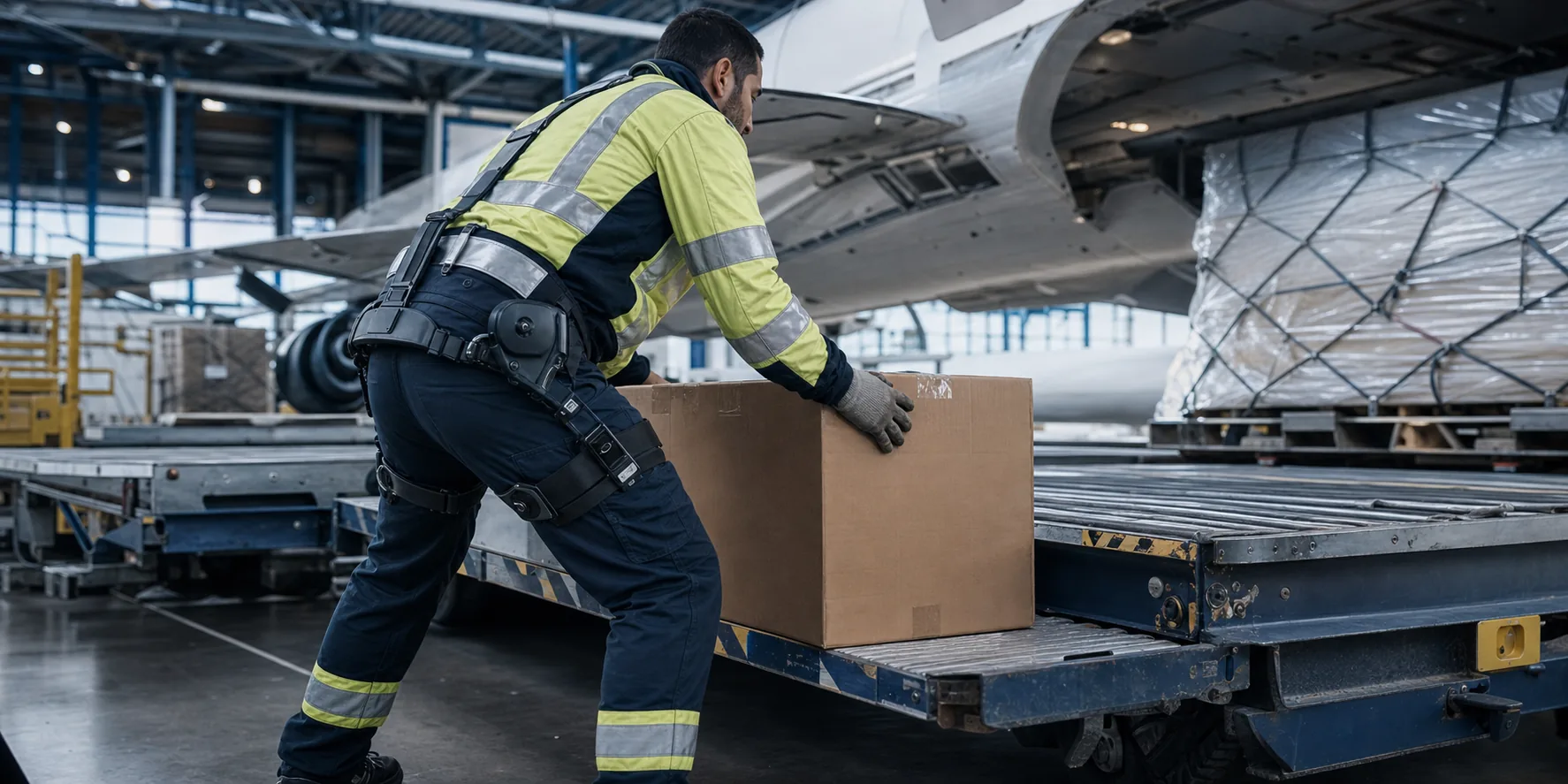
Maastricht Aachen Airport has introduced German Bionic’s Exia exoskeleton for cargo handlers working across airport cargo operations. The deployment is an important operational signal, but site-level performance and worker-outcome evidence remains limited.
At a glance
- What: Use of German Bionic Exia powered back-support exoskeletons in airport cargo handling.
- Where: Maastricht Aachen Airport in the Netherlands.
- Status: Reported operational introduction; fleet size, wearing hours and scale-up plan were not publicly documented.
- Claim boundary: German Bionic markets assistance of up to 38 kg, but this is a product claim—not a lifting-limit increase or a site-level outcome.
- Evidence gap: No public Maastricht data were located for injuries, discomfort, productivity, non-use or worker retention.
What has been introduced at Maastricht
Air Cargo News reported on 28 July 2026 that Maastricht Aachen Airport had adopted German Bionic’s Exia for cargo handling. A second independent account from aeroTELEGRAPH described daily cargo use and called Maastricht the first Dutch airport to put the system into this kind of operation. The available reports position the activity as operational use, rather than a trade-show demonstration, but they do not disclose the number of devices, start date for each shift, exact handling zones, or proportion of cargo handlers covered.
That distinction matters. “Operational” can mean a small group is wearing a device during selected lifts; it does not necessarily mean every suitable worker uses it throughout a shift. The published material also does not clearly separate apron work from warehouse handling. MST Cargo’s description of its Maastricht service spans aircraft loading and unloading, warehouse work, trucking coordination and related cargo processes, so a precise task map is still needed.
What Exia is designed to do
Exia is a powered back-support exoskeleton from German Bionic. The manufacturer describes an adaptive system that uses sensors and software to recognize movements and adjust assistance. In this context, “AI” refers to control and movement-recognition functions that tune support; it should not be interpreted as autonomous work, independent safety judgment or proof of a health outcome.
German Bionic advertises support of up to 38 kg. That figure describes maximum device assistance under the manufacturer’s specification. It does not add 38 kg to a workplace lifting limit, guarantee that a user can safely handle a heavier object, or show that the Maastricht deployment has reduced injury risk. Safe load limits still depend on posture, reach, repetition, coupling, floor conditions, work pace, individual capability and local risk controls.
Why airport cargo is a demanding test
Airport cargo combines repetitive lifting with irregular loads, constrained spaces, rapid transitions and time pressure. A device that assists a box lift may still need to tolerate walking, turning, reaching, vehicle access, scanner interaction, temperature changes and high-visibility clothing. The best task is therefore not simply the heaviest lift. It is a recurring exposure for which the device helps without creating friction elsewhere in the work cycle.
Powered systems introduce additional operational questions: charging ownership, battery availability, cleaning, inspection, software configuration, fault response and a plan for workers who cannot obtain a safe fit. These issues are less visible than a maximum-assistance number, but they often determine whether a trial becomes routine use.
Exoskeleton Index analysis
Maastricht is a meaningful commercial signal because cargo handling is a real logistics environment rather than a controlled laboratory task. The report is not, however, an effectiveness study. Buyers should treat it as evidence that an airport cargo operator considers the technology usable enough to introduce—not as proof of injury prevention or return on investment.
The next useful disclosure would be a task-level deployment record: eligible workers, fit coverage, training completion, average wearing time, removal events, charging downtime, discomfort, near misses and the share of target lifts completed with the device. Reporting productivity without those denominators would be easy to misread.
What field research can and cannot add
A 24-week randomized field trial among 20 logistics workers found that a back-supporting exoskeleton continued to reduce back-muscle activity during standardized lifting, but three intervention participants stopped using the device and the study was too small to establish injury prevention. A separate 146-worker warehouse study of an active back exosuit found generally positive short-session usability and intention to use. Both studies support longer, task-specific evaluation; neither supplies Maastricht’s missing site results.
For buyers comparing powered and passive designs, the practical differences are covered in the Exoskeleton Index guide to powered versus passive exoskeletons. The pilot planning playbook explains how to turn an announcement into a measurable trial.
Questions for the airport and supplier
A fuller operational account should identify the employing and device-owning organizations, the number of trained and fitted workers, the exact cargo zones, charging responsibility, and the criteria used to expand or stop use. It should explain whether participation is voluntary and how workers report discomfort or faults. Those facts would let readers distinguish a supported routine programme from a limited introduction centered on a small number of suitable tasks.
What remains unproven
No public site-level outcome dataset was located. The number of devices, workers, tasks, wearing hours, non-use events and ownership arrangement remain unclear. There is no published evidence from Maastricht of fewer injuries, lower absence, higher throughput or economic return. Any such conclusion would go beyond the available sources.
Sources
- Air Cargo News, “Maastricht Aachen adopts AI-powered exoskeleton for cargo handling”, 28 July 2026.
- German Bionic, Exia product information.
- MST Cargo, Maastricht cargo services.
- Jakobsen et al., 24-week logistics field trial, Applied Ergonomics (2025).
- Hess et al., active back-exosuit warehouse field study, Applied Ergonomics (2025).