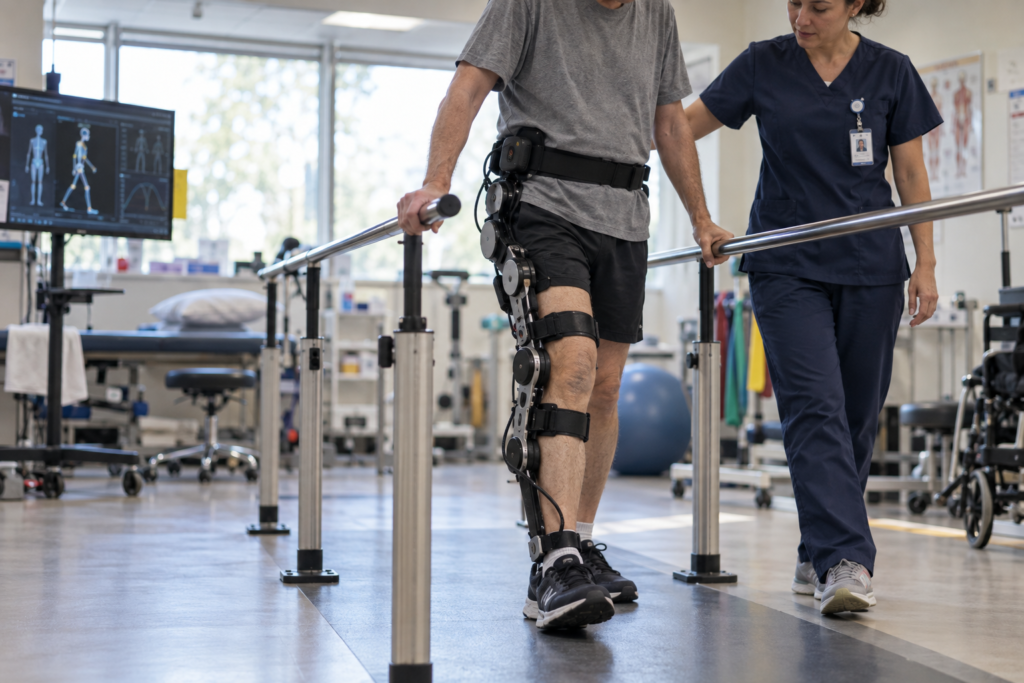


Hypershell has officially unveiled Halo, its new full-leg consumer exoskeleton, in Berlin ahead of IFA 2026. The launch confirms a significant architectural shift for the company: Halo coordinates powered assistance at both hips and both knees rather than relying on the bilateral hip-assist architecture used across the X Series.
At the centre of Halo is a four-motor architecture covering the left and right hip and knee. Hypershell describes these powered joints as operating as one coordinated lower-limb system rather than as separate assistive modules.
That distinction matters. The current consumer exoskeleton market is dominated by relatively compact hip-assist systems. Extending powered assistance to the knee gives Halo the potential to support phases of lower-limb movement that a hip-only device cannot directly power, although how much practical benefit that produces will only become clear once the product is independently tested.
At a glance
- Product: Hypershell Halo
- Unveiled: 3 September 2026 in Berlin at IFA 2026
- Architecture: Four powered motors coordinating both hips and both knees
- Peak output: Up to 1,490 W, manufacturer-listed
- Weight: 2.6 kg rigid structure; 3.2 kg with wearable system, both excluding battery
- Battery: 72 Wh removable PocketVolt; up to 20 km manufacturer-stated range
- Price: US$2,299 / €2,299 / £2,199 at current official regional stores
- Availability: Preorder; estimated shipping starts late November 2026
- Positioning: Full-leg consumer assistance for outdoor and everyday mobility
- Evidence status: Core specifications and pricing are now public, but Halo performance claims remain manufacturer-reported and independent real-world testing is still limited.
Halo is a more important change than another increase in motor power
Recent development in consumer exoskeletons has produced a familiar specification race around motor output, torque, battery endurance, weight and the number of assistance modes.
Those improvements matter, but Halo changes something more fundamental: where the device can actively assist the wearer.
Hypershell’s current products, including the Hypershell X Ultra S, use powered bilateral hip assistance. That architecture can remain relatively compact because the motors, structural elements and controls are concentrated around the waist and thighs.
Halo extends the powered system down to the knees. Hypershell says its Unified Architecture coordinates four motorised hip-and-knee joints around the complete lower-limb kinetic chain. The HyperDrive Pro system places one powered motor at each hip and knee, with a manufacturer-listed peak assistance output of up to 1,490 W.
The company also says it developed a flexible joint solution intended to balance freedom of movement with the structural stability required to transfer force through a multi-joint exoskeleton.
The engineering problem is significant. Every additional powered joint potentially adds mass, battery demand, mechanical complexity, fit challenges and another place where an exoskeleton can interfere with natural movement.
The important question is therefore not whether four motors sound better than two. It is whether Hypershell can add meaningful knee assistance without losing the relatively wearable consumer form factor that helped make its hip systems commercially interesting.
Price, weight and battery are now confirmed
The September 3 launch fills in several of the commercial and engineering gaps left by Hypershell’s initial announcement. Halo is listed at US$2,299 on the US store, €2,299 in the EU and £2,199 in the UK. It is currently a preorder product, with Hypershell estimating shipping to begin in late November.
The company lists the rigid main structure at 2.6 kg and the system with its wearable harness at 3.2 kg, in both cases excluding the removable battery. The new 72 Wh PocketVolt battery weighs 370 g and carries a manufacturer-stated range of up to 20 km. The battery can be worn at the waist or carried separately.
Halo’s HyperDrive Pro architecture uses four motors with up to 1,490 W peak output. Hypershell also lists more than 30 motion sensors and its HyperIntuition 2.0 control system, including a manufacturer-stated 0.2-second movement-prediction window. These specifications make Halo materially more complex than the company’s hip-only X Series, but real-world testing will be needed to establish how the extra knee assistance affects comfort, endurance and mobility over long sessions.
The first 200 units are being sold as the numbered Halo Origin Edition, which Hypershell says includes an additional PocketVolt battery and a one-year warranty extension. The 200-unit limit applies to the Origin Edition, not to Halo’s overall production.
Knee assistance could change how consumer exoskeletons behave on varied terrain
Hip assistance has become a popular architecture for consumer walking and hiking systems partly because it offers a useful compromise between assistance and wearable weight.
But human locomotion does not happen at one joint. The hip, knee and ankle all contribute differently as terrain, incline, speed and movement change. A hip-assist exoskeleton can influence the leg through the hip, but it cannot directly generate assistance around the knee joint.
A coordinated hip-and-knee system therefore opens a wider design space. In principle, it could assist different parts of walking, climbing, crouching, sit-to-stand movement and terrain transitions more directly than a hip-only system.
That does not mean Halo has proven advantages on descents, stairs or difficult trails. Hypershell reports up to a 40% reduction in knee-related muscle activation during controlled sit-to-stand testing. The company also reports 24% energy savings and a 20% heart-rate reduction during walking, and 39% energy savings and a 42% heart-rate reduction during cycling. These figures come from manufacturer-controlled testing; they have not yet been independently established in broad real-world use.
Halo should therefore be evaluated as more than another version of the existing X architecture, but not yet as a proven performance breakthrough.
For readers comparing currently available systems, our hiking exoskeleton guide and consumer exoskeleton comparison cover commercial products that can already be assessed with public pricing and real-world information.
Hypershell is making this move from a stronger commercial position
The launch arrives at an important stage in the development of the consumer exoskeleton market.
Hypershell says its existing products have reached tens of thousands of users across more than 70 countries. That figure is a company-reported commercial claim rather than independently audited sales data, but it suggests Halo is being introduced by a company that has already moved well beyond a laboratory prototype.
The Hypershell company profile in Exoskeleton Index tracks a growing family of commercially available consumer products, including the X Pro, X Carbon, X Max S and X Ultra S.
That gives Halo more weight than a first prototype from an unknown entrant. Hypershell already has manufacturing, direct-sales, customer-support and international-distribution experience to build on.
At the same time, commercial experience with hip systems does not automatically validate a multi-joint platform. Halo introduces new engineering and usability problems that will need to be tested separately.
Exoskeleton Index analysis
The most interesting part of Halo is that one of the most visible consumer exoskeleton companies appears willing to accept greater mechanical complexity in exchange for broader assistance. That may signal the beginning of a new competitive phase.
The first wave of modern consumer systems has largely asked whether useful powered assistance can be made light, affordable and wearable enough for normal customers. The next question may be how much of the lower limb manufacturers can assist before the device becomes too heavy, expensive or intrusive.
Those are competing pressures. A minimal hip system may remain the better product for a user who simply wants moderate assistance while walking. A coordinated hip-and-knee system could become more attractive for steeper terrain, more varied movement or users seeking broader assistance, but only if the additional benefit exceeds the penalty in mass, battery consumption and complexity.
If Halo performs well, consumer exoskeleton competition may therefore become less about who can advertise the largest wattage number and more about which assistance architecture produces the best real-world experience.
The launch answers several of the biggest questions
Price, basic weight definitions, battery configuration, stated range and initial availability are now public. Halo’s listed launch configuration uses a 72 Wh removable battery, and Hypershell separates the 2.6 kg rigid-structure weight from the 3.2 kg wearable-system weight; both figures exclude the 370 g battery.
Halo is commercially open for preorder rather than in general shipment. Hypershell currently estimates that shipping will begin in late November 2026. The official pages also list an IP54 rating, an 8 L folded volume, a -20°C to 45°C operating range and a manufacturer-reported maximum assisted speed of up to 17 km/h.
These disclosures make Halo easier to compare with current consumer systems, but they do not settle the central question: whether coordinated powered knees deliver enough practical benefit to justify the added complexity over a lighter hip-only architecture.
What remains unknown
- Independent real-world measurements of metabolic and biomechanical benefit
- Real battery endurance on steep or highly variable terrain at stronger assistance levels
- Long-duration comfort and fit across different body types
- Reliability and maintenance under sustained outdoor use
- Detailed joint torque figures
- Real-world downhill, stair and irregular-terrain behaviour
- How naturally the system behaves when assistance is disabled or the battery is depleted
- How much practical benefit the powered knees add versus lighter hip-only systems
- Independent assessment of the manufacturer’s fatigue, energy-saving and heart-rate claims
Halo is now a defined preorder product rather than only an architectural announcement. It is a significant move from powered hip assistance toward coordinated full-leg assistance, while independent evidence is still needed to determine whether that architecture becomes a new consumer benchmark.
Explore the ecosystem
View the Hypershell Halo product profile for current specifications, pricing and preorder status. You can also explore the Hypershell company profile, examine the commercially available Hypershell X Ultra S, browse consumer and outdoor exoskeletons, or use the Exoskeleton Index comparison tool.
Sources
- Hypershell, “Hypershell Redefines Human Mobility with Halo, Flagship Full-Leg Exoskeleton Built for All-Terrain Mobility,” official launch announcement, 3 September 2026.
- Hypershell Halo Exoskeleton, official technical page, accessed 4 September 2026.
- Hypershell Halo, official US product and purchase page, accessed 4 September 2026.
- Hypershell Halo, official EU product page, accessed 4 September 2026.
- Hypershell Halo, official UK product page, accessed 4 September 2026.
- Hypershell, “Hypershell to Debut Flagship Full-Leg Exoskeleton Hypershell Halo at IFA 2026,” company announcement, 27 August 2026.
- Andrew Williams, Forbes, “Hypershell Halo: An Exoskeleton To Save Your Knees As Well As Fatigue,” 27 August 2026.