
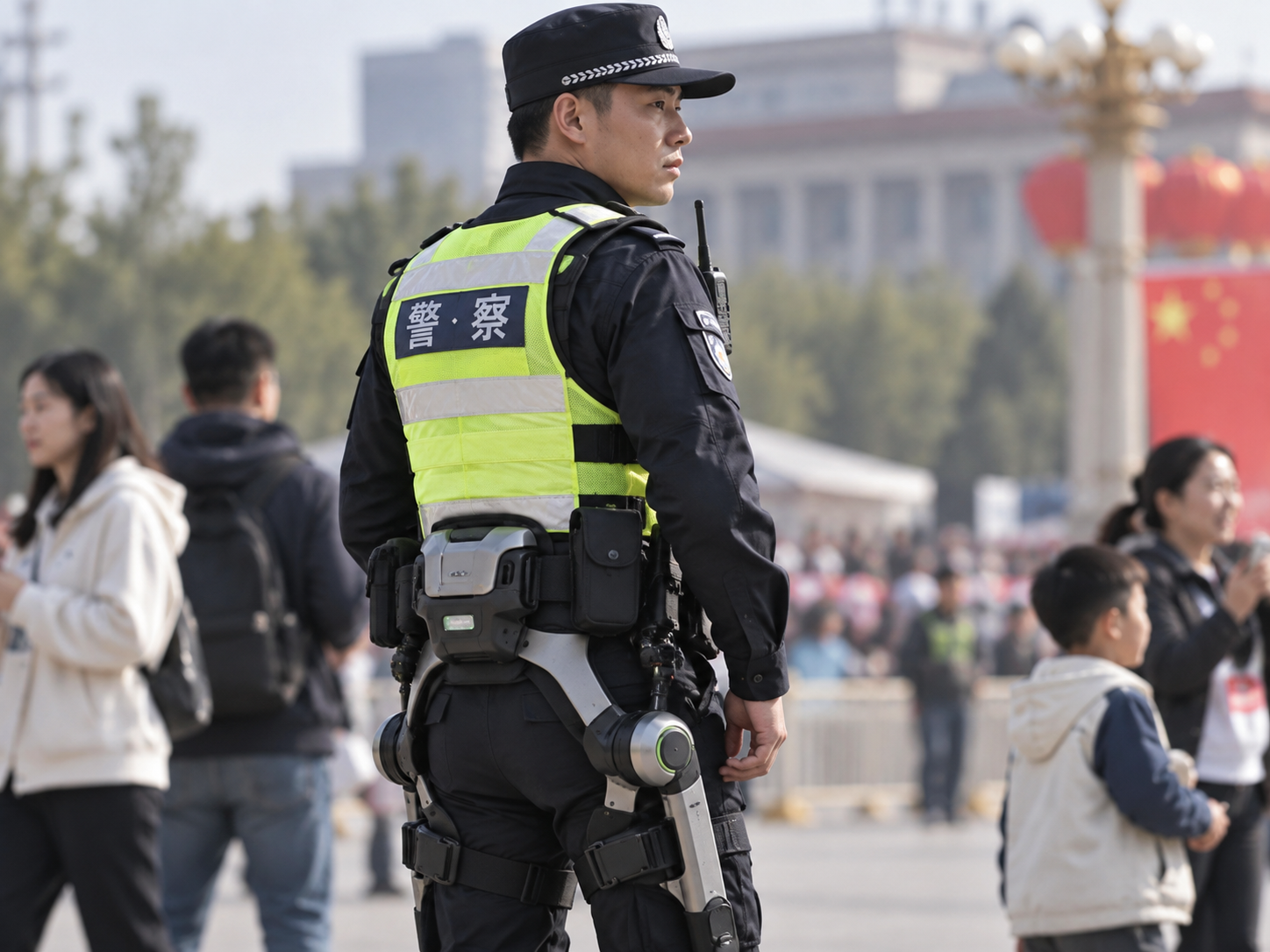
Hangzhou police have unveiled a new Ascentiz-powered police exoskeleton designed for patrol, traffic and special-police duties, with claimed load assistance of up to 30 kg and a dual-battery range of 50 km. The more important signal is not the headline specification: a consumer-style powered mobility architecture is being adapted around police equipment, prolonged standing, patrol and higher-intensity operational work.
- System
- Police AI exoskeleton identified in Chinese event coverage as Ascentiz
- Company
- Ascentiz
- Unveiled
- 20 September 2026 in Hangzhou, Zhejiang
- Event
- Zhejiang stop of the Intelligent Robot Application Skills Exhibition
- Claimed assistance
- Up to 30 kg of load assistance / compensation
- Claimed range
- Up to 50 km using two batteries
- Intended users
- Patrol officers, traffic police and special-police / SWAT units
- Configurations shown
- Higher-output special-police version and traffic-police version with additional back support
- Equipment integration
- Modular mounting for police equipment
- Motion recognition
- Chinese event coverage reports recognition of more than ten movement modes and millisecond-level response
- Donning
- Reported as under 30 seconds in event coverage
- Deployment status
- Publicly unveiled; reviewed sources do not establish fleet size, procurement volume or broad operational deployment
The important development is the move from general mobility to mission-specific assistance
Powered walking exoskeletons are increasingly familiar in hiking, consumer mobility and industrial demonstrations. Police work creates a different set of requirements. An officer may need to carry protective equipment for long periods, stand at a fixed traffic post, walk extended patrol routes, climb stairs or slopes and still retain enough mobility to respond quickly when conditions change. The system unveiled in Hangzhou is being presented around those operational demands rather than as a general-purpose consumer mobility device. Zhejiang Daily reports that the exoskeleton is intended across several police scenarios, including routine duty, traffic management and special-police operations. It also supports modular mounting of police equipment. China Media Group separately showed two configurations at the event. One uses a stronger motor for higher-intensity special-police tasks. The other adds a back-support structure intended to reduce strain during long periods of traffic duty and stationary roadside work.The 30 kg figure needs to be read as an assistance claim
Chinese coverage describes the system as providing up to 30 kg of assistance or load compensation. That does not mean the wearer can simply add 30 kg to their normal safe carrying capacity. Published event material does not provide a standardized test protocol explaining how the 30 kg figure was measured, which movement it applies to or how assistance changes across the different police configurations. The number should therefore be treated as a manufacturer or event-level assistance specification rather than a validated occupational load limit. This distinction is particularly important in operational environments where equipment weight, running, stairs, uneven ground and sudden movement can create very different loading conditions.The 50 km range also has a battery basis
The police system is reported with a claimed range of 50 km using two batteries. That number is notable because it mirrors the long-range positioning already seen in Ascentiz’s consumer H platform. The current Ascentiz H Ultra is also listed by the manufacturer with up to 50 km of range using two batteries and up to 30 kg / 66 lb of leg offload. However, Exoskeleton Index does not treat the police system as simply an H Ultra with police accessories. The reviewed public sources do not yet establish whether the police configuration is a modified H Series product, a dedicated derivative or a separate platform using shared Ascentiz hardware and software. That distinction matters for the database as well as for technical comparison.Ascentiz is moving beyond the consumer market
Until now, Ascentiz has been most visible around consumer and outdoor mobility. The company currently sells the H Pro and H Ultra as powered hip-assistance systems for walking, hiking, running, cycling and other personal mobility use cases. It has also introduced K knee-assistance modules and a wider BodyOS platform built around its shared Exo-Belt architecture. The Hangzhou police system points to a potentially different commercial direction. A modular belt, powered hip assistance, movement recognition and equipment mounting can all become more valuable when the wearer already has to carry a standardized equipment load. That does not mean a consumer system can simply be transferred into law-enforcement work. Operational environments introduce requirements around reliability, protective equipment, running, weather, maintenance, emergency behavior and procurement that are substantially different from recreational use.This is not China’s first police use of exoskeletons
The “first” claim around the Hangzhou system needs a precise boundary. Chinese coverage describes it as the country’s first AI police exoskeleton. It is not the first reported use of an exoskeleton by Chinese police. Earlier in 2026, police in Lianyungang used lightweight walking-assistance exoskeletons during mountain patrols, including steep routes where officers carried rescue and patrol equipment. Other regional police projects have also explored exoskeletons for mountain patrol and rescue. The new Hangzhou system is therefore better understood as a more explicitly police-configured, multi-role platform rather than the beginning of police exoskeleton use in China.The “AI” label is still technically underspecified
Event coverage calls the system an “AI police exoskeleton” and reports recognition of more than ten movement modes. Ascentiz’s existing commercial products already use what the company calls AI MotionEngine to identify walking, running, stairs, cycling and other movement patterns and adjust assistance accordingly. What is not yet public is the exact AI architecture used in the police configuration. The sources reviewed by Exoskeleton Index do not provide details on training data, sensor stack, model architecture, confidence thresholds or whether any police-specific environmental perception is involved. For now, the safest interpretation is that AI refers primarily to movement recognition and adaptive assistance rather than autonomous tactical decision-making.Exoskeleton Index analysis
The interesting part of this launch is not that police officers can now wear a powered exoskeleton. It is that exoskeleton companies are beginning to find markets where the value proposition is defined by a very specific operational burden. Police officers already carry standardized equipment. Traffic officers already spend long periods standing. Search and rescue already combines load carriage with difficult terrain. Special-police units already operate under higher physical loads. Those are clearer deployment problems than the broad promise that an exoskeleton simply makes a person “stronger.” Ascentiz’s modular architecture may also be relevant here. Police equipment can be mechanically integrated around the wearable system rather than layered independently onto the body. Different duty profiles can potentially justify different motor, support and attachment configurations while keeping part of the platform common. But the real test is now operational rather than promotional. A police exoskeleton needs to remain useful when officers sit in vehicles, climb stairs, run, change direction quickly, wear protective equipment, operate in heat or rain and move between assisted and unassisted tasks. It also has to justify the added battery, maintenance, training and failure-management burden. That is why procurement and field-use data will matter much more than the 30 kg and 50 km headline figures.What remains unverified
The reviewed sources identify the system as Ascentiz, but there is not yet a dedicated police-product page from Ascentiz establishing a formal model name, complete specification sheet or commercial status. Exoskeleton Index therefore does not currently treat it as a new standalone Ascentiz product record. The 30 kg assistance, 50 km range, motion-recognition and donning figures come from event and media reporting and should be treated as reported specifications until a dedicated first-party technical source becomes available. The public material also does not establish how many systems have been procured, whether the devices are already operating routinely with Hangzhou police or whether the current units remain demonstration and evaluation hardware. Finally, the “AI” designation is a product and event description. There is not yet enough public technical information to independently characterize the scope of the AI system.What to watch next
The next meaningful signal will be operational deployment. We will be watching for a dedicated Ascentiz police-system specification, named procurement contracts, fleet size, police-unit deployments and evidence showing how officers actually use the system across full duty cycles. Battery behavior will matter because the 50 km figure is tied to a dual-battery configuration. Fit and equipment integration will matter because police users carry belts, protective equipment and task-specific hardware. And the biggest question is whether the different police configurations remain specialized derivatives or become a formal commercial Ascentiz product family. If that happens, Ascentiz would be moving from a primarily consumer and outdoor brand into a second, substantially more demanding market. Explore the Ascentiz company profile, the Defense & Emergency Response exoskeleton category, or browse the wider Exoskeleton Product Directory.Sources
- Zhejiang Daily / Zhejiang Online: Hangzhou police unveil AI police exoskeleton, 21 September 2026
- Tide News: Ascentiz identified at the Hangzhou police robotics exhibition
- China Media Group coverage: police exoskeleton configurations and intended use
- Ascentiz: current H Series specifications for comparison context