
CYBERDYNE reported modest revenue growth and a sharply narrower operating loss for the three months ended 30 June 2026, while its global Medical HAL Lower Limb installed base reached 570 operating units.
The Japanese wearable-robotics company generated ¥1.027 billion in quarterly revenue, up 2.7% year over year, and reduced its operating loss from ¥100 million to ¥17 million. Profit attributable to owners of the parent rose to ¥374 million, but that bottom-line figure was supported by ¥618 million of finance income, largely associated with investment-security valuation gains and foreign-exchange effects rather than the core operating business.
At a glance
- Revenue: ¥1.027 billion for April–June 2026, up 2.7% year over year.
- Operating loss: ¥17 million, compared with ¥100 million a year earlier.
- Net profit: ¥374 million attributable to owners of the parent, up 49.2%, but supported by substantial finance income.
- Medical HAL Lower Limb: 570 units operating worldwide at the end of June, including clinical-research units.
- Japan: 119 Medical HAL Lower Limb units were being used in Japanese hospitals for treatment.
- New product: Rental sales of a redesigned Medical HAL Lower Limb model began in Japan in June 2026.
- APAC deployment: CYBERDYNE says 65 HAL units were installed at Malaysia’s new National Neuro-Robotics and Cybernics Rehabilitation Centre.
Revenue grew while the operating loss narrowed
CYBERDYNE reported ¥1.027 billion in revenue for its fiscal first quarter, compared with ¥1.000 billion in the same period a year earlier.
The 2.7% increase is not rapid top-line growth, but the cost structure improved materially. Research and development expense fell 20.7% year over year to ¥171 million, while other selling, general and administrative expenses declined 9.5% to ¥569 million.
The result was an operating loss of ¥17 million, down from a ¥100 million operating loss in the prior-year period.
CYBERDYNE attributed revenue growth partly to higher product-rental and service revenue in Asia-Pacific and treatment-service revenue in the United States.
The ¥374 million net profit needs context
The company reported ¥374 million in profit attributable to owners of the parent, up 49.2% from ¥251 million a year earlier.
That number should not be interpreted as evidence that CYBERDYNE’s core exoskeleton operations suddenly generated hundreds of millions of yen in operating profit.
The company recorded ¥618 million in finance income, mainly from valuation gains on investment securities and foreign-exchange gains. Operating activity itself remained slightly loss-making.
For Exoskeleton Index, the more useful operating signal is therefore the reduction in the operating loss alongside the expansion of rental, treatment and installed-device activity, rather than the headline net-profit figure alone.
Medical HAL Lower Limb reaches 570 operating units
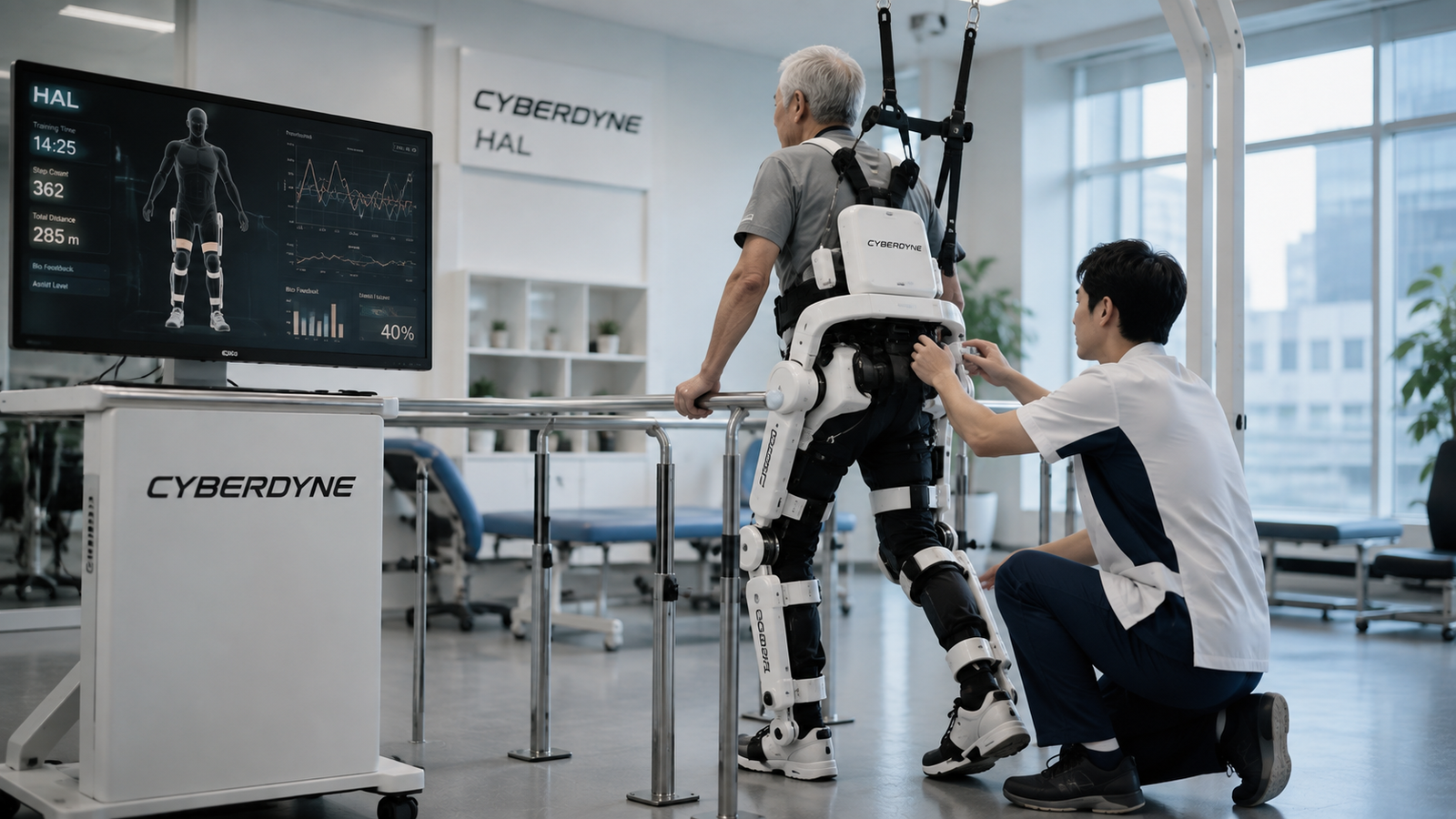
CYBERDYNE reported that 570 Medical HAL Lower Limb Type units were operating worldwide as of 30 June 2026, including units used for clinical research.
Of those, 119 were being used in Japanese hospitals for treatment.
The broader HAL fleet is larger. CYBERDYNE also reported:
- 719 HAL Single Joint Type units;
- 355 HAL Well-being Lower Limb and older Living Support Lower Limb units;
- 971 HAL Lumbar Type for Well-being units; and
- 409 HAL Lumbar Type units for Labor Support.
Installed-base figures are useful because they provide a different view of commercialization from quarterly device sales. CYBERDYNE uses rental, treatment-service and institutional deployment models, so recurring usage and geographic expansion can matter as much as one-time shipments.
A redesigned Medical HAL Lower Limb entered Japanese rental sales
In June 2026, CYBERDYNE began rental sales in Japan of a new Medical HAL Lower Limb model.
The company says a single unit can accommodate users approximately 150 to 190 cm tall and that the redesign improves operability and ease of deployment. CYBERDYNE plans a staged overseas rollout.
A wider fit range within one core configuration could matter operationally for hospitals. Medical exoskeleton programmes need to fit different patients, train staff and move devices between users without excessive adjustment or inventory complexity.
That makes ease of deployment a commercial feature rather than only an engineering refinement.
Malaysia adds a large institutional deployment
CYBERDYNE also highlighted the opening of Malaysia’s National Neuro-Robotics and Cybernics Rehabilitation Centre in June.
Under its relationship with the government-affiliated Social Security Organisation, PERKESO, CYBERDYNE says it installed 50 sets comprising 65 HAL units at the facility.
The company is also expanding treatment and rental activity across Southeast Asia and says increased APAC rentals contributed to first-quarter revenue growth.
Institutional programmes of this size are strategically important because they can create concentrated training, maintenance and clinical infrastructure around a wearable-robotics platform rather than placing isolated devices across many disconnected sites.
Exoskeleton Index analysis
CYBERDYNE’s quarter is more encouraging operationally than the 2.7% revenue-growth headline suggests. The company is approaching operating break-even while expanding a large installed base through rentals, treatment services and institutional programmes. That is a credible commercialization model for medical exoskeletons. The caution is equally clear: revenue growth remains modest, and the reported net profit was materially supported by finance income rather than core operations.
Why the installed base matters for the wider market
Medical exoskeleton companies face a different scale problem from consumer-electronics manufacturers.
The objective is not necessarily to sell hundreds of thousands of identical units directly to individuals. Hospitals, rehabilitation centres and treatment networks can use a smaller number of high-value systems repeatedly across many patients, while rental and service models generate recurring revenue around the hardware.
CYBERDYNE’s operating-unit disclosure therefore provides useful market evidence. It shows that HAL has moved well beyond a handful of demonstration systems and into a multi-country installed base spanning medical, well-being and work-support applications.
For the broader sector, the next question is whether growing installed fleets can translate into sustained revenue growth and eventually durable operating profitability.
What remains unknown
CYBERDYNE does not provide a full-year earnings forecast because it says the emerging nature of its markets makes precise forecasting difficult.
The quarter also does not disclose the exact revenue contribution from Medical HAL rentals, U.S. treatment services or the new Japanese model separately.
Key questions include how quickly the redesigned Medical HAL expands overseas, whether APAC institutional deployments become repeatable, and whether the company can convert its narrowing operating loss into sustainable core profitability without relying on investment valuation gains.
Sources
- CYBERDYNE, consolidated financial results for the three months ended 30 June 2026, 13 August 2026.
- CYBERDYNE Investor Relations, financial results and presentations.
Explore the ecosystem
View the CYBERDYNE company profile, explore the Medical HAL Lower Limb Type, browse healthcare and rehabilitation exoskeletons, or read our 2026 exoskeleton market analysis.