
Why an underwater exoskeleton is different
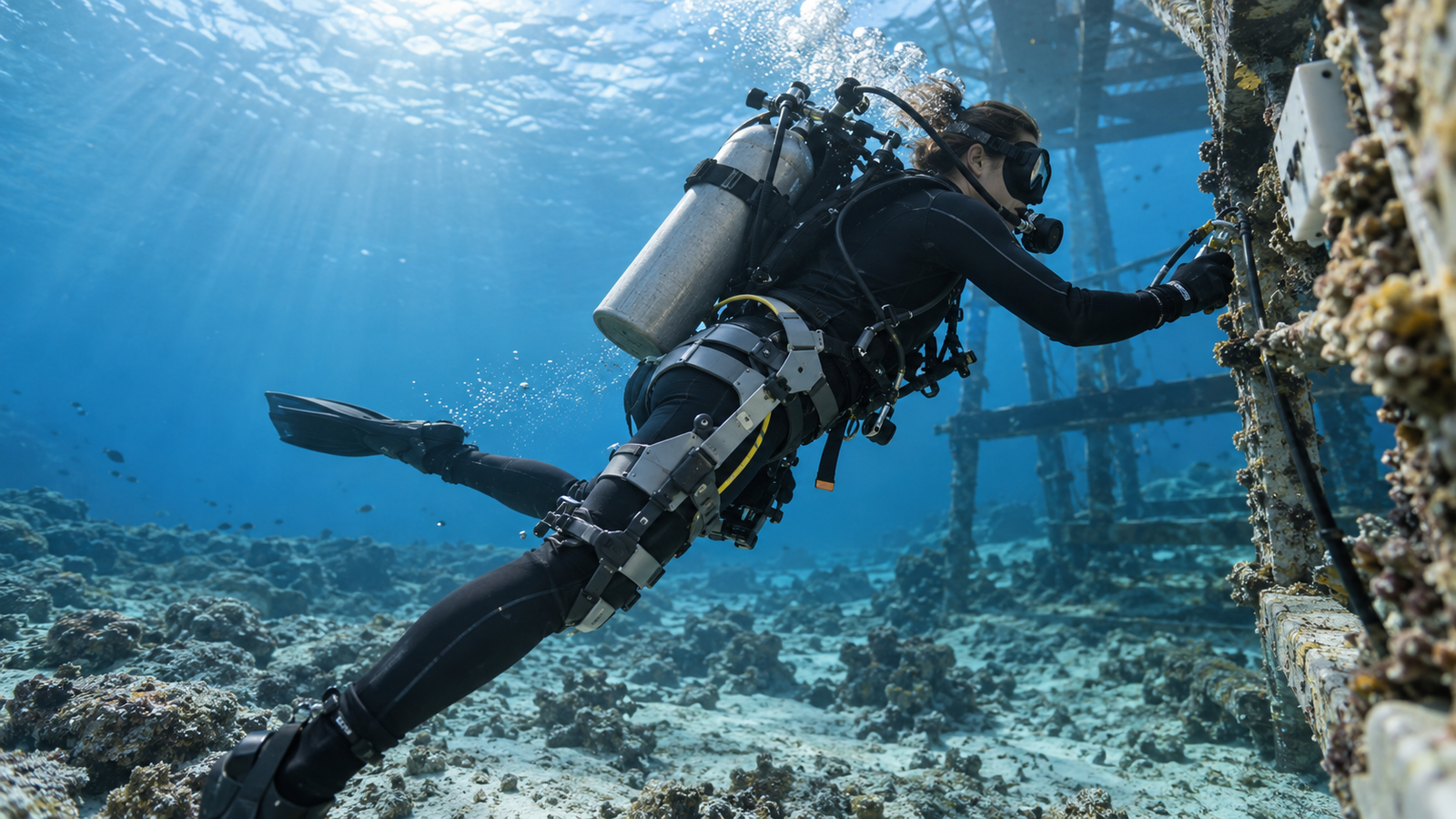
A diver has a finite supply of breathing gas. Every fin kick must overcome water resistance while the diver manages buoyancy, orientation, tools and other equipment. A wearable assistive system offers a different proposition from a diver propulsion vehicle: it could reduce the effort of moving under the diver’s own control, without replacing the diver’s direct role in the task.
A new article by Xiangyang Wang and colleagues in Science Robotics examines the potential of this approach and the design constraints that make aquatic assistance different from land-based exoskeletons. It was published October 21, 2026. The paper should not be mistaken for a new large-scale field trial or proof of a commercially available product.
Earlier PEAKED tests offer an initial performance signal
The research group’s earlier PEAKED project tested a soft, hip-assist exosuit designed to support several underwater movement patterns. The 2025 research measured respiratory minute ventilation during assisted and unassisted conditions. The reported reductions varied substantially by movement type.
The values refer to previously published PEAKED experiments, not new October 2026 trials. They describe measured breathing-gas-use rates in defined test conditions, not guaranteed increases in dive time, a reduction in decompression risk or performance for all divers.
The engineering problem changes underwater
Assistance must be synchronized with the diver’s finning pattern, which can shift rapidly between flutter kicking, frog kicking and other movements. Water changes the balance of forces: buoyancy reduces some weight-support demands, while hydrodynamic drag acts throughout a kick cycle.
Underwater integration also introduces safety requirements that are not minor product details. Sensors, actuators and batteries must withstand pressure and water ingress; a wearable system needs to coexist with cylinders, weights and buoyancy gear; and it must allow rapid disengagement if the diver needs to respond to an emergency.
A control system that provides useful torque on land may be poorly timed or restrictive underwater. The research examines why assistance direction, transmission type, and gait-phase recognition need to be tailored to aquatic movement rather than copied from walking exoskeletons.
Breathing-gas consumption is a practical outcome for scuba use, but is not identical to metabolic energy expenditure.
The system must respond to different kick patterns while preserving a diver’s ability to maneuver.
Waterproofing, entanglement avoidance, equipment compatibility and emergency release must be demonstrated.
A promising use case, not a finished diving product
Potential applications include underwater infrastructure inspection, ship maintenance, marine research and tasks in which a professional diver must remain physically present. Those are plausible use cases, not confirmed commercial deployments of PEAKED.
The current evidence is still limited. A small number of research prototypes and participant studies cannot establish real-world reliability across currents, varying depth, water temperatures, long work shifts and emergency scenarios. Any claim that a device will extend diving time by a specific percentage would require its own well-defined test conditions and safety assessment.
The next step is not simply to produce more motor assistance. It is to show that the net benefit survives the added bulk, maintenance requirements, drag and risks of wearing powered equipment underwater.
Exoskeleton Index analysis
For exoskeleton developers, the interesting shift is the metric: the goal is not necessarily a faster movement or a larger assisted load, but a lower rate of breathing-gas consumption.
That makes underwater assistance relevant to endurance and operational planning in a way that is distinct from industrial fatigue scores or consumer hiking specifications. It also imposes unusually strict requirements on fail-safe behavior and interoperability with safety-critical equipment.
It is an early market rather than an emerging retail category. The valuable evidence will come from repeatable open-water evaluations, independent controls, clear device configurations and documented failure handling. Our research and education directory provides wider context for separating laboratory exoskeleton prototypes from commercially supported systems.
What the October paper does and does not establish
The October 21 Science Robotics paper discusses how underwater exoskeletons could reduce effort and air consumption. The PEAKED percentage figures are from earlier experimental research. Neither constitutes a general safety clearance, a commercial launch, evidence of longer safe dive limits or proof of effectiveness in routine professional operations.
Minute ventilation is a useful gas-consumption indicator, but it should not be presented as a directly equivalent percentage reduction in physiological energy use.
What to watch next
The most useful next disclosures would include controlled open-water tests, diver numbers and experience levels, intervention and comparison conditions, device mass and buoyancy, pressure ratings, loss-of-power behavior, quick-release procedures, and effects across depth and finning styles.
Until then, this work is best interpreted as a technically promising extension of exoskeleton research into a difficult new environment, rather than an off-the-shelf solution for divers.
Sources and reporting notes
Wang et al., Science Robotics, October 21, 2026. Reducing energy and air consumption in scuba diving with underwater exoskeletons. New article examining the research direction and underwater design constraints.
Shenzhen Institutes of Advanced Technology, Chinese Academy of Sciences, 2025. Official report on the PEAKED soft underwater exosuit and earlier respiratory minute ventilation results.
Chinese research commentary, October 22, 2026. Context on movement patterns, safety requirements and previous findings. Used as secondary context, not a new trial report.
Reporting note. Results from different devices, projects or dates are not combined into a pooled efficacy estimate. No claims are made about regulatory approval, occupational adoption, safe dive-time extensions or commercial availability.