
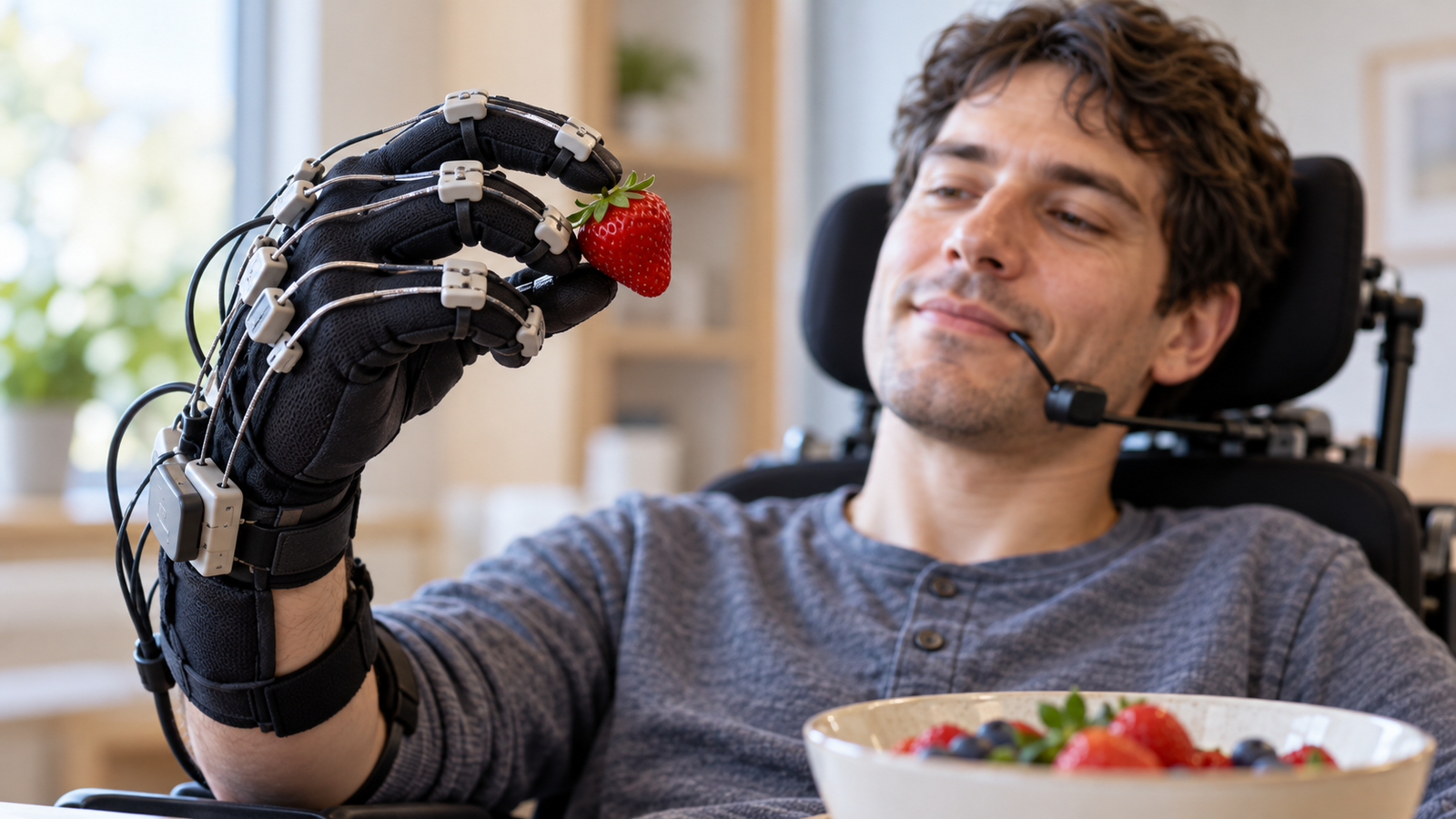
Five people with cervical spinal cord injury have used a tongue-controlled soft hand exoskeleton to perform everyday grasping tasks that they could not reliably complete unaided. The hybrid system combines tendon-driven robotic finger flexion with tongue-triggered functional electrical stimulation for hand opening and achieved a 96% overall task success rate in a new study published in npj Robotics.
The Tongue Becomes the Control Interface
For people with high cervical spinal cord injuries, the central challenge is not only producing enough robotic assistance to move the hand.
It is also finding a reliable way for the user to tell the device what they want it to do.
Conventional interfaces can rely on muscle activity, voice, eye tracking, brain signals or residual limb movement. Those options can become difficult when paralysis is severe.
The research team instead used a body part that often remains under voluntary control after cervical spinal cord injury: the tongue.
The system uses a non-invasive tongue-robot interface positioned against the palate. A small titanium activation element is moved across an array of 15 inductive sensors using tongue movements.
Importantly, nothing has to be pierced or permanently attached to the tongue.
The user can select different grasp commands, while those signals are transmitted wirelessly to the robotic hand system.
Five Fingers Are Actuated Independently
The hand exoskeleton itself uses tendon-driven actuation to flex all five fingers.
Independent finger control allows the system to form several different grasp patterns rather than simply opening and closing the entire hand as one unit.
Researchers tested five functional actions:
a pulp pinch to pick up a plastic strawberry, a lateral pinch for a business card, a full-hand grasp for a 521 g bottle, a diagonal grasp for an electric toothbrush and a pointing gesture.
Each participant performed repeated trials with two versions of the system.
One used functional electrical stimulation, or FES, to activate the user’s finger-extensor muscles and reopen the hand.
The comparison version relied on passive elastic wires to reopen the fingers after the robotic tendons released.
The study involved two consecutive experimental sessions rather than long-term home use. Success was defined as completing the required grasp and securely holding the object for five seconds.
Participants Reached 96% Overall Task Success
Without the exoskeleton, all five participants showed limited or absent functional grasping ability.
Two could occasionally manipulate some lightweight objects using compensatory wrist movements, but none could reliably perform all of the grasp types required by the study.
With the tongue-controlled exoskeleton and FES-assisted finger opening, overall success across the grasping trials reached 96%.
The passive-opening configuration reached 89%.
Performance varied by task.
The FES configuration achieved 96% success when pinching the strawberry, 96% when handling the business card, 89% when grasping the 521 g bottle and 100% when holding the electric toothbrush.
Participants could also use tongue commands to trigger the pointing gesture.
Average task-completion times were around 12 to 13 seconds for both exoskeleton configurations.
That remains considerably slower than ordinary hand use, but the researchers note that the measured time also included object positioning, user reaction, approach movements and command activation.
Electrical Stimulation Solves the Hand-Opening Problem
Closing the fingers is only half of a functional grasp.
A user also needs to reopen the hand reliably to release an object and prepare for the next task.
Adding another robotic mechanism for active finger extension would increase weight and complexity.
The researchers instead used electrical stimulation of the user’s existing extensor muscles.
Once triggered with the tongue, FES was applied for up to two seconds to extend the fingers.
The stimulation was only used during opening rather than throughout the entire grasp cycle, which the researchers designed to limit muscle fatigue.
All five participants achieved FES-assisted hand opening, including users who had lived with paralysis for between 20 and 30 years.
No participant required progressively higher stimulation intensity during the trials.
The Exoskeleton Increased Functional Grasp Force
The team also measured the force participants could produce during grasping.
Average grasp force without the exoskeleton was approximately 2.3 N.
That increased to 13.3 N with the FES-opening exoskeleton and 10.9 N with the passive-opening configuration.
The difference between the two exoskeleton configurations was not statistically significant, but both produced significantly higher assisted grasp forces than baseline.
The researchers correctly caution against interpreting this as recovery of the participants’ intrinsic muscle strength.
The additional force is generated with robotic assistance. It therefore measures the functional capability available to the user while wearing the system rather than biological recovery of hand strength.
The Hand-Worn System Weighs Just 125 g
Wearability is especially important for assistive hand technology because additional mass is placed directly on a limb that may already have little voluntary strength.
The exoskeleton components worn on the hand weigh 125 g.
Including control units, the complete robotic system weighs approximately 1.16 kg.
The intraoral tongue interface itself weighs 9.2 g.
Researchers reported generally low levels of discomfort, pain and fatigue, and participants rated the FES-opening configuration more favourably than the passive version for wearability, ease of use and willingness to use the system frequently.
That does not yet establish long-term acceptance.
The experiment lasted only two days, and everyday use over weeks or months would introduce issues such as setup burden, cleaning, charging, comfort and reliability that a short laboratory study cannot measure.
Some Human Assistance Is Still Required
The prototype does not yet create completely independent hand function.
Participants still required assistance to put on and remove the hand exoskeleton and tongue interface.
FES electrodes also have to be positioned correctly and calibrated for the individual user.
One participant who lacked observable shoulder and arm movement additionally needed the experimenter to position objects within grasping range.
The current system therefore addresses the grasping function of the hand rather than the entire chain of reaching, positioning, grasping and manipulating an object independently.
Those limitations are especially important when comparing the technology with commercial healthcare and rehabilitation exoskeletons intended for routine clinical or home use.
This Is Assistive Robotics Rather Than Conventional Hand Therapy
Many hand exoskeletons are designed primarily for rehabilitation: repeating movements under supervision to encourage neurological or muscular recovery.
This system is pursuing a different objective.
The immediate goal is to give someone with severe paralysis access to a functional grasp while they are wearing the device.
That puts it closer to assistive technologies such as Bioservo’s Carbonhand grip-assistance glove, although the control architecture and target impairment are very different.
The tongue interface is particularly relevant because it gives users with extremely limited limb movement a way to communicate multiple commands voluntarily.
The research team says the current implementation supports five distinct grasp types, but the sensor resolution could allow additional commands to be mapped through software.
Exoskeleton Index analysis
The headline result is the 96% success rate, but the more important innovation may be the division of work between the user, the robot and the nervous system.
The tongue communicates intent. Robotic tendons close the fingers. Electrical stimulation uses the user’s own muscles to reopen them.
That architecture avoids forcing one technology to solve every part of the problem.
For people with severe tetraplegia, control interfaces can become a major bottleneck. A highly capable hand exoskeleton is not particularly useful if the wearer cannot reliably tell it which grasp to perform.
The tongue is attractive because voluntary control can remain available even after very high spinal cord injuries, and the intraoral interface does not depend on residual arm or hand movement.
At the same time, the study shows how far the system still is from autonomous everyday use.
Five participants over two sessions is enough to demonstrate feasibility, but not enough to establish long-term usability, reliability or clinical benefit across the wider spinal cord injury population.
The users also needed help with donning and doffing, FES electrode preparation and, in one case, object positioning.
Those practical details will determine whether an impressive laboratory result eventually becomes a genuinely useful assistive product.
The commercial pathway may nevertheless be shorter than for many academic prototypes.
The researchers note that the system builds on an adapted commercial exoskeleton glove and a newer version of an existing tongue-computer interface, suggesting that future industry partnerships could potentially accelerate translation.
The next milestone is therefore not another grasp demonstration.
It is whether the same level of control can survive prolonged use in the messy, unscripted environments of everyday life.
What to Watch Next
The study provides a strong proof of concept, but several questions now matter more than the initial success rate.
The first is whether users can operate the system independently for longer periods rather than during supervised laboratory sessions.
Researchers will also need to reduce the setup burden associated with FES electrode placement and donning the exoskeleton.
Real-world trials should examine whether the tongue interface remains comfortable during prolonged use and whether users can speak, eat and drink naturally while wearing it.
Additional grasp types and more autonomous reaching could significantly expand the number of activities the system can support.
Long-term studies will also be needed to distinguish assistive benefit from any therapeutic effect associated with repeated FES use.
For now, the result is narrower but still significant.
Five people with severe hand impairment were able to use tongue commands to select and complete functional grasps that none of them could reliably perform unaided.
For assistive exoskeleton research, that is a meaningful step from moving a robotic hand toward giving its wearer intentional control over everyday objects.
Sources and reporting notes
Kirtas O, Veltink PH, Kæseler RL et al., npj Robotics, October 8, 2026. A tongue-controlled FES-robotic exoskeleton restores hand function in users with cervical spinal cord injury .
Study institutions: The research involved the Center for Rehabilitation Robotics at Aalborg University, the University of Twente and clinicians at the Spinal Cord Injury Centre of Western Denmark.
Evidence note: The study involved five participants across two consecutive experimental sessions. The reported 96% success rate describes device-assisted task performance during the study and should not be interpreted as permanent recovery of hand function.
Licensing note: The research article is published open access under the Creative Commons Attribution 4.0 International licence. Images and figures are covered by that licence unless a specific figure credit states otherwise.