

South Korean consumer technology group Coway has entered wearable robotics with a 1.6 kg walking-assistance exoskeleton developed with WIRobotics. The launch is notable less because another lightweight exoskeleton has reached the market than because of the company putting it there: Coway generated KRW 1.4422 trillion (approximately US$1.08 billion) in Q2 2026 revenue and is bringing the device into an established consumer rental network rather than relying on conventional hardware sales.
- Company
- Coway Co., Ltd. (KRX: 021240)
- Product
- 1.6 kg walking-assistance wearable robot developed with WIRobotics
- Commercial model
- Rental-only, with short-term rental also planned
- Reported rental pricing
- KRW 50,000-per-month range, approximately US$37+
- Q2 2026 revenue
- KRW 1.4422 trillion (approximately US$1.08 billion), up 14.6% year over year
- Q2 operating profit
- KRW 253.2 billion (approximately US$189 million), up 4.3%
- Domestic rental additions
- 242,000 net accounts added during Q2 2026
- Recent market capitalization
- Approximately KRW 7.1 trillion (US$5.30 billion)
The company behind the launch matters as much as the hardware
Coway is not a robotics startup. Founded in South Korea in 1989 and listed on the Korea Exchange, the company has built a large consumer business around water purifiers, air purifiers, bidets, mattresses, massage chairs and other home and wellness products.
Rental and recurring customer relationships are central to that model.
During Q2 2026, Coway generated KRW 1.4422 trillion (approximately US$1.08 billion) in revenue, up 14.6% year over year. Operating profit reached KRW 253.2 billion (approximately US$189 million), up 4.3%.
For the first half of the year, revenue reached KRW 2.7719 trillion (approximately US$2.07 billion), while operating profit totaled KRW 504.1 billion (approximately US$376 million).
The domestic business generated KRW 786.8 billion (approximately US$587 million) in Q2 revenue, while overseas subsidiaries contributed KRW 587.5 billion (approximately US$438 million).
More importantly for the exoskeleton story, Coway added 242,000 net domestic rental accounts during the quarter, 51.6% more than a year earlier.
That means the company is introducing wearable robotics into an existing commercial infrastructure rather than having to build subscription, servicing and demonstration networks from scratch.
The exoskeleton is being positioned as a rental service
Coway formally launched the walking-assistance wearable robot on October 2 after previewing its entry into the category in September.
The device will be offered through rental rather than conventional outright purchase. Coway is also introducing shorter-term rental options so consumers can experience the technology before making a longer commitment.
Customers will be able to try the system at Coway Gallery locations across South Korea.
Pre-launch reporting from South Korea’s Maeil Business Newspaper put expected pricing in the KRW 50,000-per-month range, approximately US$37 or more, with an expected contract period of around five years.
Coway’s final launch announcement confirmed the rental strategy but did not disclose detailed final contract pricing.
The model matters because consumer exoskeletons still require users to adopt a relatively unfamiliar category of wearable technology. Even as device prices fall, an upfront purchase costing thousands of dollars remains a meaningful barrier.
Rental changes that decision. Instead of purchasing specialist robotics hardware outright, the customer can access the device through a recurring monthly payment and an existing consumer-service relationship.
For the consumer exoskeleton market, that distribution model may prove more important than another reduction in weight or another assistance mode.
WIRobotics provides the wearable technology
Coway developed the product with South Korean wearable-robotics company WIRobotics.
The architecture is closely related to WIRobotics’ lightweight WIM walking-assist platform, which Exoskeleton Index already tracks in its global product database.
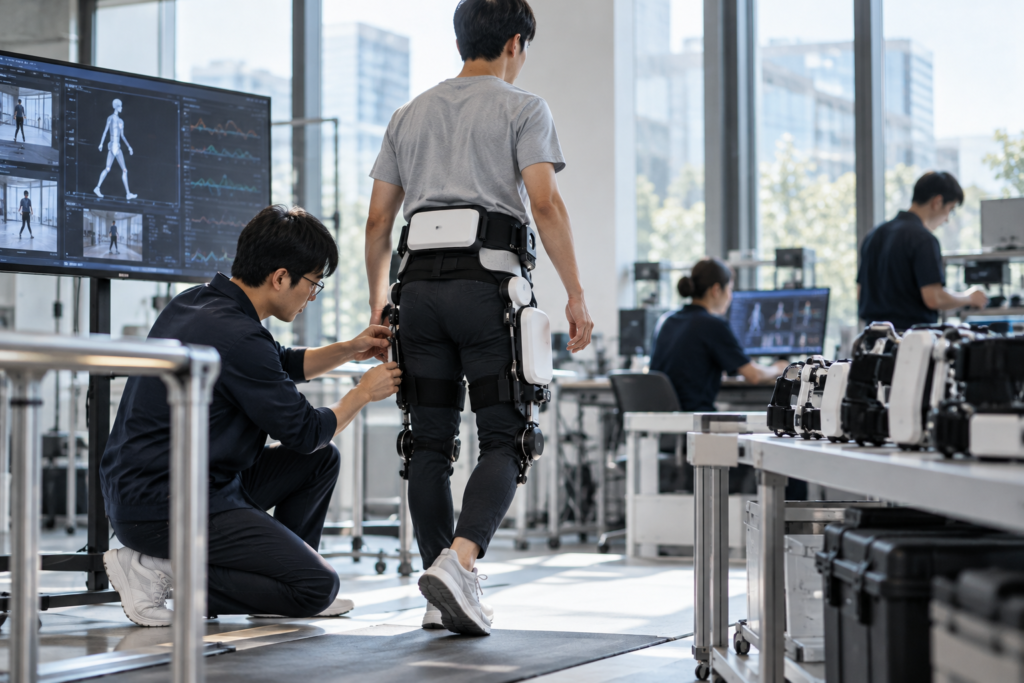
The Coway wearable weighs 1.6 kg and is worn around the waist, with components extending toward the thighs to provide powered hip assistance while walking.
Coway has introduced seven operating modes covering ordinary walking, lower-body exercise, slower gait, stairs and inclines, gait balance, softer assistance and light jogging.
The system also carries an IP65 dust and water resistance rating.
A companion application analyses data including stride and walking speed and produces what Coway calls a Smart Walking Report.
The product is being positioned primarily for consumers who remain independently mobile but may benefit from additional walking assistance, including older adults.
Korean reporting indicates that it is being positioned as a consumer wellness and mobility product rather than a medical rehabilitation device.
Early research is promising, but the evidence remains limited
Coway is also pointing to published research around WIRobotics’ lightweight hip-exoskeleton technology.
A 2025 paper in Scientific Reports evaluated a four-week outdoor walking programme involving nine older adults with a mean age of 78.6 years.
Researchers reported a 14.8% improvement in 10-metre walking speed, alongside improvements across several other measures of gait, balance and lower-limb strength.
That distinction matters as consumer exoskeleton companies increasingly use percentages around walking efficiency, metabolic reduction and mobility improvement in their marketing.
The underlying technology may be promising, but commercial success will depend on questions laboratory studies cannot answer: whether users keep wearing the device, whether the rental price feels worthwhile and whether it fits naturally into everyday life.
Coway’s financial scale changes the commercial context
Coway’s entry is unusual because publicly available financial data gives a clear picture of the scale of the company now experimenting with exoskeletons.
The company’s shares closed at approximately KRW 100,800 (US$75.23) on October 6. Its recent market capitalization was around KRW 7.1 trillion (approximately US$5.30 billion).
Its 52-week trading range was approximately KRW 68,800 to KRW 109,200, equivalent to roughly US$51.35 to US$81.49.
Those figures should not be interpreted as evidence that wearable robotics is already financially important to Coway.
The company has not disclosed unit targets, expected exoskeleton rental accounts or revenue forecasts for the category.
What the figures show is the scale of the commercial platform now testing the technology.
Most specialist exoskeleton manufacturers still need to solve hardware development, distribution, demonstrations, customer education, financing and after-sales support at the same time.
Coway already operates much of that infrastructure.
Consumer exoskeletons are entering a distribution phase
The launch reflects a broader shift in the consumer exoskeleton sector.
Lightweight powered walking systems are no longer exceptionally rare. WIRobotics, Hypershell, DNSYS, Ascentiz and a growing number of Chinese manufacturers now compete around walking assistance, hiking, outdoor mobility and exercise.
The harder question is increasingly how those products reach ordinary users.
Direct ecommerce remains common. Some companies are developing distributors and demonstration centres. Chinese tourism operators are experimenting with hourly rental fleets at major scenic destinations.
Coway introduces another route: integrating an exoskeleton into a mature consumer rental ecosystem.
That potentially gives the company several advantages:
- Lower upfront cost for users.
- Physical demonstrations before committing.
- Existing customer-service infrastructure.
- Recurring maintenance and support relationships.
- Access to consumers who may never visit a specialist robotics retailer.
It also introduces different commercial risks. Long rental contracts only work if customers continue finding value in the product.
Usage frequency, servicing costs, cancellations, reliability and customer retention may ultimately matter as much as assistance torque or battery range.
For broader pricing context, see the Exoskeleton Index guide to exoskeleton prices in 2026.
Exoskeleton Index analysis
Coway’s launch shifts the commercial question around consumer exoskeletons.
The industry no longer only needs to prove that lightweight walking-assistance hardware can be built. It increasingly needs to prove that ordinary consumers can be convinced to acquire, use and keep using it.
Coway enters that problem from almost the opposite direction of a robotics startup.
It already has a large recurring customer base, physical locations where unfamiliar hardware can be demonstrated, service relationships extending over multiple years and experience turning expensive consumer equipment into monthly payments.
WIRobotics supplies the wearable-robotics technology. Coway potentially supplies the commercialization machine around it.
That does not guarantee success.
Exoskeletons are more physically intimate than most consumer appliances. Fit, comfort, perceived usefulness, charging, weight and the inconvenience of putting the device on all affect whether an owner will actually use it regularly.
The most revealing metrics will therefore not be launch-day attention or the number of assistance modes.
They will be rental conversions, cancellations, long-term utilisation, servicing costs and whether Coway expands the category after seeing real consumer behaviour.
If the model works, it could provide an important alternative to the direct-purchase strategy dominating much of today’s consumer exoskeleton market.
What to watch next
The immediate question is whether Coway discloses early adoption figures for the wearable robot.
Several indicators would materially improve the picture:
- Rental accounts: how many consumers subscribe during the first year.
- Final pricing: the detailed monthly cost, contract length and short-term rental conditions.
- Retention: whether customers continue renting and regularly using the system.
- Economics: whether Coway eventually discloses revenue, servicing costs or profitability for wearable robotics.
- International expansion: whether the product moves into Coway’s overseas markets.
- WIRobotics partnership: whether the collaboration expands into additional products.
- Independent evidence: whether larger studies reproduce the mobility improvements reported in early research.
Coway’s launch does not yet prove that exoskeletons are becoming a mainstream consumer category.
It does, however, put the technology into the hands of a company with the scale, distribution infrastructure and recurring-revenue model to test that possibility more seriously than most robotics manufacturers can on their own.
For the emerging consumer exoskeleton market, the results of that experiment may ultimately matter more than the device itself.
Sources
- Coway, October 2, 2026: launch of walking-assistance wearable robot developed with WIRobotics
- Coway, August 7, 2026: Q2 2026 financial results
- Maeil Business Newspaper, September 2026: Coway wearable-robot rental pricing and launch details
- Scientific Reports, 2025: study of WIRobotics lightweight hip-exoskeleton technology
- Ad Hoc News, October 7, 2026: Coway share-price and market-capitalization context
- Exoskeleton Index: WIRobotics WIM product profile
- Exoskeleton Index: Exoskeleton Prices 2026