
Swiss occupational exoskeleton company Auxivo is expanding into Singapore through local industrial partner QMT, while its systems undergo research and practical testing involving Nanyang Technological University. The move combines market entry with local validation as workplace exoskeleton adoption develops across Asia.
- Company
- Auxivo
- Market
- Singapore
- Local partner
- QMT Industrial
- Research involvement
- Nanyang Technological University
- Sector
- Occupational and industrial exoskeletons
- Launch context
- OS+H Asia 2026
- Validation status
- Research and practical testing underway
Auxivo enters the Singapore market
Auxivo is using Singapore as a new entry point for its occupational exoskeleton portfolio in Asia, working with local industrial-safety company QMT.
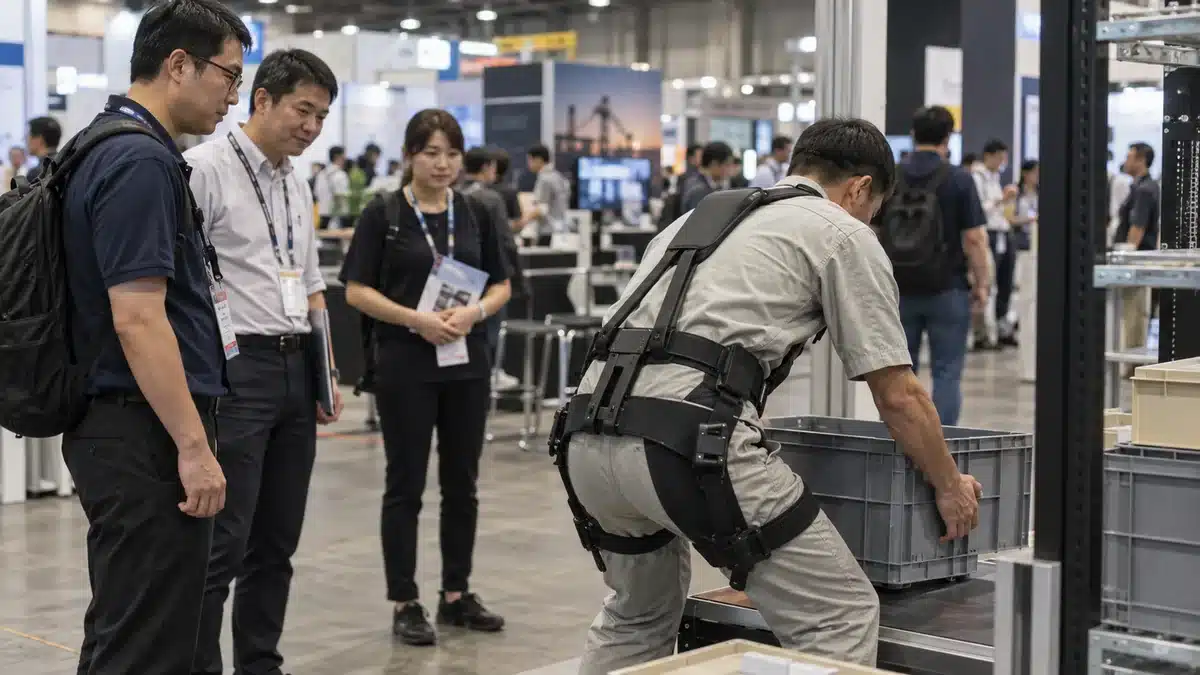
The launch coincides with OS+H Asia 2026, where workplace exoskeletons are receiving dedicated attention alongside established occupational safety and ergonomics technologies.
Auxivo develops passive occupational systems designed to reduce physical loading during tasks such as lifting, bending and overhead work.
Local validation with NTU
An important part of the Singapore expansion is the involvement of Nanyang Technological University in research and practical testing of occupational exoskeletons.
Local testing matters because workplace exoskeleton performance cannot be judged solely from laboratory measurements or manufacturer specifications.
Factors such as task compatibility, climate, worker acceptance, fitting, freedom of movement and wearing time can determine whether assistance translates into useful everyday deployment.
Exoskeleton Index analysis
The Singapore launch reflects a broader shift in the industrial exoskeleton market.
Manufacturers increasingly need more than an ergonomic claim and a product demonstration. Buyers are looking for local support, structured evaluation and evidence that a device can function within real operational conditions.
Singapore is an interesting market for that approach because logistics, manufacturing, construction and infrastructure activities all include physically demanding work, while workplace safety standards are relatively mature.
The involvement of a university and a local industrial partner could therefore be more important than the launch event itself. If the testing produces useful field evidence, it could help buyers understand where occupational exoskeletons provide measurable value and where they introduce trade-offs.
Validation is still underway
The NTU-related work should not be described as proof that Auxivo’s systems have already demonstrated effectiveness in Singaporean workplaces.
Research and testing are underway, and no final local results were identified in the material reviewed for this article.
As with other occupational exoskeleton programmes, meaningful evaluation should include not only biomechanical unloading but also comfort, wearing time, task interference, worker adoption and operational practicality.
Industrial exoskeletons move deeper into workplace safety
OS+H Asia’s dedicated exoskeleton activity also shows how wearable robotics is becoming integrated into the wider workplace-safety discussion.
Rather than being presented only as robotics technology, occupational exoskeletons are increasingly evaluated alongside ergonomics programmes, PPE, workforce safety and manual-handling interventions.
For manufacturers such as Auxivo, that places greater emphasis on evidence, deployment support and task-specific evaluation rather than headline assistance figures alone.