
Saudi Arabia’s exoskeleton market is no longer defined only by isolated demonstrations or long-term Vision 2030 ambitions. In 2026, three pieces of market infrastructure are appearing at the same time: a NUPCO rehabilitation framework that explicitly lists a robotic exoskeleton and its lifecycle costs, a new Saudi distribution channel for ABLE Human Motion, and a PIF/NUPCO investment opportunity calling for local production, assembly and servicing of wearable robotic exoskeletons. The important counterpoint is that fresh Saudi hospital research still finds limited access to advanced mobility technology, import dependence, procurement delays and uncertainty among clinicians about whether powered exoskeletons are even available. The market is taking shape, but it is not yet mature.
Key takeaways
- NUPCO has created a concrete procurement pathway. Its 2026 open rehabilitation framework, NPT0015/26, includes a line item for a “ROBOTIC EXOSKELETON” plus battery, charger, third- to fifth-year warranty costs, and main- and remote-area delivery. As of this evidence review, the tender is still listed as “Under Studying”, so it should not be reported as an awarded national purchase.
- Localization is now an explicit investment objective. PIF’s private-sector platform, through NUPCO, calls for local production, assembly and servicing of wearable robotic exoskeletons using OEM partnerships and advanced manufacturing investment.
- The public localization figure still needs careful handling. PIF’s English opportunity page displays indicative annual addressable demand of SAR 180 million (US$48 million). The Arabic version also displays US$48 million but shows SAR 300 million, an internally inconsistent currency pair that appears to be a localization or data-entry error. Exoskeleton Index therefore uses the internally consistent SAR 180 million / US$48 million figure while treating it as indicative demand rather than verified Saudi exoskeleton market revenue.
- Commercial distribution is broadening. Zahrawi Group announced a Saudi partnership with ABLE Human Motion on 30 July 2026, and ABLE now lists Dar Al Zahrawi Medical LLC as its official Kingdom of Saudi Arabia distributor.
- Saudi rehabilitation capacity is expanding. Johns Hopkins Aramco Healthcare opened a larger Dhahran rehabilitation centre in June 2026 with a Robotic Hub and Assistive Technology Clinic, while projecting rehabilitation visits to rise by more than 33% in 2026.
- Clinical and research activity is real but still fragmented. The SFDA lists an ongoing Riyadh stroke trial using CYBERDYNE’s HAL-ML05, while Saudi-affiliated researchers published a lower-limb exoskeleton prototype study in 2026.
- The biggest near-term opportunity is medical and rehabilitation, not industrial. Exoskeleton Index found strong current evidence for healthcare procurement, clinical use pathways and localization planning, but did not identify a primary-source-confirmed large Saudi industrial exoskeleton rollout during this review.
Direct answer: what changed in Saudi Arabia’s exoskeleton market in 2026?
Saudi Arabia moved closer to an organised exoskeleton market in 2026 because procurement, distribution, clinical research and localization began to align. NUPCO explicitly included robotic exoskeletons in a national rehabilitation framework, ABLE Human Motion added an official Saudi distributor, PIF/NUPCO published a localization opportunity for production and servicing, and rehabilitation capacity continued to expand. However, adoption remains uneven, with recent Saudi research documenting limited access to advanced assistive technology, import dependence, procurement delays and training gaps.
Why 2026 looks different for Saudi Arabia’s exoskeleton market
Saudi Arabia has had exposure to rehabilitation exoskeletons for years. That history matters, but it is not the reason this market deserves a fresh 2026 assessment. The more important development is that several parts of the commercial system are now visible at once.
First, the country’s centralised healthcare procurement system has created a specific procurement line for a robotic exoskeleton. Second, a European rehabilitation-exoskeleton manufacturer has added a formal Saudi distributor. Third, PIF’s private-sector opportunity platform is not merely encouraging imports; it is inviting investment in local production, assembly and servicing. Fourth, Saudi rehabilitation institutions and researchers are expanding advanced-technology capacity while the national regulator continues to host exoskeleton clinical research.
Taken separately, none of these proves a large market. Together, they form something more useful: evidence of market infrastructure.
This distinction is important. Emerging technology markets rarely become mature because of one product launch. They mature when buyers can define the category, procurement systems can purchase it, regulators can process it, distributors can sell and service it, clinicians can use it, researchers can generate local evidence, and manufacturers can see enough demand to justify a durable local presence.
Saudi Arabia is not at the end of that process. In 2026, it is starting to show more of the pieces.
| 2026 signal | What happened | What it demonstrates | What it does not prove |
|---|---|---|---|
| NUPCO NPT0015/26 | Robotic exoskeleton explicitly listed in an open rehabilitation framework with battery, charger, warranty and delivery items | Formal procurement category and lifecycle-cost thinking | An awarded contract, shipment volume or national installed base |
| PIF/NUPCO localization opportunity | Local production, assembly and servicing proposed through OEM partnerships | State-linked interest in building domestic capability | That a Saudi exoskeleton factory has been commissioned or built |
| ABLE + Zahrawi | ABLE adds an official Saudi distributor | A new commercial route to clinics and buyers | Confirmed Saudi sales volume or hospital deployments |
| JHAH rehabilitation expansion | New Robotic Hub, Assistive Technology Clinic and larger rehabilitation footprint | Rising advanced-rehabilitation capacity | That JHAH’s Robotic Hub specifically contains wearable exoskeletons |
| SFDA HAL-ML05 trial | Ongoing powered lower-extremity exoskeleton trial for adult stroke patients in Riyadh | Active regulated clinical research | Routine reimbursement or broad commercial availability |
| 2026 Saudi MAT study | Advanced-device access gaps, import dependence, delays and training barriers documented across three public hospitals | The adoption bottleneck is still substantial | National prevalence of exoskeleton use across every Saudi hospital |
NUPCO has formally put a robotic exoskeleton into a procurement framework
The strongest current demand-side signal is not a marketing announcement. It is a procurement document.
The National Unified Procurement Company, or NUPCO, is the PIF-owned company responsible for centralised healthcare procurement and supply-chain functions across Saudi Arabia. Its 2026 tender NPT0015/26, titled the Open Framework Agreement for Rehabilitation, opened on 25 May 2026. The current NUPCO tender page lists the submission deadline as 2 August, bid opening as 3 August and the status as Under Studying.[1]
On page 38 of the official item list, serial number 1413 is item MRH300045, NUPCO code 4225162601500, described simply as ROBOTIC EXOSKELETON.[2]
The lines immediately after it are more revealing than the headline item. NUPCO separately lists a battery, battery charger, third-year warranty, fourth-year warranty, fifth-year warranty, main-area delivery and remote-area delivery for the robotic exoskeleton.[2]
Exoskeleton Index analysis: the lifecycle items matter
A procurement system that separately recognises the battery, charger, multi-year warranty and delivery is treating the exoskeleton as a maintainable clinical asset rather than an experimental gadget. For suppliers, that signals that serviceability, battery replacement, logistics, warranty structure and remote-area support may matter almost as much as the device specification itself.
There is an important limit. The PDF’s quantity formatting is ambiguous when extracted from the table, and the tender is still under study. Exoskeleton Index therefore does not interpret the document as evidence that a particular number of exoskeletons has been purchased, awarded or deployed.
The correct conclusion is narrower but still significant: Saudi Arabia’s central procurement architecture now contains an explicit exoskeleton line item and a commercial structure around ownership costs.
For buyers trying to understand how exoskeleton procurement should be evaluated beyond the purchase price, see the Exoskeleton Index practical exoskeleton buyer’s guide.
Saudi Arabia is exploring localization, not only imports
The second major signal comes from PIF’s Private Sector Hub. Under NUPCO, PIF lists an investment opportunity titled “Establish local capabilities for production to servicing of wearable robotic exoskeletons.”[3]
The opportunity describes local production, assembly and servicing built around strategic OEM partnerships and advanced-manufacturing investment. PIF defines the target systems as externally worn powered orthotic devices that assist or augment upper- and lower-limb movement for people with motor impairments.[3]
This is a more consequential policy signal than a generic statement about robotics. It names the product category, identifies a localization path and places NUPCO between demand aggregation and industrial development.
PIF also explicitly links the opportunity to precision manufacturing and frontier medical technology. That fits the fund’s broader 2026–2030 strategy, approved in April 2026, which places greater emphasis on competitive domestic ecosystems, private-sector participation and value-chain development. Advanced Manufacturing & Innovation and Industrials & Logistics are among the six ecosystems identified in the Vision Portfolio.[4]
A likely localization error in the Arabic demand figure
There is, however, a material data-quality issue in the public opportunity pages.
During Exoskeleton Index’s evidence review, the English PIF page displayed indicative annual addressable demand of SAR 180 million (US$48 million) for the wearable-exoskeleton opportunity.[3] The Arabic version displayed the same US$48 million figure but paired it with SAR 300 million.[5]
Those two currency values cannot both be correct at the Saudi riyal’s long-standing dollar peg: US$48 million corresponds to approximately SAR 180 million. Because both language versions preserve the same US-dollar value, the SAR 300 million entry is more consistent with a localization or data-entry error than with a genuinely different underlying demand estimate.
Why US$48 million is still not a Saudi exoskeleton market-size figure
Exoskeleton Index uses SAR 180 million / US$48 million as the internally consistent version of PIF’s published indicative annual addressable demand. But PIF describes this as an investment-opportunity estimate, not audited exoskeleton sales or verified national market revenue. It should therefore be treated as a signal of prospective demand supporting localization, not as the definitive size of Saudi Arabia’s exoskeleton market.
This discrepancy is also a reminder of why country-level exoskeleton market sizing should not be built by repeating a single government or commercial forecast. The Exoskeleton Index 2026 global exoskeleton market analysis uses the same principle: definitions, boundaries and evidence quality matter more than the largest headline number.
What localization could realistically mean
“Local production” does not necessarily mean Saudi Arabia will immediately manufacture motors, transmissions, batteries, sensors, frames, embedded electronics and control software for a complete exoskeleton from raw materials.
A more credible localization pathway is layered.
| Localization stage | Capability | Commercial significance |
|---|---|---|
| 1. Local distribution | Saudi sales channel, tenders, clinical education and account support | Creates market access and buyer relationships |
| 2. Service and maintenance | Spare parts, battery replacement, diagnostics, repair, calibration and field support | Reduces downtime and import-related service delays |
| 3. Final configuration or assembly | Local fitting, subassembly, final assembly, testing or packaging | Adds local value and can improve responsiveness |
| 4. Local component production | Soft goods, harnesses, structural components, selected electronics or battery packs | Deepens supply-chain participation |
| 5. Deeper platform localization | Actuation, electronics, software, control systems and locally owned IP | Represents a much higher technology and capital threshold |
PIF’s wording — production, assembly and servicing through OEM partnerships — is consistent with a staged model rather than an assumption that a fully Saudi-designed exoskeleton platform appears overnight.
For established manufacturers, this matters strategically. A Saudi localization partnership could eventually offer three benefits at once: access to centralised procurement, a regional service base for the Gulf, and alignment with local-content priorities. But those benefits depend on actual tender awards, device authorisation, clinical demand and economics.
Distribution is becoming more structured
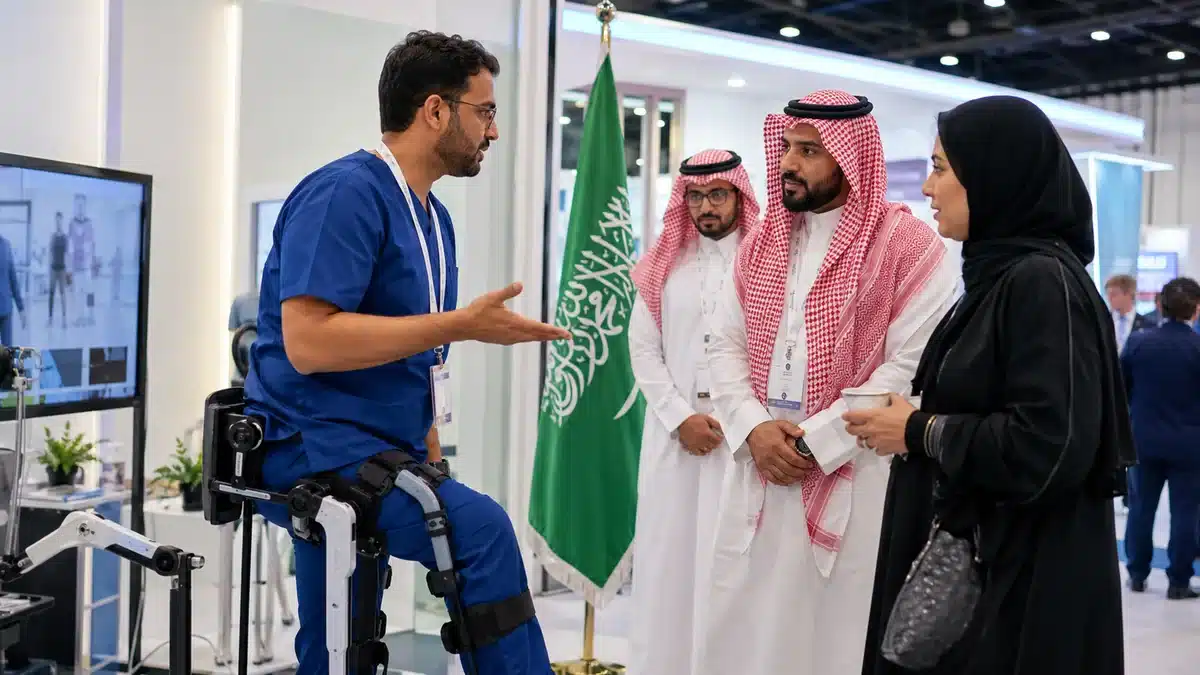
On 30 July 2026, Zahrawi Group announced a partnership with Barcelona-based ABLE Human Motion in the Kingdom of Saudi Arabia, adding rehabilitation exoskeleton technology to its portfolio.[6] ABLE’s own distributor directory now lists Dar Al Zahrawi Medical LLC in Riyadh as its official Saudi distributor.[7]
This is more useful than an overseas manufacturer saying it is “entering the Middle East”. A named local distributor creates an identifiable route for hospitals, rehabilitation centres and procurement teams to obtain demonstrations, quotations, implementation support and after-sales service.
Service is particularly important for powered rehabilitation exoskeletons. Zahrawi says its service teams across its locations include more than 50 trained engineers and provide maintenance-management and after-sales support.[8] The company does not state that all of those engineers are specifically trained on ABLE systems, so that should not be assumed. But the existence of a biomedical service organisation is commercially relevant in a market where fresh research identifies imported-device maintenance and repair delays as a barrier.
Exoskeleton Index analysis: distribution is part of the product
For complex rehabilitation robotics, the effective product is not only the hardware. It is the hardware plus clinical training, fitting, technical service, spare parts, software support, regulatory documentation and the ability to keep a device operating after purchase. Saudi market entry through a distributor with healthcare and engineering infrastructure is therefore more meaningful than a simple reseller listing.
The partnership does not disclose Saudi sales, installed units or named hospital customers. Those are now important proof points to watch.
Saudi rehabilitation capacity is expanding
The demand environment is also changing.
Johns Hopkins Aramco Healthcare opened a new Rehabilitation Center in Dhahran in June 2026. The centre expanded from 900 to 2,000 square metres, increased treatment rooms from 25 to more than 40, and added a Robotic Hub, an Assistive Technology Clinic, comprehensive neurorehabilitation and a sports-performance laboratory.[9]
JHAH also projects rehabilitation visits to increase from 58,594 in 2025 to 78,201 in 2026, growth of more than 33%.[9]
That number should not be translated into exoskeleton demand. JHAH does not say that its Robotic Hub contains wearable exoskeletons, and most rehabilitation visits will have nothing to do with exoskeleton therapy. What it does show is expanding capacity and patient volume in precisely the clinical environment where advanced mobility and rehabilitation technology can be evaluated.
Saudi buyers and clinical teams considering these technologies can explore Exoskeleton Index’s Healthcare & Rehabilitation exoskeleton sector for the broader product and evidence landscape.
Clinical exoskeleton research is active inside the Saudi regulatory system
The Saudi Food and Drug Authority’s clinical-trials database currently lists an ongoing trial titled “Wearable Cyborg Device (Powered Lower Extremity Exoskeleton) in Adult patient with stroke: Single Center Clinical Trial.” The device is CYBERDYNE’s Hybrid Assistive Limb HAL-ML05, protocol ICT22R/006/10, sponsored by King Abdullah International Medical Research Center and conducted at King Abdulaziz Medical City in Riyadh.[10]
The Arabic SFDA listing also marks the trial as جاري, meaning ongoing, providing a useful cross-language confirmation of the current status.[11]
This matters for two reasons. It shows that powered lower-extremity exoskeleton research is not only a historical Saudi story, and it places that work inside the national medical-device clinical-trial framework.
It does not establish routine clinical use, reimbursement, or a national treatment pathway for HAL. Trial activity is evidence of clinical investigation, not market penetration.
Saudi researchers are also building exoskeleton technology
Local capability is not limited to procurement and distribution.
A 2026 paper in the International Journal of Artificial Organs described the design, optimisation and implementation of a controlled lightweight double-leg rehabilitation exoskeleton. Saudi affiliations included Taif University’s Orthopedic Division and Mechanical Engineering Department, as well as the Department of Orthopedic Surgery at East Jeddah General Hospital.[12]
The paper describes a prototype with powered hip and knee joints, a control system and experimental validation against gait-cycle torque and angle profiles. It is a research prototype, not evidence of a Saudi commercial product line.
Still, it matters to the localization thesis. Building a domestic exoskeleton ecosystem requires more than assembly capacity; it also requires clinicians, biomechanical researchers, control engineers and mechanical engineers who understand the technology. Saudi-affiliated work in this area is a small but relevant capability signal.
The market is still immature where it matters: access, training and implementation
The strongest counterweight to the optimistic signals is also one of the newest sources.
A mixed-methods study published online in May 2026 examined mobility-assistive technology provision across three Saudi public hospitals in two regions. It combined a survey of 67 stakeholders, interviews with 33 participants and analysis of six policy documents.[13]
The study found that basic mobility technologies were generally accessible, while advanced devices were much less consistently available and showed regional disparities. Notably, 33% of survey respondents (22 of 67) were uncertain whether wearable powered exoskeletons were available in their hospitals.[13]
The qualitative work identified 52 barriers across the Consolidated Framework for Implementation Research. Relevant barriers included dependence on imported devices, high costs, procurement delays, regulatory ambiguity, insufficient professional training, inadequate strategic planning, limited specialist capacity and inconsistent service provision.[13]
Participants specifically described reliance on imported assistive technology as a source of waiting times for both devices and repairs. The study also reports that NUPCO procurement can restrict purchases to pre-approved devices and that introducing new technologies can require evaluation that delays purchasing.[13]
The central 2026 market insight
Saudi Arabia appears to be building the commercial infrastructure ahead of broad utilisation. Central procurement can now recognise exoskeletons, distributors are entering, localization is being explored and clinical research is active — yet clinicians still report uncertainty about availability and structural barriers to advanced assistive-technology provision. That gap is where the next phase of the market will be decided.
This finding also strengthens the case for local service capability. If an imported device takes too long to repair, the cost is not only technical downtime; it can interrupt treatment pathways, reduce clinician confidence and undermine future procurement.
What the demand drivers actually say
PIF’s exoskeleton localization page cites stroke, spinal cord injury and population ageing as demand drivers. The direction is plausible, but the public numbers require careful interpretation.
Stroke: the “30 per 100,000” figure is not the whole current picture
PIF references stroke incidence of roughly 30 per 100,000. That closely matches a 2020 systematic review and meta-analysis of five Saudi studies that estimated pooled annual stroke incidence at 29 per 100,000, with a 95% confidence interval of 15 to 47.[14]
A newer 2026 Saudi analysis using Global Burden of Disease 2021 modelling reports a much higher age-standardised incidence estimate of 130.7 per 100,000 in 2021, down from 166.3 in 1990.[15]
Those two numbers should not be treated as a direct contradiction. The 29-per-100,000 estimate pooled older empirical hospital and regional studies; the GBD figure is a modelled national age-standardised estimate using a different methodology. A separate 2026 Saudi stroke analysis explicitly notes this epistemological difference.[16]
For exoskeleton demand, an even more relevant indicator is disability burden. The 2026 GBD-based rehabilitation study estimates that absolute stroke-related years lived with disability rose from approximately 10,900 in 1990 to 36,245 in 2021, even as age-standardised incidence declined. It projects absolute stroke-related YLDs to reach approximately 40,764 by 2030 under its model.[15]
The commercial implication is not “stroke incidence is exploding”. It is that Saudi Arabia can face a growing absolute rehabilitation workload because of population growth, ageing and improved survival even when age-standardised incidence rates fall.
Spinal injury: road traffic matters, but national burden is more complex
PIF’s localization page also links Saudi spinal cord injury burden to road traffic accidents. Recent Saudi data support road traffic as a major contributor in traumatic hospital cohorts, but not as the only national burden driver.
A 2026 retrospective study from a Riyadh tertiary centre included 623 patients with traumatic spinal injuries between 2018 and May 2025. Four-wheel motor-vehicle accidents accounted for 57.6% of cases, and 78.5% of patients were male.[17]
By contrast, a national GBD-based analysis of spinal cord injury published in late 2025 found that non-transport unintentional injuries accounted for 75.5% of age-standardised SCI prevalence and 74.8% of YLDs in 2021.[18]
Again, the datasets answer different questions. A tertiary-centre traumatic-spine cohort is not the same as a national model of SCI prevalence by cause. The responsible conclusion is that transport trauma remains highly relevant to Saudi spinal injury care, while the total national disability burden cannot be reduced to road crashes alone.
Medical rehabilitation is the clearest Saudi exoskeleton market today
Current evidence strongly suggests that Saudi Arabia’s near-term exoskeleton opportunity is medical and rehabilitation-led.
The NUPCO localization opportunity itself defines the target category as powered orthotic devices for people with motor impairment. The 2026 procurement line sits inside a rehabilitation framework. ABLE’s Saudi partnership is explicitly positioned around rehabilitation and mobility. The HAL-ML05 activity is a stroke trial. The strongest Saudi academic work identified in this review is a rehabilitation exoskeleton prototype.
By comparison, searches across Arabic and English primary sources did not identify a major, current, independently verifiable Saudi industrial exoskeleton rollout at Saudi Aramco, SABIC, airports, major logistics operators or construction projects during this evidence review.
Industrial exoskeletons: opportunity, not yet a verified Saudi deployment story
Saudi Arabia has sectors where occupational exoskeletons could be relevant — logistics, aviation ground handling, construction, manufacturing, mining and energy — but a plausible use case is not the same as a deployment. Exoskeleton Index will treat the Saudi industrial segment as an emerging opportunity until primary sources confirm material pilots or rollouts.
This is particularly important because industrial and medical exoskeletons follow different regulatory, procurement and evidence pathways. Readers evaluating workplace systems should use the Exoskeleton Index pilot playbook rather than extrapolating from rehabilitation adoption.
What manufacturers need to enter Saudi Arabia
A manufacturer looking at the Saudi opportunity should not interpret the PIF localization listing as a shortcut around regulation or procurement.
The Saudi Food and Drug Authority states that its medical-device registration and licensing function evaluates devices intended to be marketed in the Kingdom, issues medical-device marketing authorisations, licenses importer/distributor establishments through the MDEL system, licenses authorised representatives and approves medical-device clinical trials.[19]
SFDA also maintains a public list of licensed medical-device importer/distributor establishments, and its current regulations include marketing-authorisation requirements, establishment licensing, quality-management and inspection requirements, post-market requirements, and 2026 requirements for safe use of medical devices inside healthcare facilities.[20]
The exact regulatory classification and evidence package depend on the device’s intended use and claims. Exoskeleton Index does not assign a Saudi device class without product-specific regulatory documentation.
| Market-entry requirement | Why it matters for exoskeleton suppliers |
|---|---|
| Product regulatory pathway | Intended use, claims and technical documentation determine the relevant SFDA pathway |
| Licensed local market access | Importer/distributor and authorised-representative structures are part of the Saudi medical-device system |
| NUPCO procurement readiness | Central procurement can require pre-approval, tender documentation, pricing and lifecycle-cost detail |
| Clinical training | Powered rehabilitation systems depend on correct patient selection, fitting, therapist training and protocols |
| Technical service | Batteries, wear parts, diagnostics, repair and maintenance influence uptime and buyer confidence |
| Local evidence | Saudi-specific implementation, usability and health-economic data can reduce uncertainty for hospitals and payers |
| Arabic-language support | Clinical, technical and training materials need to work inside the local care environment |
| Localization plan | PIF/NUPCO’s stated direction favours OEM partnerships that can build domestic assembly or service capability where economics justify it |
Exoskeleton suppliers comparing regulatory regimes can also use the Exoskeleton Index 2026 exoskeleton standards and regulation guide.
A market-maturity scorecard for Saudi Arabia in 2026
The following is an Exoskeleton Index qualitative assessment based on the evidence reviewed for this article. It is not an official Saudi government score or a forecast model.
| Market layer | EI assessment | Evidence in 2026 |
|---|---|---|
| Clinical need | Strong | Growing absolute stroke disability burden, traumatic spine cases and rising rehabilitation volumes |
| Central procurement | Emerging / concrete | NUPCO framework explicitly contains a robotic exoskeleton category and lifecycle items |
| Distribution | Developing | ABLE adds Zahrawi; prior rehabilitation-exoskeleton presence means the market is not starting from zero |
| Clinical evidence in Saudi Arabia | Developing | Ongoing HAL trial plus Saudi-affiliated engineering research |
| Service infrastructure | Developing | Local healthcare distributors have biomedical service capability, but exoskeleton-specific coverage remains only partly public |
| Hospital access | Uneven | 2026 mixed-methods study documents advanced-device gaps and regional disparities |
| Local manufacturing | Intent / opportunity stage | PIF/NUPCO localization opportunity exists; no verified large-scale Saudi exoskeleton manufacturing facility identified |
| Reimbursement / routine funding | Unclear | No broad national exoskeleton reimbursement pathway identified in reviewed public sources |
| Industrial adoption | Early / unverified at scale | No major primary-source-confirmed Saudi rollout identified in this review |
Why the service layer may decide the Saudi market
The most underestimated part of exoskeleton commercialization in Saudi Arabia may be service.
Powered clinical exoskeletons combine mechanical structures, batteries, sensors, actuators, electronics, software and wearable interfaces. A failure in any one of those systems can make a device unavailable. The 2026 Saudi assistive-technology study directly connects import dependence with delays in obtaining devices and repairs.[13]
That creates a straightforward localization logic. Even before deep manufacturing becomes viable, local spare-parts inventory, trained biomedical engineers, battery replacement, diagnostics and repair can reduce the operational penalty of importing complex hardware.
This also helps explain why PIF’s wording includes servicing alongside production and assembly. A Saudi or GCC service base could create value even at shipment volumes too low to support full component manufacturing.
For manufacturers, this suggests that the first serious localisation proposal may not be “build a factory”. It may be “build an accountable clinical and technical support system, then localise more of the value chain as installed volume grows.”
What would turn the current signals into a real market?
The next phase requires evidence of transactions and repeat use, not more strategic language.
The NUPCO tender needs to progress from an item list to disclosed awards, suppliers or purchase activity. The ABLE–Zahrawi relationship needs named clinical implementations or measurable Saudi adoption. The HAL trial needs results or a clearly documented next clinical step. PIF’s localization opportunity needs an OEM partner, investment decision or facility. Hospitals need stronger training and service capacity. Most importantly, buyers need evidence that exoskeleton programmes deliver clinically meaningful outcomes at an acceptable total cost of ownership.
That is the difference between a market that can buy exoskeletons and a market that buys them repeatedly.
Exoskeleton Index outlook
Saudi Arabia is one of the more credible Gulf markets to watch for rehabilitation exoskeletons through 2027. The bullish case is not based on Vision 2030 branding. It is based on a rare alignment of central procurement, state-linked localization interest, formal distribution, expanding rehabilitation capacity and active clinical research. The caution is equally clear: access remains uneven, public demand figures are inconsistent, and there is still little transparent evidence of scale. The most important upcoming signal will be whether this infrastructure converts into awarded procurement, installed devices and local service or assembly capacity.
What to watch through 2027
- NUPCO NPT0015/26: whether the rehabilitation framework reaches award/final-result status and whether robotic-exoskeleton suppliers are disclosed.
- PIF/NUPCO localization: whether the Arabic SAR figure is corrected and whether an OEM or local investment partner is announced.
- ABLE in Saudi Arabia: first named clinics, hospital installations, training programmes or Saudi case studies through Zahrawi.
- HAL-ML05: trial completion, published results, regulatory updates or expansion beyond the current Riyadh study.
- JHAH’s Robotic Hub: whether wearable exoskeleton technologies become part of the publicly described equipment mix.
- Local engineering: movement from university prototypes toward translational programmes, licensing, startups or OEM partnerships.
- Industrial use: the first primary-source-confirmed pilots or deployments in logistics, aviation, construction, manufacturing, mining or energy.
- Service localisation: evidence of Saudi-based exoskeleton repair, spare-parts, calibration, battery and training capability.
Frequently asked questions
Does Saudi Arabia have an exoskeleton market in 2026?
Yes, but it is still emerging. Saudi Arabia has active rehabilitation exoskeleton research, an explicit NUPCO procurement category, formal distribution for at least one current rehabilitation-exoskeleton manufacturer, and a PIF/NUPCO localization opportunity. However, public evidence of broad installed volume, reimbursement and repeat procurement remains limited.
How large is the Saudi Arabia exoskeleton market?
There is no independently verified national revenue figure. PIF’s English localization page displays indicative annual addressable demand of SAR 180 million (US$48 million). The Arabic version also displays US$48 million but pairs it with SAR 300 million, which appears to be an internal localization or data-entry inconsistency. Exoskeleton Index therefore uses SAR 180 million / US$48 million as the internally consistent published estimate while treating it as indicative addressable demand, not verified Saudi exoskeleton market revenue.
Are exoskeletons included in Saudi government procurement?
NUPCO’s 2026 Open Framework Agreement for Rehabilitation, tender NPT0015/26, explicitly lists a robotic exoskeleton together with a battery, charger, third- through fifth-year warranty costs and delivery items. As of this review, the tender is listed as Under Studying, so it is evidence of a procurement pathway rather than proof of an awarded purchase.
Which exoskeleton companies are active in Saudi Arabia?
Current public evidence includes ABLE Human Motion, which lists Zahrawi as its official Saudi distributor, and CYBERDYNE’s HAL-ML05, which is listed in an ongoing SFDA-registered stroke clinical trial in Riyadh. This is not an exhaustive list of every device that may be present in individual hospitals.
Is Saudi Arabia manufacturing exoskeletons locally?
Exoskeleton Index did not identify a verified large-scale commercial Saudi exoskeleton manufacturing facility during this review. PIF/NUPCO is actively advertising an opportunity to establish local production, assembly and servicing through OEM partnerships, while Saudi-affiliated researchers are developing exoskeleton prototypes. The localization opportunity is therefore real, but commercial manufacturing remains a future proof point.
What is the biggest Saudi exoskeleton opportunity?
Based on currently verifiable evidence, medical rehabilitation is the strongest near-term segment. Industrial applications may become important because of Saudi Arabia’s logistics, construction, manufacturing, aviation, mining and energy sectors, but large industrial exoskeleton deployments were not verified in primary sources during this review.
For a wider global view, see The Exoskeleton Market in 2026, browse exoskeleton applications by industry, or use the Exoskeleton Index comparison tool to compare published product information.
Methodology and limitations
This Insight was prepared from evidence reviewed through 4 September 2026. Exoskeleton Index prioritised Saudi government sources, NUPCO procurement records, PIF investment-opportunity pages, SFDA regulatory and clinical-trial records, official manufacturer/distributor information, Saudi healthcare-provider announcements and peer-reviewed research.
The research was cross-checked across English and Arabic official Saudi sources, with additional checks of French PIF localisation pages and Spanish/English ABLE distributor information where useful. The English PIF page shows SAR 180 million / US$48 million, while the Arabic page shows SAR 300 million alongside the same US$48 million value. Because the dollar figure is identical and SAR 180 million is the internally consistent conversion, Exoskeleton Index treats the SAR 300 million entry as a likely localization or data-entry error rather than a separate demand estimate.
Searches also covered Saudi industrial exoskeleton use cases in Arabic and English. The absence of a verified large rollout in this article does not prove that no private or undisclosed pilot exists. It means Exoskeleton Index did not identify a sufficiently strong primary source to report one as a current market fact.
NUPCO tender documents establish a procurement category but do not establish final purchase quantities or awards. JHAH’s Robotic Hub is evidence of advanced rehabilitation infrastructure, not proof that a wearable exoskeleton is installed there. Distribution partnerships are evidence of market access, not sales. Clinical trials and prototypes are evidence of research activity, not routine clinical adoption.
Health-burden statistics are also methodology-dependent. Empirical pooled stroke incidence and GBD-modelled age-standardised incidence should not be compared as though they are the same measurement. The article therefore emphasises the trend in absolute rehabilitation burden rather than using a single incidence figure to inflate addressable demand.
References
- NUPCO. Open Framework Agreement for Rehabilitation, tender NPT0015/26. Current tender page, status “Under Studying”. NUPCO tender page.
- NUPCO. Item List, NPT0015/26, Open Framework Agreement for Rehabilitation, 25 May 2026. Serial 1413–1420 list the robotic exoskeleton, battery, charger, warranties and delivery. Official item-list PDF.
- Public Investment Fund. “Establish local capabilities for production to servicing of wearable robotic exoskeletons.” English Private Sector Hub page. PIF English opportunity page.
- Public Investment Fund. PIF 2026–2030 Strategy, approved 15 April 2026. PIF strategy announcement.
- صندوق الاستثمارات العامة. “تأسيس قدرات محلية لإنتاج وتجميع وصيانة الهياكل الخارجية الروبوتية القابلة للارتداء.” Arabic Private Sector Hub page. During this review, the page displayed SAR 300 million alongside US$48 million for the opportunity, an internally inconsistent currency pair. PIF Arabic opportunity page.
- Zahrawi Group. “ABLE Human Motion Partnership in KSA”, 30 July 2026. Official partnership announcement.
- ABLE Human Motion. Official distributors: Dar Al Zahrawi Medical LLC, Kingdom of Saudi Arabia. ABLE distributor directory.
- Zahrawi Group. Service Unit. Zahrawi service and engineering support.
- Johns Hopkins Aramco Healthcare. “JHAH Expands Access to Specialized Therapy with New Rehabilitation Center”, 5 July 2026. JHAH announcement.
- Saudi Food and Drug Authority. Clinical Trials List: HAL-ML05 powered lower-extremity exoskeleton trial in adult stroke patients, Riyadh; status Ongoing. SFDA English clinical-trials list.
- الهيئة العامة للغذاء والدواء. قائمة الدراسات السريرية المسجلة على الأجهزة والمنتجات الطبية; HAL-ML05 trial status جاري. SFDA Arabic clinical-trials list.
- Eleashy H, Bukhary HA, Alhomayani KM, et al. Double-leg exoskeleton for rehabilitation: Design, optimization, and implementation. International Journal of Artificial Organs. 2026;49(6):411–427. PubMed.
- Aldawood A, Field B, Rushton S, Hind D. Barriers to the provision of mobility assistive technology in Saudi Arabian healthcare: a mixed-methods study using the Consolidated Framework for Implementation Research. Published online 13 May 2026. Full study.
- Alqahtani BA, Alenazi AM, Hoover JC, et al. Incidence of stroke among Saudi population: a systematic review and meta-analysis. Neurological Sciences. 2020;41(11):3099–3104. PubMed.
- Alenzy F, Abu Araigah SA, Almarwani M, Vennu V, Bindawas SM. Trends in Stroke Burden and Rehabilitation Demand in Saudi Arabia, 1990–2021, with Projections to 2030: A National Analysis Using GBD 2021 Data. Journal of Clinical Medicine. 2026;15(6):2382. PubMed.
- Temporal Trends and Burden of Stroke in Saudi Arabia: A Secondary Analysis of Global Burden of Disease Data from 1990 to 2021. 2026. Full text.
- Algarni NA, Aljurayyan RN, Alrasheed KF, et al. Traumatic spinal injuries: A retrospective epidemiological analysis following the 2018 driving policy reform in Saudi Arabia. Injury. 2026;57(2):112968. PubMed.
- Three Decades of Spinal Cord Injury in Saudi Arabia: Trends in Incidence, Prevalence, and Disability Outcomes. Journal of Clinical Medicine. 2025;14(24):8836. PubMed.
- Saudi Food and Drug Authority. Executive Management of Registration & Licensing, Medical Devices. SFDA registration and licensing responsibilities.
- Saudi Food and Drug Authority. Medical-device regulations, including MDS-REQ1, MDS-REQ9, MDS-REQ10, MDS-REQ11 and 2026 MDS-REQ3. SFDA medical-device regulations.
- Public Investment Fund. The National Unified Procurement Company (NUPCO) portfolio profile. PIF NUPCO profile.
- Saudi Food and Drug Authority. Licensed Establishments List, Medical Devices — Importer/Distributor. SFDA licensed establishments.