
Innophys has redesigned one of Japan’s long-running industrial assist suits around a deceptively important specification: weight. The new Muscle Suit Every-Light cuts approximately 1.2 kg from its predecessor, reducing total device weight from 4.3 kg to 3.1 kg.
The Japanese wearable-assistance company will publicly show the pre-production Every-Light prototype for the first time at Logis-Tech Tokyo 2026, running September 8–11 at Tokyo Big Sight.
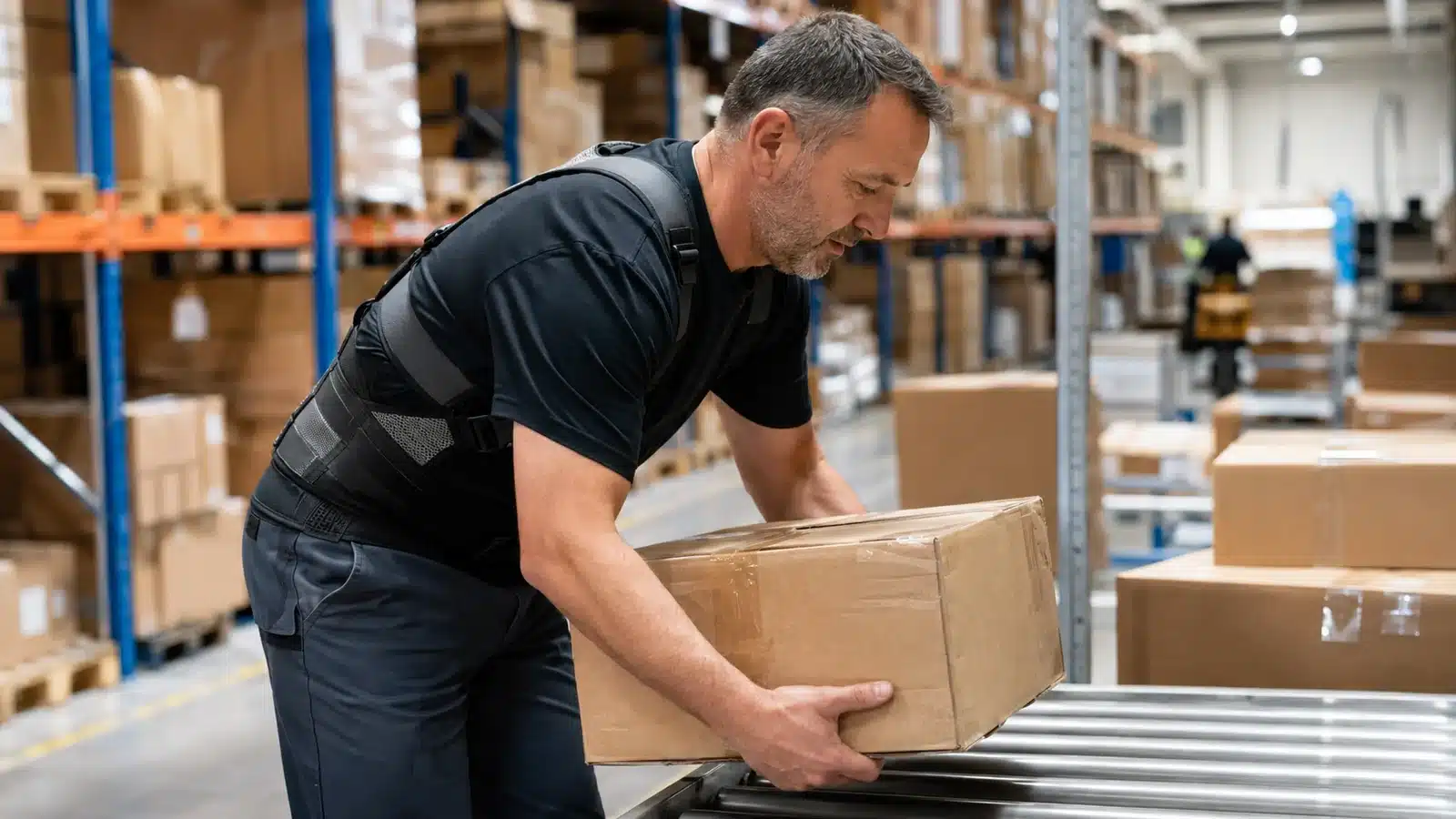
Innophys says the new back-support system retains the pneumatic architecture of the Muscle Suit Every, using compressed-air McKibben artificial muscles to provide up to 20 kgf of assistance without batteries or external electricity.
The redesign also moves from two sizes to a single adjustable configuration intended for users approximately 150–185 cm tall.
Innophys has announced a tax-inclusive Japanese price of ¥132,000.
For industrial exoskeletons, those changes are more important than they may initially sound.
Weight, fit complexity and whether several workers can share one unit are among the practical details that often determine whether wearable equipment remains in daily use after a pilot ends.
At a glance
- Product
- Muscle Suit Every-Light from Innophys.
- Weight
- 3.1 kg, down from 4.3 kg for the previous model.
- Reduction
- Approximately 1.2 kg, or about 28%.
- Assistance
- Up to 20 kgf, according to Innophys.
- Technology
- Compressed-air McKibben artificial muscles; no battery or electrical charging required.
- Fit
- One-size configuration for a recommended height range of approximately 150–185 cm.
- Announced price
- ¥132,000 including Japanese consumption tax.
- Status
- Pre-production prototype scheduled for first public display at Logis-Tech Tokyo, September 8–11, 2026.
Every-Light is a redesign of an established product, not a new category experiment
The Muscle Suit Every-Light is based on Innophys’s long-running Muscle Suit Every.
Rather than replacing its pneumatic principle with motors, batteries or increasingly complicated electronics, the company has focused the redesign on the mechanical experience of wearing and sharing the product.
The current Every-Light prototype uses the same broad McKibben artificial-muscle concept associated with the Muscle Suit family.
Compressed air causes the artificial muscles to contract, creating assistance around the wearer’s trunk and hips during lifting and forward-bending tasks.
Because the system does not depend on an electrical powertrain, it does not require charging infrastructure or battery management.
That can be useful in warehouses, loading operations, agriculture and other workplaces where users may need support across long shifts or in areas where charging devices between tasks would be inconvenient.
The architecture also avoids one of the basic failure modes of powered exoskeletons: assistance disappearing because the battery is depleted.
The trade-off is that a passive pneumatic system cannot dynamically control torque in the same way as a motorized exoskeleton.
Its value therefore depends heavily on how well the mechanical assistance profile matches the user’s actual lifting and bending tasks.
Removing 1.2 kg could matter more than adding another feature
Industrial exoskeleton product announcements often focus on maximum assistance.
But assistance strength is only one part of the adoption problem.
A worker may wear an exoskeleton for hours while receiving significant assistance only during specific movements.
The device’s own mass remains present during the rest of the task cycle.
That makes a 1.2 kg reduction potentially meaningful.
Innophys says the Every-Light falls from 4.3 kg to 3.1 kg, a reduction of approximately 28%.
The company has also redesigned the frame around a slimmer fit intended to improve freedom of movement.
Whether users experience a corresponding improvement in comfort will require real workplace evidence, but reducing non-assisting mass is directionally important for wearable equipment.
An industrial exoskeleton does not only need to help when the worker bends down.
It also needs to remain tolerable while the worker walks, turns, reaches, waits, scans goods, moves through tight spaces or performs tasks where assistance is not required.
One-size fitting may be just as important for fleet deployment
The second important change is sizing.
The previous Muscle Suit Every used two size configurations.
Every-Light moves to a single model intended for users between approximately 150 and 185 cm tall.
That could make the product easier to share between workers.
Shared deployment is common in industrial exoskeleton programs because a company may initially purchase a small fleet for a department rather than assign one device permanently to every employee.
Every additional size creates inventory and scheduling complexity.
A warehouse manager may need to ensure that the correct device is available for the correct worker on the correct shift.
Reducing that to one adjustable configuration can simplify:
- fleet purchasing;
- storage;
- shift handovers;
- training;
- replacement planning;
- and trial programs involving different users.
Fit still needs to be evaluated individually. A recommended height range does not guarantee identical comfort or mechanical alignment across different body proportions.
But operationally, wider adjustability is valuable.
Exoskeleton Index analysis
Every-Light illustrates a more mature phase of industrial exoskeleton development. The headline innovation is not artificial intelligence, a new motor or a futuristic control mode. It is a 28% weight reduction, slimmer geometry and simpler fleet sizing. Those improvements address the less glamorous reasons workplace wearables succeed or fail: whether people tolerate wearing them, whether supervisors can fit them quickly and whether a small fleet can be shared across a real workforce. For an established supplier with tens of thousands of cumulative Muscle Suit shipments, refinement may now matter more commercially than novelty.
Innophys already has a substantial shipment base behind the redesign
The context around Every-Light makes the launch more interesting.
In May, Innophys announced that cumulative shipments across its Muscle Suit series had exceeded 40,000 units worldwide as of April 30, 2026.
That figure comes from the manufacturer and represents cumulative shipments since the first generation, not the number of Every units currently operating in the field.
Innophys also specifies that the total covers its waist- and arm-support assist suits and excludes products such as insoles and cooling vests.
Even with those qualifications, 40,000 cumulative shipments is substantial for the exoskeleton sector.
The company says recent growth has been supported by easier-to-adopt Soft-series products, wider use across logistics, construction, forestry and agriculture, and increasing international sales.
Innophys also opened a German representative office in 2025 and says sales have expanded in markets including South Korea, Spain, Slovenia and Singapore.
That makes Every-Light part of a product portfolio that is already being tested commercially across multiple industries and regions.
Logistics is the obvious target for Every-Light
Innophys will debut the product at one of Japan’s major logistics exhibitions rather than at a general robotics conference.
The company explicitly connects the redesign to workforce shortages, employee ageing and the physical demands of unloading, sorting and transferring goods between pallets.
Those are tasks where full automation can remain difficult.
Warehouses may use conveyors, autonomous mobile robots, automated storage systems and increasingly sophisticated software while still relying on people for irregular manual handling.
That remaining human work is precisely where wearable support systems are competing for a role.
Innophys has already documented deployments of other Muscle Suit products in that environment.
In a recent company case study, Yazaki Parts introduced the Muscle Suit Soft-Light 2 in a manufacturing-center mailroom where employees handle items ranging from very small parcels to loads of approximately 30 kg.
The company reported that the work involves unloading, sorting, loading carts and internal transport for around five hours a day.
According to the Innophys case material, users reported reduced perceived back strain and fatigue during the evaluation period.
Those are manufacturer-published customer observations rather than an independent controlled study, but they show the kind of operational setting the wider Muscle Suit family is already targeting.
Battery-free systems still have a real commercial argument
The industrial exoskeleton market is increasingly diverse.
Powered devices can use sensing and motors to vary assistance dynamically.
Passive textile systems can be exceptionally light and simple.
Spring-based rigid systems offer another compromise.
Innophys continues to argue for pneumatic artificial muscles in products like Every-Light.
That approach has several practical characteristics:
- no battery charging;
- no electrical runtime limit;
- high mechanical assistance relative to many soft supports;
- and the ability to use the system in places where electrical power availability is inconvenient.
The disadvantage is that the assistance profile is mechanically defined and less adaptable than an actively controlled motor system.
For buyers, the correct question is therefore not whether powered technology is inherently superior.
It is whether a device’s assistance architecture matches the actual movement, environment and duration of the work.
Our Back-Support Exoskeleton Buyer’s Guide examines those trade-offs across passive, powered, soft and rigid products in more detail.
What remains unknown
Every-Light is not yet a fully characterized production product.
Innophys says the unit being shown at Logis-Tech Tokyo is a pre-production prototype. The company has published its target specifications and ¥132,000 price, but the September 2 announcement does not provide a commercial shipping date.
Public information also does not yet establish whether the final production hardware will be identical to the exhibition prototype, what certifications will apply, how long-term durability compares with the previous Every model or whether the lighter frame changes assistance characteristics under different loads and body types.
The stated maximum 20 kgf assistance is a manufacturer specification rather than a new independent workplace outcome measured specifically for Every-Light.
Most importantly, the commercial benefit of the 1.2 kg weight reduction still needs real-world evidence. Lower device mass is attractive on paper, but long-duration worker acceptance, thermal comfort, freedom of movement and adherence across full shifts will determine whether the redesign changes actual usage.
International pricing and availability have also not been announced.
Those questions should become easier to answer once production hardware reaches users.
But the direction of the redesign is already revealing.
Industrial exoskeleton suppliers are increasingly competing not simply on how much assistance they can generate, but on whether the equipment is light enough, simple enough and flexible enough to become ordinary workplace gear.
Every-Light is a clear example of that transition.
Sources
- Innophys, announcement of the Muscle Suit Every-Light and Logis-Tech Tokyo 2026 debut, September 2, 2026.
- Innophys / PR Times, Every-Light product announcement, September 2, 2026.
- Innophys, Muscle Suit cumulative shipments exceed 40,000 units, May 29, 2026.
- Innophys, Yazaki Parts Muscle Suit Soft-Light 2 deployment case, August 26, 2026.
Explore the ecosystem
Explore the Muscle Suit Soft-Light 2 and Muscle Suit GS-BACK, read our Back-Support Exoskeleton Buyer’s Guide, browse logistics and warehousing exoskeletons, or compare systems in the Exoskeleton Index comparison tool.