
Consumer exoskeletons have received an unusually prominent endorsement of their relevance as an emerging technology category: Nature has published both a major feature and a follow-up video examining how wearable robotics is moving beyond laboratories and clinical rehabilitation toward everyday walking, hiking and mobility assistance.
The 18 August feature asks whether people could be routinely wearing exoskeletons within the next decade. Nature followed on 24 August with a video titled The exoskeletons are coming (to a store near you), describing technology for walking, running and jumping as moving rapidly from laboratories to hiking trails.
Neither publication proves that mass adoption has arrived. But the framing is significant: exoskeletons are increasingly being discussed not only as rehabilitation devices or futuristic robotics, but as a plausible consumer technology category.
At a glance
- Nature News Feature: Published 18 August 2026.
- Nature Video: Published 24 August 2026.
- Main theme: Smaller, lighter wearable robotics moving from clinical and research applications toward consumer mobility.
- Use cases highlighted: Age-related mobility, walking and outdoor activity.
- Commercial context: Consumer products are already reaching direct buyers rather than remaining exclusively inside research labs.
- Evidence context: Peer-reviewed studies increasingly show measurable reductions in walking effort, but commercial products still vary widely in evidence and maturity.
From rehabilitation technology to something people might buy themselves
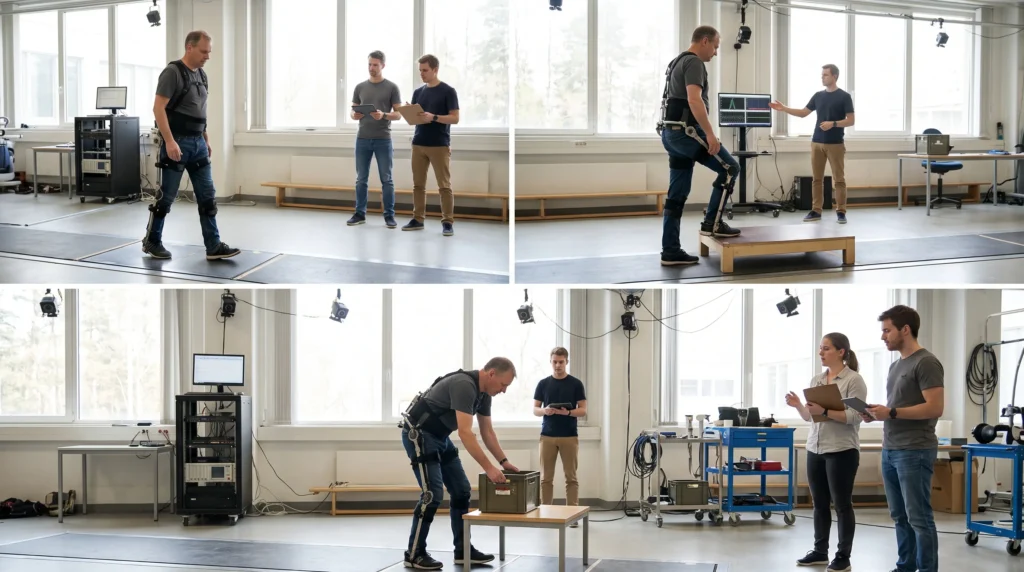
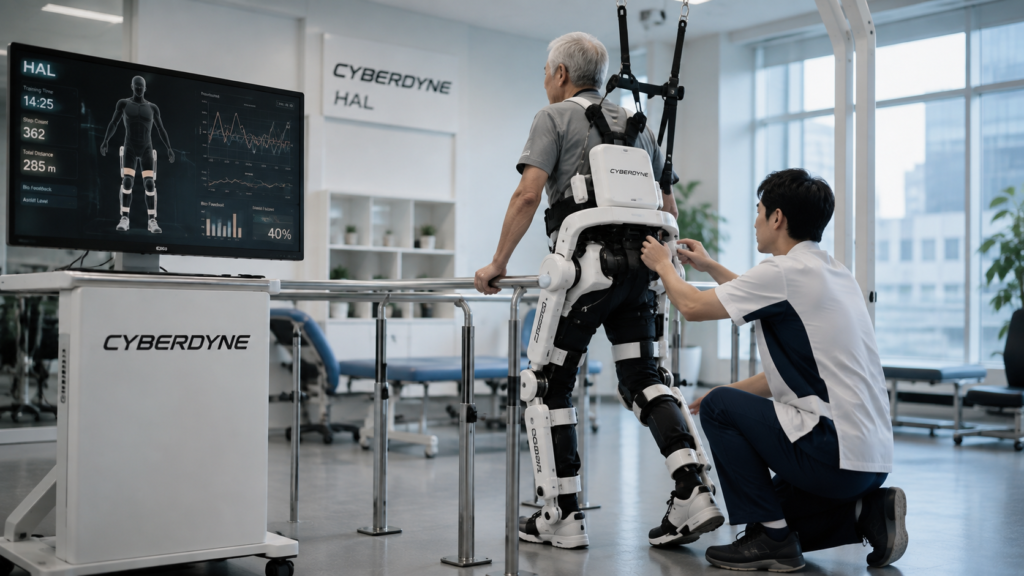
For much of the modern exoskeleton industry’s history, the public associated wearable robots with one of three environments: rehabilitation hospitals, military research programmes or industrial workplaces.
Consumer mobility is changing that picture.
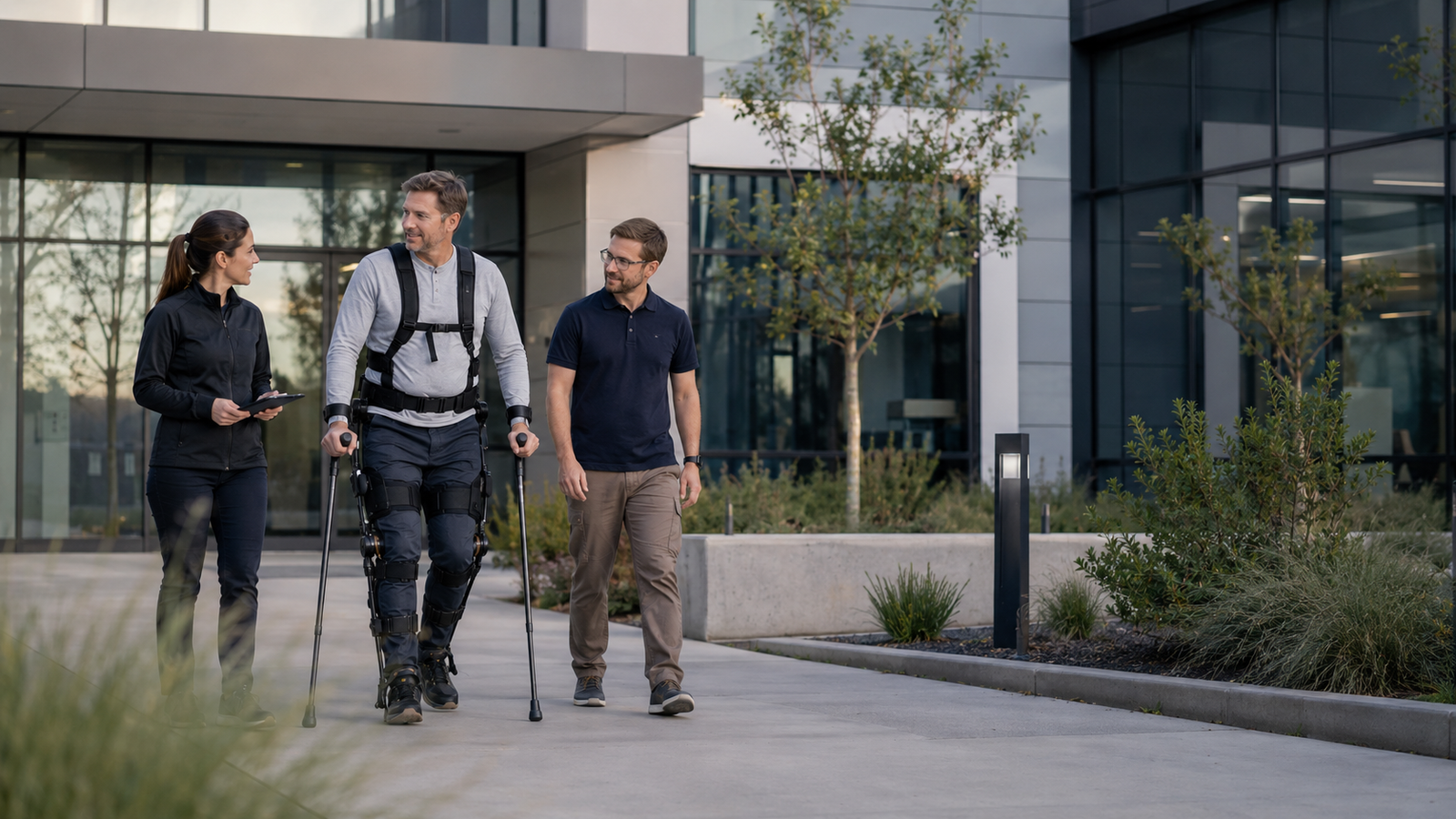
Nature’s feature explicitly describes a shift toward cheaper and smaller systems intended for a much wider population, ranging from people experiencing age-related mobility decline to younger users interested in climbing mountains.
The feature uses consumer systems from Hypershell as one visible example of that transition.
This market is already more than a conceptual exercise. A growing group of hip-, knee- and ankle-assist systems is now being sold or prepared for direct consumer sale, while manufacturers increasingly position wearable assistance alongside outdoor equipment, mobility technology and premium personal electronics.
We recently examined this shift in our consumer exoskeleton comparison and our more specific analysis of what actually works for hiking and outdoor mobility.
The underlying research is also becoming more relevant to real-world use
The commercial market and academic research should not be treated as interchangeable.
A controlled study does not validate the claims of every consumer product, and a successful consumer launch does not prove a physiological benefit.
But recent research does provide evidence that lightweight wearable assistance can reduce the effort of walking outside a laboratory.
A 2024 Nature Machine Intelligence study evaluated a soft robotic system called WalkON. Twelve younger participants used it on a 500-metre uphill outdoor route, where the researchers reported an average 17.79% reduction in metabolic cost of transport compared with wearing the device unpowered.
The same study tested ten adults aged 67 to 82 on a flat 400-metre outdoor track and reported an average 10.48% reduction in metabolic cost of transport with assistance.
The WalkON system weighed approximately 2.93 kg and assisted hip flexion through a textile, tendon-driven structure.
These were small studies of a research system, not proof that a commercially available hiking exoskeleton will produce the same results. Their significance is that the research question has moved beyond whether wearable assistance can work at all toward whether it can work while people move in realistic outdoor environments.
Research focused specifically on older adults is also progressing
A more recent Nature Communications study published in July 2026 tested another soft hip exosuit with ten older adults.
The researchers reported that the system increased the number of sit-to-stand repetitions completed in one minute by an average of 1.8 and reduced the metabolic cost of walking by 13.6% compared with the unassisted condition.
The study also reported that natural movement and a strong sense of user control were preserved.
Again, this is a feasibility study involving a small group. It should not be translated into a universal clinical claim.
But it points toward an important possible consumer category: people who do not require a full medical walking exoskeleton, but who could benefit from moderate assistance while retaining independent control of their own movement.
Exoskeleton Index analysis
The most important part of Nature’s coverage is not that a major publication has discovered exoskeletons. It is the category it is describing. Wearable robotics is beginning to sit between medical assistance, outdoor equipment and personal mobility technology. If that category develops, the addressable user is no longer limited to a patient in a clinic or an employee performing a defined industrial task.
The next consumer market will not be defined by the biggest motor
Early consumer competition has naturally produced a race around easily advertised specifications: watts, torque, modes, range and weight.
Long-term adoption is likely to depend on less dramatic factors.
A wearable robot has to understand what the user is trying to do, apply assistance at the right moment, remain comfortable for extended periods and avoid making ordinary activities more complicated.
For outdoor systems, battery endurance, backpack compatibility, downhill behaviour and weather resistance become important. For older users, stability, fitting, simple controls and confidence may matter more than maximum power.
This is why commercial maturity and user experience are becoming increasingly important filters in the Exoskeleton Index product database.
Consumer visibility can become a market catalyst
Mainstream coverage matters because unfamiliarity remains a barrier to exoskeleton adoption.
People understand what an e-bike does. Most still do not have a clear mental model for what a hip-assist exoskeleton, powered knee device or ankle-assist system actually feels like.
As more buyers encounter wearable robotics through outdoor activities, consumer electronics, travel and ageing-related mobility rather than only through disability or science fiction, the social meaning of the technology can change.
That matters commercially.
Greater awareness can create more product trials. More trials create more real-world feedback. More buyers generate better information about fit, return rates, battery behaviour, reliability and which use cases create enough value to justify the cost.
The category still needs that evidence.
What Nature’s coverage does not prove
The current attention should not be confused with evidence that consumer exoskeletons have already become a mass market.
Several major questions remain unresolved:
- How many consumers continue using the devices after the novelty period?
- Which user groups receive enough benefit to justify a four-figure purchase?
- How well do consumer systems perform after hundreds of hours of use?
- What are real-world return and repair rates?
- How quickly will battery, actuator and control-system improvements reduce weight and cost?
- Will older adults become a major direct consumer group, or will healthcare and mobility channels be required?
- How should manufacturers communicate wellness and mobility benefits without drifting into unsupported medical claims?
Why the timing is important
The Nature coverage arrives as the commercial market is becoming visibly more competitive.
Consumer systems are now available across several assistance architectures and price points. Specialist companies are competing on lighter hardware, longer battery life, more adaptive controls and better integration with normal clothing and outdoor equipment.
At the same time, peer-reviewed research is demonstrating measurable assistance in outdoor walking, ageing-related mobility and increasingly diverse movements.
Those two trends are beginning to converge.
That does not guarantee a mass-market breakout. But it does make 2026 look increasingly like the period when consumer exoskeletons stopped being a hypothetical future segment and started becoming a market that can be observed, compared and measured.
What remains unknown
- The size of sustained consumer demand after the current wave of attention.
- Which assistance architecture will dominate consumer mobility.
- How quickly prices will fall.
- Whether outdoor enthusiasts or older adults become the larger early market.
- How much independent evidence current commercial products will accumulate.
- Whether large outdoor, footwear, mobility or consumer-electronics companies enter the category directly.
For now, Nature’s coverage is best interpreted as another marker of the category’s transition: exoskeletons are increasingly being discussed as technology that ordinary people may encounter outside factories and hospitals.
Explore our consumer exoskeleton guide, see which systems we currently consider credible for hiking and outdoor mobility, or browse the full product directory.
Sources
- Nature, “Will you be wearing an exoskeleton in ten years? The tech that could change how we move,” News Feature, 18 August 2026. DOI: 10.1038/d41586-026-02527-z.
- Nature, “The exoskeletons are coming (to a store near you),” Nature Video, 24 August 2026. DOI: 10.1038/d41586-026-02641-y.
- Tricomi et al., “Soft robotic shorts improve outdoor walking efficiency in older adults,” Nature Machine Intelligence 6, 1145–1155, 2024. DOI: 10.1038/s42256-024-00894-8.
- Zhang et al., “Enhancing sit-to-stand transitions and walking efficiency in older adults with a soft robotic suit,” Nature Communications, 2026.
- Exoskeleton Report, Week 34 newsletter archive, 24 August 2026.