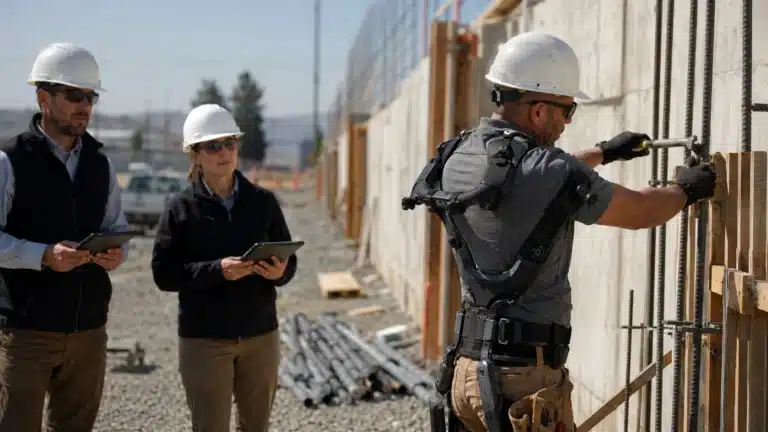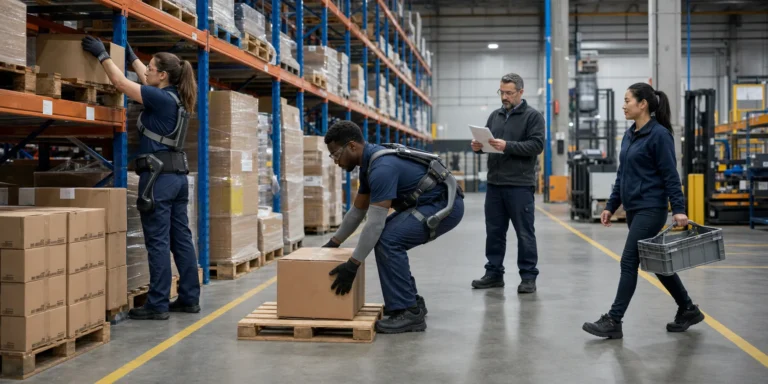

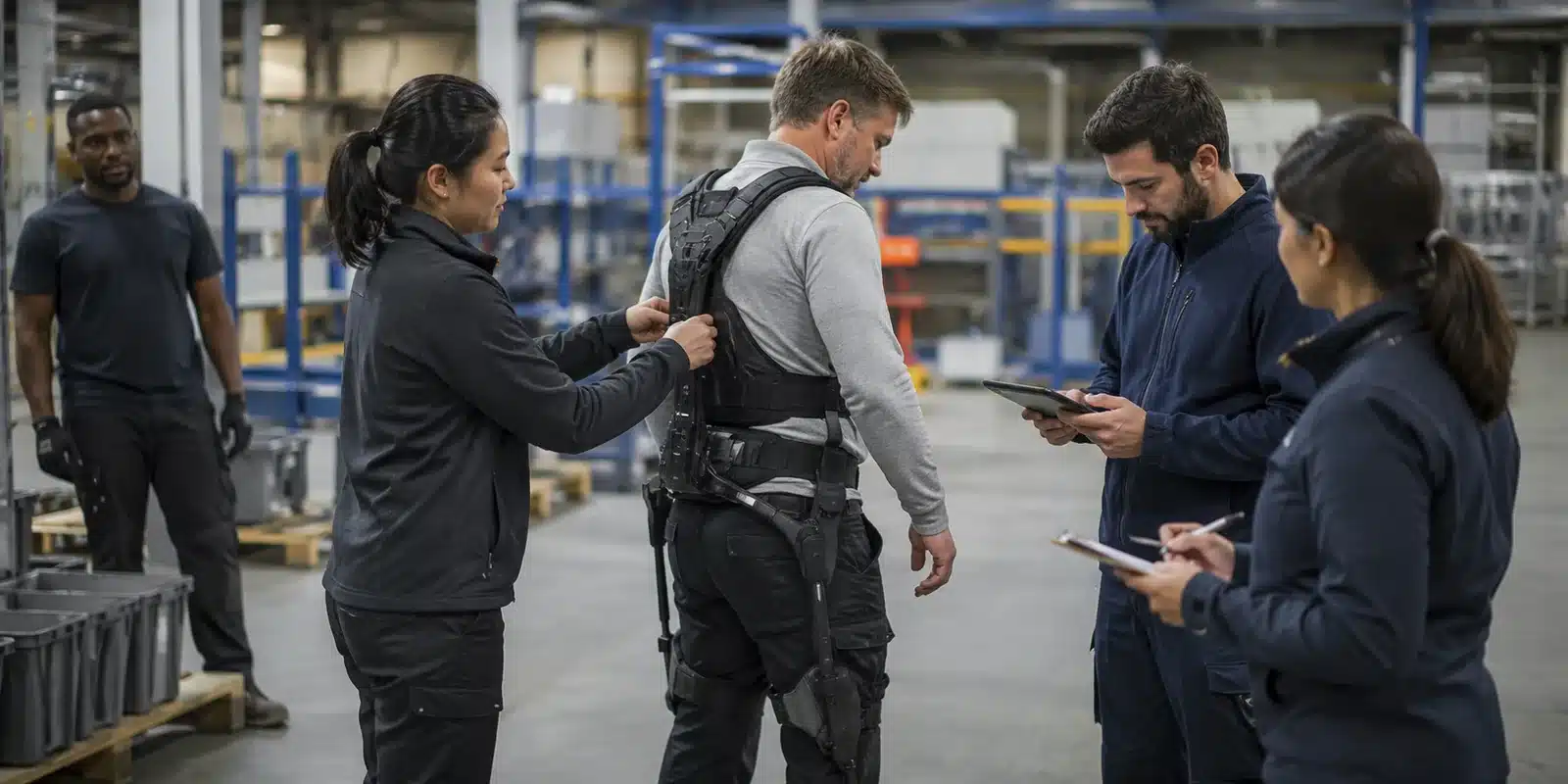
An exoskeleton pilot should answer a decision question, not create a promotional demonstration. The organisation needs to know whether a particular device can be used safely, consistently and acceptably for a defined task and workforce, whether it produces the intended benefit without unacceptable trade-offs, and whether the result is strong enough to justify further testing or deployment. That requires a protocol, baseline data, representative users, task-specific risk assessment, repeated exposure and an agreed decision process before the first device is fitted.
Key takeaways
- A pilot begins before the device arrives. The task, exposure, unmet need, alternative controls, success criteria and stop conditions should be documented first.
- A demonstration is not a pilot. A short supplier-led trial can support screening and familiarisation, but it cannot establish sustained acceptance, operational compatibility, injury prevention or return on investment.
- Measure benefits and trade-offs together. Targeted physical loading, discomfort and effort should be assessed alongside movement restriction, heat, fit, task quality, productivity, safety and non-use.
- Usage is an outcome, not an instruction. Workers who stop wearing a device, use it only for selected tasks or require repeated adjustment are providing important evidence about implementation.
- The decision rules must be written in advance. A pilot should end with one of four defensible outcomes: stop, modify and retest, proceed to limited deployment, or scale with continued monitoring.
What an exoskeleton pilot is supposed to prove
A workplace pilot is a structured test of a specific device-task-user combination under controlled but increasingly realistic conditions. It is not intended to prove that exoskeletons work in general. It should establish whether the selected system is a credible intervention for the organisation’s own work situation.
That distinction matters because occupational exoskeleton performance is highly context-dependent. The same back-support device may reduce physical demand during repetitive stoop lifting yet interfere with sitting, vehicle access, walking, twisting or work at another height. A shoulder-support system may assist sustained overhead work but create contact pressure or resistance during neutral and below-shoulder movements. A powered system may provide adaptable assistance but introduce charging, software, maintenance and failure-mode requirements that do not exist with a passive device.
A useful pilot question
“For workers performing defined order-picking tasks involving repeated lifts below waist height, does Device A reduce perceived and measured back demand without unacceptable effects on fit, movement, task quality, work pace, safety or willingness to use the system over the planned evaluation period?”
A weak pilot question is “Do workers like the exoskeleton?” Preference matters, but it is only one part of the decision. A strong protocol connects the problem, the intended mechanism of assistance, the selected outcomes and the deployment decision.
Use a gated process rather than starting with a product trial
The safest and most efficient approach is to use decision gates. At each gate, the organisation decides whether the evidence is strong enough to continue. This prevents a pilot from becoming an open-ended project that continues because a device has already been purchased, management has publicly supported it or a supplier has invested time in the trial.
| Gate | Decision question | Minimum output |
|---|---|---|
| Gate 0: Need | Is there a clearly defined physical demand or operational need that remains after higher-level controls are considered? | Task and exposure statement |
| Gate 1: Candidate | Is the device designed for the task, user population and environment? | Shortlist and exclusion record |
| Gate 2: Safety | Can foreseeable risks be controlled before field use? | Task-specific risk assessment |
| Gate 3: Feasibility | Can representative users fit, learn and operate the device in simulated and supervised conditions? | Fit, training and usability results |
| Gate 4: Field value | Does repeated workplace use produce sufficient benefit without unacceptable trade-offs? | Measured field outcomes and usage data |
| Gate 5: Deployment | Is the evidence strong enough for limited deployment or scale-up? | Signed decision and monitoring plan |
Gate 0: Confirm that an exoskeleton is an appropriate intervention
A pilot should sit inside an ergonomics and occupational-safety programme, not replace one. NIOSH describes an ergonomics programme as a systematic process for identifying, analysing and controlling workplace risk factors, with worker and management participation, evaluation and long-term commitment.[1] Its implementation guidance recommends using higher levels of the hierarchy of controls where possible, testing proposed interventions on a limited basis, modifying them as required and proceeding to wider implementation only when the pilot is judged successful.[2]
The pilot team should therefore record what has already been considered. Could the lift be eliminated? Could the workstation height change? Could a hoist, manipulator, tool balancer, conveyor or job redesign reduce the exposure more reliably? Could material flow or packaging change? An exoskeleton may still be appropriate when fixed engineering controls are impractical, when tasks are mobile or variable, or when it complements other controls. It should not be used to preserve an avoidably poor work design.
NIOSH has also cautioned that workplace exoskeletons can shift rather than remove physical load and may introduce skin, thermal, joint, stability and battery-related risks. It recommends evaluating benefits, risks and adoption barriers before widespread implementation.[3]
The pre-pilot evidence package
Before selecting a product, document the task, frequency, duration, posture, load, movement variability, current controls, affected worker population, environmental conditions and the precise outcome that needs to improve. This becomes the reference point for every later decision.
Establish governance and decision ownership
An exoskeleton pilot crosses ergonomics, safety, operations, procurement, human resources, worker representation, maintenance, data protection and sometimes occupational medicine. It should therefore have a named pilot owner and a multidisciplinary steering group rather than being left to a supplier or a single enthusiastic manager.
ASTM F3527-24 recommends contextual risk assessment by people with knowledge of the task, device and risk-analysis process. It treats the assessment as a living document because users, tasks, tools and work organisation change over time.[4] The same principle should govern the full pilot.
Minimum roles
The exact team depends on the organisation, but the following responsibilities must be assigned even when one person holds more than one role:
- Executive sponsor: authorises resources but does not control participant feedback or interpretation.
- Pilot lead: owns the protocol, schedule, records and final decision package.
- Ergonomics or human-factors lead: defines task analysis, outcomes, fit and usability methods.
- Safety lead: owns contextual risk assessment, incident response and stop conditions.
- Operations representative: verifies that tests reflect real work and operational constraints.
- Worker representatives and participants: contribute to task selection, feedback and deployment decisions.
- Technical and maintenance owner: manages inspection, charging, software, cleaning, faults and configuration control.
- Independent evaluator where feasible: protects analysis from commercial or managerial pressure.
The supplier can provide training, fitting knowledge and technical support, but should not be the sole designer, data owner or judge of the pilot. Commercial involvement, funding and conflicts of interest should be documented.
Map the task at element level
“Warehouse lifting” or “overhead assembly” is too broad for a pilot protocol. Work should be decomposed into task elements: approach, reach, grasp, lift, carry, position, release, return, walking, sitting, climbing, vehicle entry, tool change and recovery. The pilot must capture the moments when assistance is expected and the transitions where the device may hinder the user.
Record typical and peak loads, lift heights, reach distance, asymmetry, repetitions, static duration, movement speed, surface, temperature, clothing, PPE, available clearance, obstacles, stairs, ladders, vehicles, machinery and emergency routes. ASTM F3427-25 provides a structure for documenting environmental conditions such as floor or ground surface, temperature, humidity, lighting, airflow, electrical interference, vibration, contaminants, boundaries and proximity to hazards.[5]
Video and direct observation can be useful, but workers should also describe variability that an observer may miss: unusual loads, rush periods, equipment failures, seasonal clothing, cleaning tasks, end-of-shift fatigue and workarounds. A pilot designed only around the easiest representative cycle will overestimate compatibility.
Create a task-device compatibility matrix
| Task element | Expected assistance | Possible interference | How it will be tested |
|---|---|---|---|
| Repeated low lift | Back-extension support during trunk flexion | Resistance during return, thigh-interface pressure | Standardised lifts and real order picking |
| Walking with load | Little or no intended assistance | Gait restriction, heat, device movement | Normal route, turns and variable pace |
| Sitting or vehicle entry | None | Structural interference or pressure | Actual seat and vehicle access |
| Emergency movement | None | Delayed release or restricted escape | Supervised emergency procedure |
Write the pilot hypothesis and decision criteria before testing
A pilot hypothesis should state what is expected to change, for whom, during which task and over what period. It should also identify counter-outcomes that must not worsen. This protects the project from selective interpretation.
For example, the pilot may hypothesise that a back-support exoskeleton will reduce perceived physical demand and back-muscle activity during below-waist order picking. The protocol should simultaneously test whether the device increases discomfort elsewhere, restricts movement, changes work technique, reduces task quality, slows the operation, creates safety issues or is frequently left unused.
The success criteria should be organisation-specific. Universal thresholds are rarely defensible because tasks, devices, methods and measurement reliability differ. The team should nevertheless decide in advance what constitutes a meaningful change, an unacceptable result and an inconclusive result.
Separate three levels of claim
Biomechanical claim: the device changes measured loading or movement during a task. Operational claim: the device can be used consistently without unacceptable disruption. Health or economic claim: use reduces symptoms, injuries, absence or total cost. A short pilot may support the first two levels, but usually cannot establish the third.
This separation is essential because the current evidence base remains dominated by short and laboratory-based studies. A 2024 systematic review identified 49 eligible occupational exoskeleton studies from 2014 to 2024 and noted the continued need for real-world evaluation.[6] A separate systematic review screened 6,722 records and included 15 studies on quality and productivity; none directly evaluated economic implications.[7]
Select candidate devices through pre-screening
The purpose of pre-screening is to eliminate poor matches before exposing workers or consuming operational time. The shortlist should be based on intended use, support architecture, body area, task range, size coverage, environmental compatibility, evidence, local service and risk profile.
Ask suppliers to identify the exact model, generation, assistance setting, accessories, software version and configuration evaluated in each study. ASTM F3576-22 exists because test results cannot be interpreted or replicated without recording hardware and software configuration, adjustment parameters and associated test equipment.[8] ASTM F3519-21 also provides a reporting structure intended to make manufacturers’ analyses more comparable for purchasers.[9]
The team should reject a candidate before the pilot when the manufacturer cannot define intended and prohibited tasks, cannot fit the target population, lacks a credible emergency procedure, has no service capacity in the region, cannot provide required documentation, or expects the organisation to accept unsupported health or ROI claims.
Design a protocol that can answer the question
A credible pilot compares work with and without the exoskeleton under sufficiently similar conditions. ASTM F3518 recommends selecting quantitative measures according to uncertainty in the intended application and highlights repeated-measures designs in which the same user is assessed under different conditions or at multiple times.[10]
The protocol does not need to become a clinical trial, but it should control avoidable sources of bias. Task order can influence fatigue and learning. Workers may perform differently when observed. A novelty effect can temporarily increase enthusiasm. Managers may unintentionally pressure participants. Production demand, product mix, temperature and staffing can change between conditions. These factors should be recorded and, where feasible, balanced.
Minimum protocol components
- Purpose, scope and decision question.
- Device and configuration.
- Task and environmental description.
- Participant criteria and recruitment method.
- Baseline and comparison condition.
- Training and familiarisation plan.
- Outcome definitions and measurement schedule.
- Risk controls, incident reporting and stop conditions.
- Data ownership, privacy and analysis plan.
- Predefined decision rules.
ASTM F3474-25 distinguishes near-term evaluation over hours or days, mid-term evaluation over days or weeks, and far-term evaluation over months or years.[11] A pilot should reflect this time dimension. A device can look promising during a supervised hour yet fail after repeated use because of discomfort, maintenance burden, task variability or declining acceptance.
Complete task-specific risk assessment before field exposure
Risk assessment should cover the interaction between the exoskeleton, user, task, tools, machinery, other people and the environment. ASTM F3527-24 can support purchase decisions, risk-reduction measures, identification of unknowns and ongoing risk monitoring. It also states that no current occupational exoskeleton certification mechanism guarantees that contextual risks have been evaluated for the real working context.[4]
The assessment should examine acute harm scenarios and longer-term ergonomic trade-offs. The team should review pinch and entanglement points, unexpected assistance, structural failure, battery or electrical hazards, contact pressure, balance, falls, stairs, ladders, confined spaces, vehicles, emergency release, heat, hygiene, PPE interaction and communication. ASTM F3688-25 adds guidance for potential ergonomic risks such as force, awkward posture, repetition, contact pressure, vibration and environmental stressors.[12]
Stop conditions must be explicit
Testing should stop for pain, numbness, skin injury, dizziness, loss of balance, unsafe device movement, malfunction, overheating, emergency-route interference, inability to release the device, unexpected machinery interaction or any participant request to stop. A worker should never have to justify withdrawal to a supervisor or supplier.
Recruit representative users and document fit
A pilot with only the most enthusiastic, experienced or easily fitted employees can produce a false positive. Participants should reflect the intended population across relevant body dimensions, sex, age, work experience, shift, task style and previous symptoms, while respecting medical and legal requirements.
A 2026 systematic review analysed 191 arm- and back-support exoskeleton studies published between 2019 and 2024. Participants were predominantly young and male, with approximately 78% male representation, no reporting of race or ethnicity and limited anthropometric diversity.[13] Organisations should not repeat that limitation in their own pilot.
Fit should be assessed statically and dynamically. ASTM F3661-24 distinguishes fit in standardised postures from fit during functional range of motion and warns that poor fit can contribute to discomfort, distraction, disuse, accidents and task failure.[14] Record who cannot be accommodated, which adjustments are used, where pressure occurs, whether alignment changes during work and whether clothing or PPE alters fit.
Participant selection must also avoid coercion. Employees should understand that declining or stopping will not affect employment, performance ratings or access to work. Feedback should be collectable without supervisors or supplier representatives present.
Train for competence, then allow familiarisation
Training and familiarisation are not the same. Training establishes safe use: intended tasks, prohibited use, inspection, fitting, adjustment, donning, doffing, assistance settings, emergency release, cleaning, charging, fault reporting and storage. ASTM F3444/F3444M-20 describes minimum training requirements and recommends demonstration followed by user repetition to verify knowledge, skills and abilities.[15]
Familiarisation allows the user to develop a realistic experience of the device. This should progress from neutral movements to simulated work and then supervised field use. The schedule should not force rapid progression simply to meet a project deadline.
Evidence shows that implementation method matters. In a 2025 intervention study, 18 participants were assigned either to a tailored application-training group or a standardised briefing group during four weeks of shoulder-exoskeleton implementation. The application-training group reported higher usefulness and usability, greater curiosity, less scepticism and higher wearing time during the final two weeks; some differences remained at approximately one year.[16] The study was small and involved a commercial product, but it supports treating implementation as an active process rather than a one-time briefing.
Familiarisation should not be used to dismiss persistent problems. If users repeatedly report pressure, restriction or poor task fit, the response should not automatically be “they need more time.” Adjustment, device selection or the pilot itself may need to change.
Run the pilot in progressive stages
A staged pilot protects users and improves interpretation. The next stage begins only when the preceding stage meets its safety and feasibility criteria.
| Stage | Purpose | Typical evidence |
|---|---|---|
| 1. Technical inspection | Verify documentation, configuration, maintenance and basic function | Inspection and configuration record |
| 2. Fit and neutral movement | Check accommodation, adjustment, release and unrestricted basic movement | Fit record, discomfort map, range-of-motion observations |
| 3. Simulated task | Test controlled versions of the intended task and foreseeable transitions | Safety, usability and preliminary physical-demand results |
| 4. Supervised field use | Observe real work while maintaining close support | Task compatibility, incidents, adjustments, worker feedback |
| 5. Repeated operational use | Assess sustained usage, variability, maintenance and acceptance | Wearing time, reasons for non-use, repeated outcomes and faults |
| 6. Review period | Remove immediate project pressure and examine the full evidence | Independent analysis and decision package |
The duration should be driven by the claim. A one-day pilot may be sufficient to reject an obviously incompatible device. It is not sufficient to claim sustained acceptance or health benefit. Where operational feasibility and adoption are central, repeated use over weeks is more informative.
Measure outcomes that match the deployment decision
No single measure can determine whether an exoskeleton pilot is successful. Muscle activity, perceived effort, comfort, productivity and acceptance answer different questions. A balanced measurement plan should include a primary outcome, several counter-outcomes and contextual information.
Physical and ergonomic outcomes
Depending on the question and available expertise, measures can include muscle activity, joint loading estimates, posture, range of motion, movement speed, heart rate, perceived exertion, local discomfort and fatigue. Advanced instrumentation is not always necessary, but the limitations of simpler measures should be acknowledged.
A reduction in electromyographic activity can support a claim about muscle demand during the measured task. It does not by itself prove reduced injury risk. Likewise, a lower discomfort score after one session does not establish long-term health impact.
Operational outcomes
Record task completion time, quality, errors, rework, throughput where relevant, tool access, movement transitions, donning time, adjustment time, cleaning, charging, maintenance, faults and supervisor intervention. Do not present faster or slower work as automatically good or bad without understanding how work technique changed.
Acceptance and perceived safety
ASTM F3585-25ae1 provides a method for assessing exoskeleton use intent, cognitive fit and perceived safety by comparing user responses after work without and with the device.[17] A newer 2026 instrument, ExoAccept, contains 33 items representing 24 factors intended to provide a pragmatic and broader assessment of occupational exoskeleton acceptance.[18]
Acceptance should be measured repeatedly and linked to behaviour. Ask whether the user would choose the device for the target task, but also record whether it was actually worn, for how long and why it was removed.
Safety and adverse outcomes
Record discomfort by body region, pressure, skin effects, near misses, slips, trips, restricted escape, unexpected assistance, device movement, overheating, faults and any change in work technique that could create risk. “No reported injury” is not a sufficient safety result when the sample and exposure are small.
Treat adherence and non-use as core evidence
Usage data can expose the difference between initial enthusiasm and operational fit. A worker may accept the general idea of an exoskeleton yet use it only for a narrow task. That can still support limited deployment. Conversely, a device can produce measurable biomechanical benefit but fail because it is too disruptive across the rest of the job.
A field study involving 146 logistics employees found that 80% were willing to continue after a four-hour active-back-exosuit trial. Perceived effectiveness and compatibility predicted intent to use with 78% accuracy, while some employees identified sitting, equipment use or lack of relevant lifting as reasons not to continue.[19] The scale is useful, but the exposure was short; the result demonstrates short-term intent, not sustained adoption.
Longer studies show why non-use must be recorded rather than hidden. In a five-week shoulder-exoskeleton study, ten logistics workers entered a progressive familiarisation programme and ten served as controls. The device reduced selected shoulder-muscle activity during tested tasks, but only 22% of the planned usage protocol was completed; seven of the ten intervention workers stopped using it, and subjective evaluations declined.[20]
A 24-week randomised field trial involving 20 logistics workers found maintained reductions in back-muscle activity during lifting. Three users stopped using the device, while the remaining intervention workers progressively increased daily use and reported an overall reduction in perceived work intensity.[21] The mixed result is more informative than a simple “worked” or “did not work” conclusion.
Record the reason behind every removal
Distinguish task mismatch, discomfort, heat, fit, maintenance, social concerns, lack of perceived benefit, time pressure, forgotten equipment, unavailable device and supervisor instruction. These reasons lead to different decisions.
Include organisational barriers in the pilot
Implementation does not fail only because of hardware. A 2026 systematic review included 28 studies and identified 70 facilitators and 67 barriers to sustainable occupational exoskeleton integration. Reported barriers were most frequently associated with the device at 36.4%, followed by the person or user at 24.5%, work or job factors at 20.0%, company or management factors at 14.5%, and attitude at 4.5%. Facilitators were distributed differently, with user, work and management factors playing substantial roles.[22]
The pilot should therefore test ownership, storage, availability by shift, cleaning, maintenance response, training for new users, supervisor support, communication, scheduling and worker participation. A product can be technically compatible yet operationally fail because nobody owns daily inspection, devices are stored too far from the task or workers fear being judged for using assistance.
Management messaging matters. The device should not be presented as evidence that work is already safe, as a solution for “weak” workers or as a reason to increase load, pace or exposure. Participation data should not become individual productivity surveillance.
Protect data quality, privacy and independence
The protocol should state who collects, stores, analyses and can access each type of data. Connected exoskeletons may record movement, settings, duration, location, user identity or performance-related data. The organisation should establish a lawful purpose, data minimisation, retention period, access control and rules for secondary use before collection begins.
Keep research and employment decisions separate. Individual discomfort, health and acceptance data should not be sent to line managers unless required for immediate safety and handled through an appropriate process. Aggregate reporting is usually more appropriate for operational decisions.
The analysis plan should also address missing data and withdrawal. Removing users who stopped wearing the device can make the result look artificially positive. Non-use, dropout and incomplete exposure are themselves outcomes. Supplier-funded analysis should be clearly labelled, and raw data or sufficiently detailed results should remain available to the organisation.
Use a structured decision framework
The final decision should be based on the predefined criteria, not the loudest opinion in the room. Review the target benefit, critical safety findings, fit coverage, task compatibility, sustained usage, worker feedback, operational burden, supplier performance and uncertainty.
| Decision | When it is justified | Required next step |
|---|---|---|
| Stop | Critical safety issue, poor task match, inadequate fit, no meaningful benefit or unacceptable disruption | Document reasons and alternative controls |
| Modify and retest | Potential value exists, but configuration, task scope, training, device choice or protocol needs correction | Define exactly what changes and repeat only the necessary stages |
| Limited deployment | Benefit is credible for a narrow task or user group, with manageable residual risk | Restrict intended use and continue monitoring |
| Scale with monitoring | Task fit, safety, fit coverage, operational compatibility and sustained usage meet predefined criteria | Deployment plan, training system, maintenance ownership and review schedule |
A numerical score can help organise evidence, but it should not override a critical failure. A device that scores well overall but interferes with emergency egress, excludes a material part of the workforce or cannot be maintained safely should not proceed.
Example eight-week occupational pilot structure
The following timeline is an example for a relatively focused occupational pilot. It is not a universal minimum. Complex powered systems, highly variable tasks, seasonal environments, healthcare work or claims about sustained symptoms may require substantially longer evaluation.
| Period | Main activities | Decision output |
|---|---|---|
| Pre-pilot | Task analysis, controls review, governance, shortlist, protocol and risk assessment | Approval to begin testing |
| Week 1 | Inspection, fit screening, baseline measurements and user training | Eligible users and safe configuration |
| Week 2 | Simulated tasks and supervised field exposure | Feasibility gate |
| Weeks 3–4 | Progressive real-task use, frequent feedback and configuration review | Early compatibility findings |
| Weeks 5–7 | Repeated operational use with reduced researcher presence | Adherence, operational and maintenance evidence |
| Week 8 | Final measurements, interviews, device inspection and evidence review | Stop, retest, limit or scale decision |
A newly published 2026 multicentre trial protocol illustrates the depth required when medium-term effectiveness is the question. ELSA LogiCare plans to recruit 120 logistics and care workers, assign participants to two passive back-support devices or a control group, monitor three months of use, assess outcomes every four weeks, combine self-reported and sensor-derived wearing time, and evaluate feasibility, discomfort, workload, fatigue, acceptance, job satisfaction, cognitive performance and implementation barriers.[23] An organisational pilot does not need to copy a randomised trial, but it should understand why serious claims require serious exposure and measurement.
Pilot checklist
Before users wear the device
Confirm the task and unmet need, review higher-level controls, appoint the pilot team, define the intended claim, document the exact device configuration, screen fit coverage, complete contextual risk assessment, establish stop conditions, approve the protocol, clarify data governance and train users.
During the pilot
Record exposure, configuration, adjustments, wearing time, non-use, task variability, environmental conditions, target outcomes, counter-outcomes, incidents, maintenance, worker feedback and any deviation from the protocol. Do not correct inconvenient findings out of the dataset.
Before deployment
Review whether the benefit is task-specific and meaningful, whether all critical risks are controlled, whether the intended workforce can be accommodated, whether usage is sustainable, whether the supplier and organisation can support the system, and whether the evidence justifies the exact deployment scope proposed.
Common pilot mistakes
The most common failure is starting with a device rather than a problem. Other pilots fail because the supplier chooses the easiest task, only enthusiastic users participate, baseline data are missing, success is defined after the results are known or discomfort and non-use are treated as participant failure.
Short-term novelty can also distort conclusions. In a 2026 aeronautics field study, ten male workers used a passive back exoskeleton during seven polishing tasks. Back-muscle activity fell by 7% to 25% in four tasks, while acceptance was mixed but overall positive.[24] The task-level variation is precisely why organisations should not report one average benefit across an entire job.
Do not make claims the pilot cannot support
A small or short pilot can identify task fit, safety concerns, immediate physical effects, usability and operational barriers. It normally cannot establish reduced injury incidence, long-term symptom prevention, absence reduction or organisation-wide ROI. Those outcomes require longer exposure, appropriate comparison data and adequate statistical power.
Conclusion
A successful exoskeleton pilot is not one that ends in a purchase. It is one that produces a defensible decision.
The organisation should be able to explain why the task was selected, why an exoskeleton was considered after other controls, why the candidate device matched the intended use, who was represented, how risks were managed, what changed with and without the device, why some users did or did not wear it, and how the final deployment boundary was chosen.
That process may support scale-up. It may support a narrow deployment for one task, a modified protocol with another device or a decision not to proceed. All four outcomes create value when the evidence is collected honestly and the health, safety and agency of workers remain central.
Methodology and scope
This playbook was prepared from official ergonomics guidance, current ASTM and ISO materials and peer-reviewed occupational exoskeleton research reviewed up to 30 July 2026. ISO/CD 25563, which addresses the process for integrating wearable physical-assistance devices into work situations, remains a committee draft under development and is not a certification standard.[25] Priority was given to standards bodies, government sources, systematic reviews, field studies and prospective protocols. Examples from individual products or studies are included to illustrate pilot-design principles and are not product endorsements.
The guide focuses on occupational and workplace exoskeleton pilots. Medical rehabilitation, personal mobility, defence and consumer applications require additional clinical, regulatory, ethical and technical processes that are outside its scope.
Explore related Exoskeleton Index resources
References
- National Institute for Occupational Safety and Health. Elements of Ergonomics Programs. Updated 2024. Official guidance.
- National Institute for Occupational Safety and Health. Step 4: Implement Your Ergonomic Program. Updated 2024. Official guidance.
- Howard J, Murashov V, Lowe B, Lu J. Industrial Exoskeletons. NIOSH Science Bulletin. CDC/NIOSH.
- ASTM International. ASTM F3527-24: Standard Guide for Assessing Risks Related to Implementation of Exoskeletons in Task-Specific Environments. DOI: 10.1520/F3527-24.
- ASTM International. ASTM F3427-25: Standard Practice for Documenting Environmental Conditions for Utilization with Exoskeleton Test Methods. DOI: 10.1520/F3427-25.
- Cardoso A, Ribeiro A, Carneiro P, Colim A. Evaluating Exoskeletons for WMSD Prevention: A Systematic Review of Applications and Ergonomic Approach in Occupational Settings. International Journal of Environmental Research and Public Health. 2024;21(12):1695. DOI: 10.3390/ijerph21121695.
- Fournier DE, Yung M, Somasundram KG, Du BB, Rezvani S, Yazdani A. Quality, productivity, and economic implications of exoskeletons for occupational use: A systematic review. PLOS ONE. 2023;18(6):e0287742. DOI: 10.1371/journal.pone.0287742.
- ASTM International. ASTM F3576-22: Standard Practice for Recording the Exoskeleton Test Configuration. DOI: 10.1520/F3576-22.
- ASTM International. ASTM F3519-21: Standard Guide for Establishing a Reporting Structure for Exoskeleton Analysis. DOI: 10.1520/F3519-21.
- ASTM International. ASTM F3518-21(2025)e1: Standard Guide for Quantitative Measures for Establishing Exoskeleton Functional Ergonomic Parameters and Test Metrics. DOI: 10.1520/F3518-21.
- ASTM International. ASTM F3474-25: Standard Practice for Establishing Exoskeleton Functional Ergonomic Parameters and Test Metrics. DOI: 10.1520/F3474-25.
- ASTM International. ASTM F3688-25: Standard Guide for Evaluating Potential Ergonomic Risks From Exoskeleton Use. Official standard page.
- Kazemi Z, Park J, Srinivasan D. Unequal assistance? A systematic review of demographic representation and outcome differences in exoskeleton studies. Applied Ergonomics. 2026;137:104808. DOI: 10.1016/j.apergo.2026.104808.
- ASTM International. ASTM F3661-24: Standard Guide for Assessing Fit Accommodation of Exoskeletons for Manufacturers and Designers. DOI: 10.1520/F3661-24.
- ASTM International. ASTM F3444/F3444M-20: Standard Practice for Training Exoskeleton Users. DOI: 10.1520/F3444_F3444M-20.
- Fleps M, Hörandel M, Fischer M, et al. Effects of different implementation approaches on the acceptability of a passive exoskeleton for workplace health promotion: An intervention study using the MATE-XT®. Applied Ergonomics. 2026;130:104625. DOI: 10.1016/j.apergo.2025.104625.
- ASTM International. ASTM F3585-25ae1: Standard Test Method for Measuring Exoskeleton Cognitive Fit, Perceived Safety, and Acceptance. DOI: 10.1520/F3585-25AE01.
- Elprama SA, Vannieuwenhuyze J, Wittens MMJ, et al. ExoAccept: a holistic instrument to assess factors influencing acceptance of occupational exoskeletons. Applied Ergonomics. 2026. DOI: 10.1016/j.apergo.2026.104735.
- Hess A, Jacobs JV, Sullivan S, et al. Active back exosuits demonstrate positive usability perceptions that drive intention-to-use in the field among logistic warehouse workers. Applied Ergonomics. 2025;122:104400. DOI: 10.1016/j.apergo.2024.104400.
- Jakobsen LS, et al. Biomechanical changes, acceptance, and usability of a passive shoulder exoskeleton in manual material handling: A field study. Applied Ergonomics. 2023;113:104104. DOI: 10.1016/j.apergo.2023.104104.
- Jakobsen LS, Samani A, Desbrosses K, de Zee M, Steinhilber B, Madeleine P. Effects of 24-weeks in-field use of a back-supporting exoskeleton on biomechanics, work intensity and musculoskeletal discomfort: A randomized controlled trial among logistic workers. Applied Ergonomics. 2025;125:104469. DOI: 10.1016/j.apergo.2025.104469.
- van Laar DM, Bieleman HJ, Rijnders CSI, et al. Occupational Exoskeletons as a Technological Solution for Musculoskeletal Disorders: A Systematic Review of Barriers and Facilitators for Sustainable Workplace Integration. Journal of Occupational Rehabilitation. 2026. DOI: 10.1007/s10926-026-10397-5.
- Sieber W, Voß J, Falz R, et al. Practical applicability and effectiveness of passive, back-support exoskeletons in logistics and care: a randomized controlled trial protocol (ELSA LogiCare). Trials. 2026;27:501. DOI: 10.1186/s13063-026-09890-2.
- Albouy T, Zare M, Chin E, Mornieux G. Field assessment of a passive back exoskeleton in the aeronautics industry: biomechanical responses and worker acceptance. Ergonomics. 2026. DOI: 10.1080/00140139.2026.2690386.
- International Organization for Standardization. ISO/CD 25563: Ergonomics — Process for the integration of wearable physical assistive devices — Expression of needs, selection, design, assessment and deployment. Committee Draft, under development. Official project page.