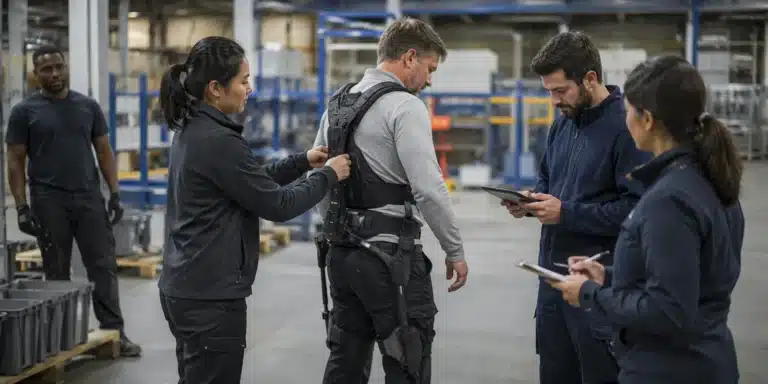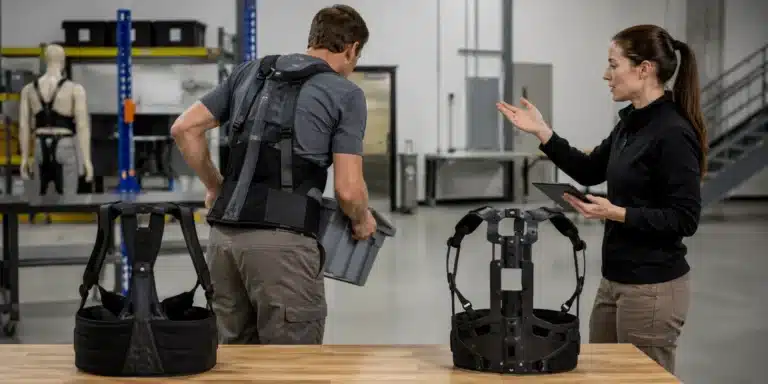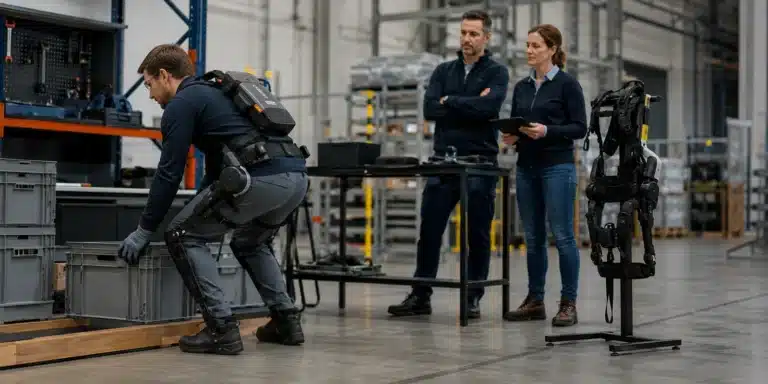

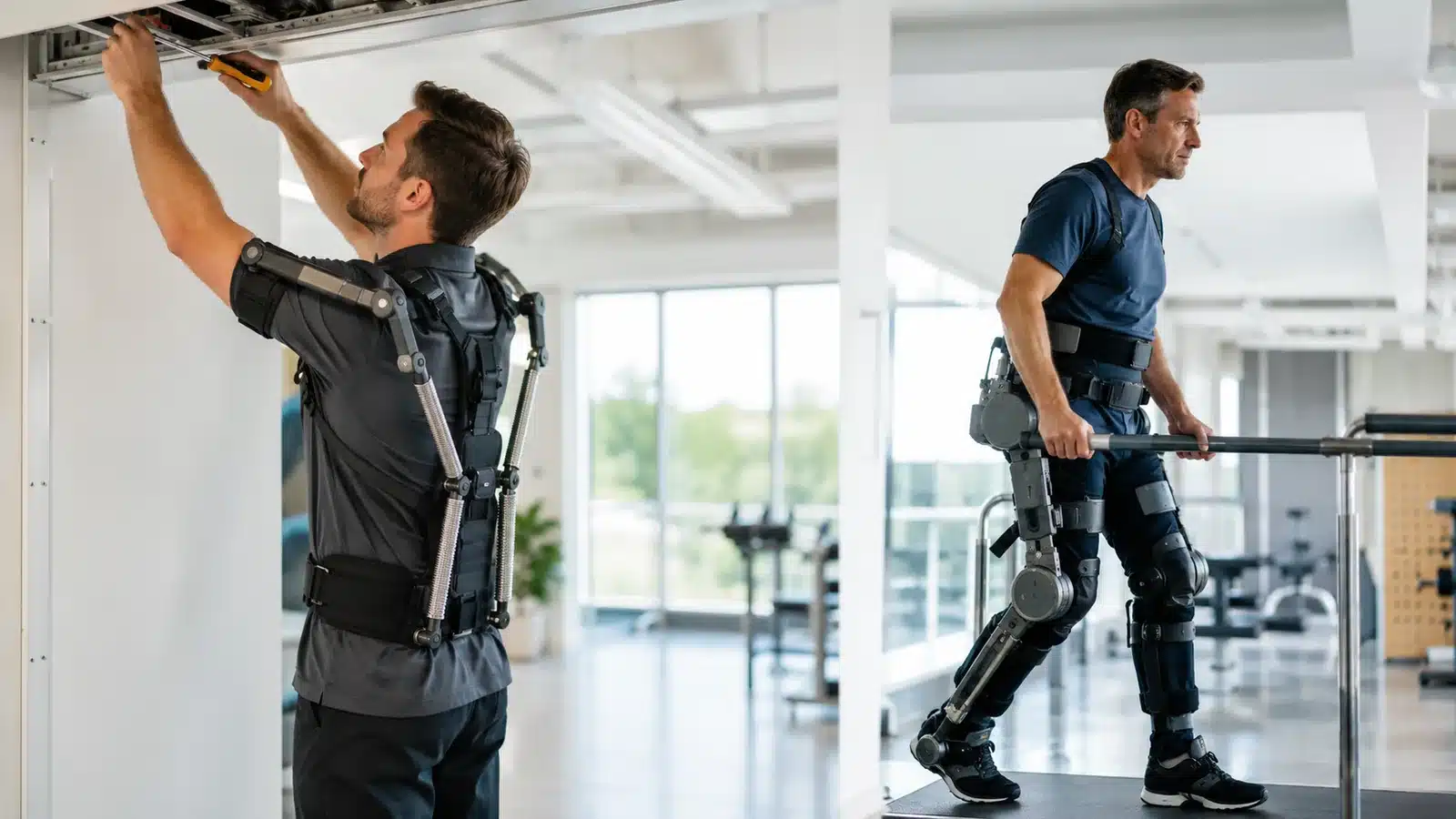
Powered and passive exoskeletons are not simply two levels of the same technology. A passive system stores, redirects or counterbalances energy already present in the user’s movement or posture. A powered system adds externally generated mechanical work through actuators and control. That difference affects assistance, weight, movement freedom, safety, maintenance and the type of evidence needed to evaluate a device. The current research supports a careful conclusion: powered systems can deliver larger and more adaptable assistance in some tasks, while passive systems can create meaningful physiological benefits with less technical infrastructure. Neither category is automatically better.
The distinction also matters because published results can look impressive while answering only a narrow question. A study may show a 40% reduction in a specific muscle signal during a two-minute laboratory task, yet say little about eight-hour use, productivity, comfort, user acceptance, long-term injury prevention or whether the same device interferes with walking and reaching. The current evidence supports a more careful conclusion: powered systems can deliver larger and more adaptable assistance in some tasks, while passive systems can achieve meaningful physiological benefits with less technical infrastructure. Neither category is inherently superior. The better system is the one whose assistance profile, fit, control and operational burden match the real task.
Key takeaways
- Passive systems reshape existing mechanical energy. They use springs, elastic textiles, gas springs, counterbalances, dampers, clutches or structural load paths rather than powered actuators.
- Powered systems can add net positive mechanical work. Sensors and controllers determine when and how actuators apply force or torque.
- Greater muscle offloading can come with a whole-body cost. In a 2026 active shoulder-exoskeleton study, upper-trapezius activity fell by 68.2% during static holding, but metabolic cost rose by 57.2%.[12]
- Task dependence is decisive. Direct comparative studies show that device category, movement pattern and support settings all change the outcome.[5][7]
- Commercial selection requires more than biomechanical data. Current reviews still find a laboratory-heavy evidence base, limited long-duration field data and almost no direct economic evidence.[13][14]
Powered and passive describe the source of assistance
ASTM F3323-24 provides the current terminology framework for exoskeletons and exosuits across occupational, medical, military, emergency-response and recreational settings.[1] For practical comparison, the most important question is straightforward: where does the assistive mechanical energy come from?
A passive system cannot continuously add net positive mechanical work. Instead, it stores energy, returns it later, counterbalances a body segment or tool, resists a movement, or transfers load through a frame. A powered system uses an actuator to add mechanical work and a control system to decide when and how that assistance is applied.[2]
The distinction changes several practical features at once:
- Assistance profile: passive support follows geometry, stiffness and posture; powered support can be changed through software and sensing.
- System burden: passive systems avoid batteries and actuators, while powered systems add electronics, charging and control hardware.
- Adaptability: powered systems can respond to gait phase, task mode or user intent; passive systems are strongest when the movement is predictable.
- Failure behavior: passive systems can fail mechanically or resist movement; powered systems add battery, sensor, actuator and software failure modes.
- Maintenance: both require inspection and fit management, but powered systems add calibration, battery and software support.
The category is a continuum, not a binary
Semi-active and quasi-passive systems sit between the two ends. Electronics may engage a clutch, change stiffness or switch a passive element without continuously driving the user. Soft exosuits can be powered with very little rigid structure, while hybrid systems may combine powered assistance at one joint with passive support at another. Product records therefore need to describe the mechanism, not only label the device “active” or “passive.”
The mechanical difference: energy return versus net work
Passive systems can improve the efficiency of the human-device system without adding external mechanical energy. The best-known example is the unpowered ankle exoskeleton reported by Collins and colleagues in 2015. Its clutch-and-spring mechanism operated in parallel with the calf muscles and Achilles tendon and reduced the metabolic cost of walking by 7.2% ± 2.6% under natural walking conditions.[8]
That result shows why passive should not be confused with ineffective. Correctly timed energy storage and return can reduce muscular effort. But the mechanism must also overcome the cost of wearing the device. A passive knee-ankle system reduced metabolic power by 11% compared with the same device with its springs disengaged, yet walking with the device still required 23% more energy than walking with no exoskeleton.[9]
Powered systems can add enough net work to offset that burden. In a 2014 autonomous ankle-exoskeleton study, seven participants walked at 1.4 m/s while the device added 2.12 kg to the foot-shank system and generated 26 ± 1 W of positive mechanical power. The powered condition reduced metabolic cost by 10% ± 3% compared with no device and by 14% ± 2% compared with the unpowered condition. The same hardware was metabolically worse than no device when it was unpowered.[10]
What these walking studies demonstrate
- A well-timed passive mechanism can create a meaningful physiological benefit.
- Device mass and resistance can cancel that benefit.
- Powered assistance must first overcome the burden of its own hardware.
- A motor helps only when timing, torque and control are good enough.
What direct back-support comparisons reveal
The most useful evidence comes from studies that compare active and passive devices under the same protocol. Schwartz and colleagues tested one passive and two active back-support exoskeletons in 29 participants, 15 men and 14 women, handling a 15 kg load during static holding, symmetric lifting and asymmetric lifting. The passive BackX reduced activity in selected trunk and hip-extensor muscles by 12% to 27% compared with no exoskeleton, with the clearest effects during the static task. The two active devices reduced activity across the studied muscles by 7% to 62% compared with no exoskeleton and by 10% to 52% compared with the passive device.[5]
The headline result favors powered assistance, but the details matter. For the erector spinae, the active devices reduced activity by 12% to 45% across the three tasks, while the passive device did not produce a statistically significant difference from the no-device condition. During the static task, the passive system reduced other extensor-muscle activity by 13% to 27%, while the active systems produced reductions of 35% to 62%. During symmetric lifting, active-device reductions ranged from 19% to 40%; during asymmetric lifting they ranged from 7% to 35%. The active systems also altered trunk kinematics, which means the reduction in muscle activity cannot be interpreted as a pure transfer of force without changes in movement strategy.
The study supports a specific conclusion: powered back-support exoskeletons can produce stronger and more consistent muscle offloading across varied handling tasks than the tested passive system. It does not establish that all powered devices are better, nor does it prove reduced injury incidence. The tested products differed not only in actuation but also in weight, geometry, anthropomorphic alignment and control.
More assistance can also change how work is performed
A second comparative study tested the active CrayX and passive Paexo Back during a 15-minute dual task involving lifting, carrying, walking and cognitive responses. Sixteen participants completed the protocol. The passive Paexo Back weighed 4.5 kg, while the active CrayX weighed 7 kg. Paexo support changed with body angle; CrayX used two motors and could produce extension and flexion moments.[6]
The study found that:
- Reaction time and accuracy were not significantly different; accuracy stayed close to 99% in all conditions.
- The time to approach and grasp the box increased from 1.32 ± 0.17 seconds without a device to 1.55 ± 0.19 seconds with the passive device.
- After placing the box, the return phase took 1.70 ± 0.27 seconds with CrayX and 1.74 ± 0.27 seconds with Paexo Back, versus 1.54 ± 0.23 seconds without an exoskeleton.
The authors interpreted the passive device’s slower first phase as possible resistance to trunk bending. The slower return phase with both systems suggested an additional physical or cognitive burden. This is the kind of result that disappears when evaluation focuses only on muscle activity: a device can offload the back while also slowing transitions or changing how the task is performed.
A practical interpretation
Powered systems can separate assistance from body angle and may reduce resistance during non-target movement, but they usually weigh more. Passive systems are mechanically simpler and often lighter, but their force profile is tied more closely to posture and geometry.
Recent active-back evidence shows strong task dependence
Recent studies of the Apogee active exoskeleton reinforce the importance of task and settings. In 2026, Hasenmaier and colleagues tested 17 healthy adults lifting a 15 kg box with no device, the exoskeleton in passive mode, 50% support with 20% counterforce, and 100% support with 60% counterforce.[7]
During stoop lifting, erector-spinae activity fell by 10% to 27% MVC and biceps-femoris activity by 7% to 10% MVC. During squat lifting, erector-spinae activity fell by 10% to 17% MVC, while the smaller 2% to 3% MVC reductions in biceps-femoris activity were not statistically significant. The device therefore helped more when the movement relied strongly on hip extension, the action it was designed to assist.
A related 2025 study with 16 participants compared lifting at 9 and 12 cycles per minute. At full support, erector-spinae activity decreased by about 22.3% MVC and biceps-femoris activity by 10.6% MVC, while hip range of motion increased by 6 degrees.[11]
The useful takeaway is not simply that the active device reduced muscle activity. It is that support level, counterforce, lifting technique and movement speed all changed the outcome. Buyers should ask whether the device can be tuned to the real task rather than relying on one headline percentage.
Shoulder exoskeletons expose the offloading-versus-energy trade-off
Upper-limb exoskeletons make the powered-versus-passive trade-off especially visible because added mass is carried high on the body. In a 2026 study of a quasi-direct-drive active shoulder exoskeleton, seven healthy men completed dynamic screwing and static holding with a 3 kg load. During static holding, upper-trapezius activity fell by 68.2% and anterior-deltoid activity by 43.6%. At the same time, metabolic cost increased by 57.2% during static work and by 30.6% during dynamic work.[12]
The device clearly offloaded the target muscles, but the wearer spent more energy stabilizing and moving the complete system. Local muscle relief and whole-body effort therefore moved in opposite directions.
Passive shoulder systems show a different profile. The Exo4Work study found reduced shoulder and elbow loading during high lifting and overhead wiring, but warned that below-shoulder tasks could increase loading in neighboring joints.[15] The 2024 OmniSuit study involved 31 healthy participants and reported reductions of 4.1 to 15.7 percentage points of MVC in selected shoulder and back muscles, reaching as much as 49.1% relative to no exoskeleton in some conditions.[16]
For shoulder applications, a useful evaluation should therefore include:
- Target-muscle activity and endurance
- Whole-body metabolic cost
- Movement smoothness and freedom
- Performance below as well as above shoulder height
- Pressure, comfort and device mass on the torso
Powered and passive in rehabilitation are not equivalent categories
In rehabilitation, powered systems dominate lower-limb gait applications because they can generate movement, control joint trajectories and provide assistance to users who cannot produce sufficient torque independently. Passive devices remain relevant for gravity compensation, range-of-motion support and selected upper-limb applications, but they generally cannot substitute for powered propulsion when the clinical objective requires active joint motion.
The terminology can become confusing because some rehabilitation papers use “active” and “passive” to describe how the user controls the device, not whether the device contains motors. A 2025 spinal-cord-injury review defined actively controlled exoskeletons as systems that detected bioelectrical signals, while the passively controlled group included several motor-powered commercial exoskeletons. In that literature, a powered robot can therefore be described as “passively controlled” if it follows a preset control strategy rather than responding to voluntary biosignals.[17]
This distinction matters for procurement and research interpretation. Hardware actuation answers whether the device can add mechanical work. Control strategy answers how assistance is triggered and adapted. User participation answers how much of the movement is generated by the person. These are separate dimensions and should not be collapsed into one label.
The hidden engineering problem is transparency
An exoskeleton is useful only when the assistance it provides is greater than the burden it imposes. Engineers often describe the desirable no-assistance behavior as transparency: when the device is not helping, it should resist the wearer as little as possible.
Transparency can be reduced by joint friction, poor anatomical alignment, cable drag, gearbox resistance and device mass. Powered control can compensate for some of those effects, but only if sensing and control are accurate. The 2014 ankle study is a clear example: the same hardware increased metabolic cost when unpowered and reduced it by 10% when powered.
Mass location matters as much as total mass. Weight on the lower legs and feet must be accelerated and decelerated during each step and is usually more costly than weight carried near the torso. In a 2026 portable hip-exoskeleton study with seven stroke survivors, powered assistance reduced walking metabolic cost by 18% ± 2%. The researchers separately estimated the penalty from 0.67 kg added to each thigh and 1.29 kg at the pelvis, showing that assistance first had to overcome the energetic cost of the hardware.[18]
Why laboratory percentages should not be treated as product rankings
Exoskeleton papers contain many percentage reductions, but those values are not directly comparable unless studies use the same task, load, speed, support setting, participant population and normalization method. A 40% reduction during static holding is not automatically more valuable than a 15% reduction during repetitive lifting.
A headline result should always be read alongside at least five questions:
- Which muscle, joint or physiological measure changed?
- Was the task static, repetitive or representative of real work?
- How long was the device used?
- Did movement, task time, comfort or whole-body effort worsen?
- Was the result compared with no device, an inactive device or another exoskeleton?
A 2024 systematic review included 49 occupational studies published between 2014 and 2024 and found that laboratory evaluation still dominated the field.[13] A separate review screened 6,722 records but included only 15 studies on quality, productivity or economic outcomes. Productivity effects depended on the task, and none of the included studies directly evaluated economic results.[14]
What the current evidence does not prove
Current research does not justify a general claim that powered exoskeletons prevent more injuries than passive systems, that passive devices always offer better usability, or that either category produces a predictable return on investment. Long-duration field studies, injury-incidence data, maintenance data and direct economic evaluations remain limited.
A deeper comparison of system trade-offs
| Dimension | Passive systems | Powered systems | What buyers should verify |
|---|---|---|---|
| Mechanical work | Cannot continuously add net positive work; stores, redirects or counterbalances energy | Can add net positive work through actuators | Assistance torque or force across the actual movement cycle |
| Assistance profile | Determined mainly by geometry, stiffness, springs, clutches and body angle | Can be adjusted by software, sensors and task modes | Whether the profile matches the real task and non-target movements |
| Weight burden | Often lower, but rigid frames and counterbalances can still be heavy | Often higher because of motors, transmissions, batteries and electronics | Total mass and where that mass sits on the body |
| Transparency | Can resist movement through spring force, friction or geometry | Can compensate actively, but may suffer from delay, gearbox friction or control error | Resistance during walking, sitting, reaching, stairs and emergency movement |
| Infrastructure | No charging or software updates; mechanical inspection still required | Charging, calibration, firmware, battery management and electronic maintenance | Real maintenance process, downtime and support response |
| Failure behavior | Spring, strap, clutch, frame or alignment failure; unwanted stored-energy release | Mechanical failure plus sensor, battery, actuator or software faults | Safe state, manual override, emergency release and fault reporting |
| Best fit | Predictable postures, repetitive overhead work, counterbalance and low-infrastructure settings | Variable torque, gait assistance, rehabilitation and tasks requiring active propulsion | Whether the application truly requires adaptive or net-positive assistance |
How to choose between powered and passive
Selection should begin with a task model, not with a product demonstration. Document the target posture, load, repetition, duty cycle, transitions, non-target activities, environment and user population. The central technical question is whether the required assistance can follow a predictable mechanical curve or must vary in real time.
- Start with passive when the task is repetitive and constrained. Sustained overhead work, static arm elevation and bending within a narrow range may not justify batteries and powered actuators.
- Consider powered assistance when net positive work is needed. This is more relevant for gait, rehabilitation, variable lifting phases or users who cannot generate sufficient movement independently.
- Test non-target movements. Walking, sitting, twisting, reaching, stairs and emergency reactions often reveal resistance or bulk that the main task does not show.
- Measure burden as well as assistance. Include device mass, whole-body effort, movement quality, pressure, discomfort, donning time and maintenance.
- Evaluate failure behavior. Passive devices can fail through springs, straps, clutches and alignment; powered systems add battery, sensor, actuator and software faults.
- Compare against both no device and an alternative. A powered system should also be tested in low-support or unpowered mode to quantify the burden of the hardware itself.
- Use representative users and realistic exposure. A short demonstration with one body type cannot establish usability across a workforce or patient population.
The final decision should not be “powered or passive” in the abstract. It should be whether a specific system improves the complete task enough to justify the constraints it adds.
Standards are beginning to formalize the comparison
Published in May 2026, ISO 18646-6:2026 specifies performance criteria and test methods for lower-limb wearable robots using an anthropomorphic test dummy. Its scope explicitly covers powered and non-powered systems, including electric and hydraulic driving methods, although it excludes systems controlled through biosignals such as electromyography.[3]
For occupational deployment, ISO/CD 25563 is under development. It focuses on the process of identifying needs, selecting, assessing and deploying wearable physical-assistance devices in work situations. The document is aimed at user organizations, designers, manufacturers and integrators, and excludes medical rehabilitation, sport and leisure applications.[4]
These standards reflect an important shift. The industry is moving away from judging devices only by maximum assistance or isolated muscle reduction and toward repeatable performance testing, task-specific risk assessment and structured implementation. That is the correct direction because powered and passive systems fail in different ways and create different operational burdens.
Conclusion: powered and passive are different engineering strategies
Passive exoskeletons can deliver real physiological benefit without batteries or powered actuators. They are particularly effective when a well-defined mechanical structure can support a predictable posture or movement. Powered exoskeletons can add net mechanical work and shape assistance in real time, making them better suited to gait, rehabilitation and variable tasks. Their greater adaptability is accompanied by higher mass, energy, control and maintenance requirements.
The most defensible conclusion from the current research is not that one category wins. It is that performance depends on the relationship between assistance and burden. The best passive device is one whose mechanical curve aligns with the task and disappears during everything else. The best powered device is one whose added work exceeds the energetic and operational cost of carrying and controlling it. Any comparison that ignores task, control, fit, mass location, non-target movement and field implementation is incomplete.
Explore powered and passive exoskeletons
References
- ASTM International. ASTM F3323-24: Standard Terminology for Exoskeletons and Exosuits. 2024. DOI: 10.1520/F3323-24.
- Preethichandra DMG, Piyathilaka L, Sul JH, et al. Passive and Active Exoskeleton Solutions: Sensors, Actuators, Applications, and Recent Trends. Sensors. 2024;24(21):7095. DOI: 10.3390/s24217095.
- International Organization for Standardization. ISO 18646-6:2026, Robotics — Performance criteria and related test methods for service robots — Part 6: Lower-limb wearable robots. Published May 2026. Official standard page.
- International Organization for Standardization. ISO/CD 25563, Ergonomics — Process for the integration of wearable physical assistive devices (exoskeletons). Committee Draft, under development. Official project page.
- Schwartz M, Desbrosses K, Theurel J, Mornieux G. Biomechanical Consequences of Using Passive and Active Back-Support Exoskeletons during Different Manual Handling Tasks. International Journal of Environmental Research and Public Health. 2023;20(15):6468. DOI: 10.3390/ijerph20156468.
- Govaerts R, De Bock S, Provyn S, et al. Evaluating cognitive and physical work performance: A comparative study of an active and passive industrial back-support exoskeleton. Wearable Technologies. 2023;4:e27. DOI: 10.1017/wtc.2023.25.
- Hasenmaier J, Siebert T, Mayer D, Stutzig N. Effects of an active exoskeleton on the muscle activity of the erector spinae and biceps femoris muscles during lifting with symmetric stoop and squat technique. Frontiers in Bioengineering and Biotechnology. 2026;14:1631785. DOI: 10.3389/fbioe.2026.1631785.
- Collins SH, Wiggin MB, Sawicki GS. Reducing the energy cost of human walking using an unpowered exoskeleton. Nature. 2015;522:212–215. DOI: 10.1038/nature14288.
- Etenzi E, Borzuola R, Grabowski AM. Passive-elastic knee-ankle exoskeleton reduces the metabolic cost of walking. Journal of NeuroEngineering and Rehabilitation. 2020;17:104. DOI: 10.1186/s12984-020-00719-w.
- Mooney LM, Rouse EJ, Herr HM. Autonomous exoskeleton reduces metabolic cost of human walking. Journal of NeuroEngineering and Rehabilitation. 2014;11:151. DOI: 10.1186/1743-0003-11-151.
- Mayer D, Hasenmaier J, Siebert T, Stutzig N. Biomechanical analysis of different lifting speeds when using an active exoskeleton. Frontiers in Bioengineering and Biotechnology. 2025;13:1685634. DOI: 10.3389/fbioe.2025.1685634.
- Task-Dependent Effectiveness of a Quasi-Direct-Drive Upper-Limb Exoskeleton: Shoulder Muscle Offloading Versus Metabolic Cost in Overhead Work. Peer-reviewed research article. 2026. PubMed record.
- Cardoso A, Ribeiro A, Carneiro P, Colim A. Evaluating Exoskeletons for WMSD Prevention: A Systematic Review of Applications and Ergonomic Approach in Occupational Settings. International Journal of Environmental Research and Public Health. 2024;21(12):1695. DOI: 10.3390/ijerph21121695.
- Fournier DE, Yung M, Somasundram KG, et al. Quality, productivity, and economic implications of exoskeletons for occupational use: A systematic review. PLOS ONE. 2023;18(6):e0287742. DOI: 10.1371/journal.pone.0287742.
- van der Have A, Rossini M, Rodriguez-Guerrero C, Van Rossom S, Jonkers I. The Exo4Work shoulder exoskeleton effectively reduces muscle and joint loading during simulated occupational tasks above shoulder height. Applied Ergonomics. 2022;103:103800. DOI: 10.1016/j.apergo.2022.103800.
- van Sluijs R, Scholtysik T, Brunner A, et al. Design and evaluation of the OmniSuit: A passive occupational exoskeleton for back and shoulder support. Applied Ergonomics. 2024;120:104332. DOI: 10.1016/j.apergo.2024.104332.
- Chiu KIA, Taylor C, Saha P, et al. Actively Controlled Exoskeletons Show Improved Function and Neuroplasticity Compared to Passive Control: A Systematic Review. 2025. DOI: 10.1177/21925682251343529.
- Portable hip exoskeleton improves walking economy for stroke survivors. Nature Communications. 2026. Article page.