

FreeGait
Powered hip-and-knee rehabilitation exoskeleton for supervised overground gait therapy in clinical settings.
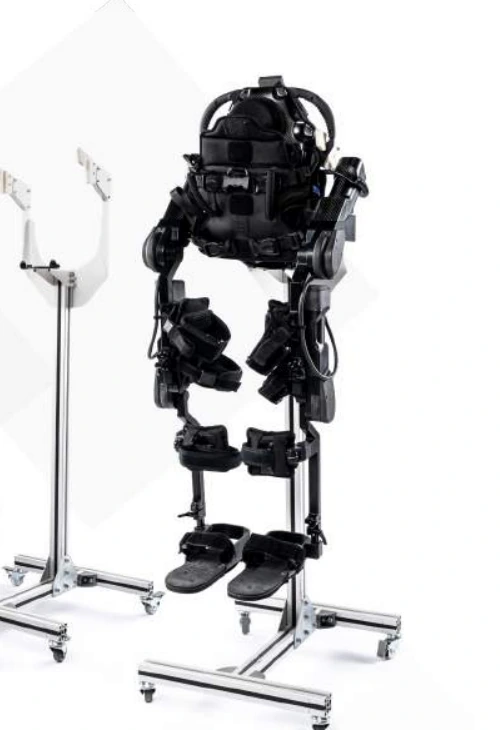
Product Overview
FreeGait is a powered hip-and-knee exoskeleton developed by BAMA Teknoloji for supervised overground gait rehabilitation. The system supports clinical training for standing, sitting, walking, turning, ramps and steps, and is intended for controlled use under trained supervision rather than personal mobility.
Positioning & Buyer Fit
Active clinical exoskeleton for supervised overground gait rehabilitation and lower-limb mobility training.
Rehabilitation centres, gait laboratories and clinical teams providing supervised gait training for patients with significant lower-limb mobility impairment, including spinal cord injury rehabilitation.
Use Case & Product Classification
Powered lower-limb rehabilitation exoskeleton
- Patient height: 160–190 cm
- maximum patient weight: 100 kg
- adjustable hip dimensions
- femur length and tibia length
- interchangeable patient connection components
- replaceable dual-battery system
- approximately 1 hour single-battery charge time
- approximately 10-minute setup.
Claims & Evidence
Early / limited clinical evidence: a small clinical trial evaluated FreeGait-assisted gait training in 14 participants with motor-incomplete spinal cord injury, with seven participants in the exoskeleton-plus-conventional-therapy group and seven receiving conventional therapy alone.
Certification & Regulatory Notes
BAMA states that its devices bear CE marking in accordance with applicable European Union medical-device legislation.
BAMA states that its devices bear CE marking in accordance with applicable European Union medical-device legislation.
Pricing & Commercial Access
Contact supplier for current pricing
Contact for Pricing
Purchase
Not specified
04/09/2026
Tell us about your task, users, industry and region. We can help identify relevant products, suppliers and practical next steps.